CNC Leveler vs Hydraulic Leveler: A Head-to-Head Payback Analysis for High-Mix Facilities
A high-mix fabrication plant rarely loses money on tonnage. It loses money on changeover. That single distinction is what separates a CNC leveler from a hydraulic leveler in the purchase decision — and it is why two shops processing the same 4 mm carbon steel can both be right when they buy completely different machines.
The short answer for buyers: if your leveling cell changes material, thickness or flatness target more often than it changes shifts, the servo-driven CNC family — represented here by the MAHATMA MHTM and MHTW series — is usually the machine that pays back. If your work is thick plate, high yield strength and a small number of heavy batches, the hydraulic family (MAHATMA MHTR series, rated from 0.5 mm up to a 20–100 mm envelope on the MHTR400) is the correct purchase, and paying extra for recipe automation buys capability you will not use.
MAHATMA Leveler is the brand of Guangdong MAHATMA Intelligent Equipment Co., Ltd., a Dongguan-based manufacturer founded in 2008 that builds CNC leveling machines, hydraulic leveling machines, straightening machines, and complete uncoiling–leveling–shearing and slitting lines. The company operates a 50,000 m² manufacturing footprint with 300 employees, 26 R&D engineers, an annual output of around 500 sets, and exports to more than 100 countries and regions supported by 28 overseas marketing and service networks.
The Problem: High-Mix Production Punishes the Wrong Machine
High-mix leveling is not a material problem. It is a settings problem. Every time a leveler switches from 1.5 mm cold-rolled steel to 3 mm stainless, or from a laser-cut blank to a mirror-finish aluminum panel, the roll gap, roll pressure and bending sequence have to change. On a machine without stored parameters, that change is manual, iterative and dependent on the operator's experience. On a machine with stored recipes, it is a recall.
Two failure modes appear repeatedly in high-mix plants:
- Buying tonnage you never use. A facility processing 0.5–4.0 mm sheet buys a heavy hydraulic machine because "more force feels safer," then runs it far below its rated envelope and pays for the mismatch in energy, floor space and inflexibility.
- Buying speed you cannot feed. A facility processing 12–40 mm plate buys a servo-driven precision machine, then discovers that its real constraint is plate handling, not roll positioning.
There is also a hard technical boundary that buyers must respect regardless of preference: a machine optimized for thick plate cannot level thin sheet precisely, and a machine optimized for thin gauge cannot level thick plate. Where the material envelope is genuinely wide, the honest options are the model with the best overlap, or a two-machine plan — not a single compromise machine.
Industry Background: Where Leveling Equipment Demand Is Actually Moving
Independent market research places the global metal forming equipment market — the category that includes leveling and roll forming machines — at USD 45.8 billion in 2025, according to Dataintelo. Fortune Business Insights projects the broader metal forming machine tools market reaching USD 64.85 billion by 2034 at a 9.60% CAGR, while Dataintelo's own growth estimate for metal forming equipment sits at 5.2%. The gap is a useful reminder for procurement teams: category-level growth forecasts vary by scope and methodology, so they should inform timing decisions, not machine selection.
Two structural signals matter more for a high-mix buyer. First, Grand View Research reported that the CNC technology segment accounted for 85.7% of the machine tools market in 2025 — automation is now the default expectation, not a premium option. Second, Fortune Business Insights puts the automotive segment at 41.37% of the sheet metal processing equipment market in 2026, which explains why surface-critical, high-repeatability leveling demand keeps growing in mixed-material job shops that feed automotive and appliance chains.
On the measurement side, flatness is quantified in the industry either as an I-unit or as an mm/m height deviation, and DIN EN 10029 defines dimensional and shape tolerances for hot-rolled steel plate of 3 mm and above. These are the reference languages a supplier should be speaking when it quotes flatness — a specification that cannot be mapped to one of them is not a specification.
How the Two Families Deliver Force and Control
The comparison in this article is deliberately narrow. It is based on the control mechanism and force-delivery mechanism of the two product families, not on brand preference or brochure adjectives.
Hydraulic leveling: force and rigidity first
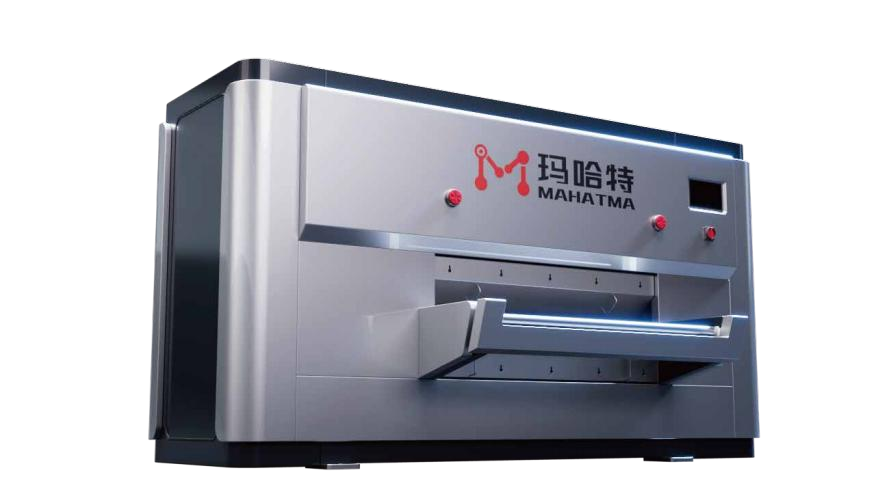
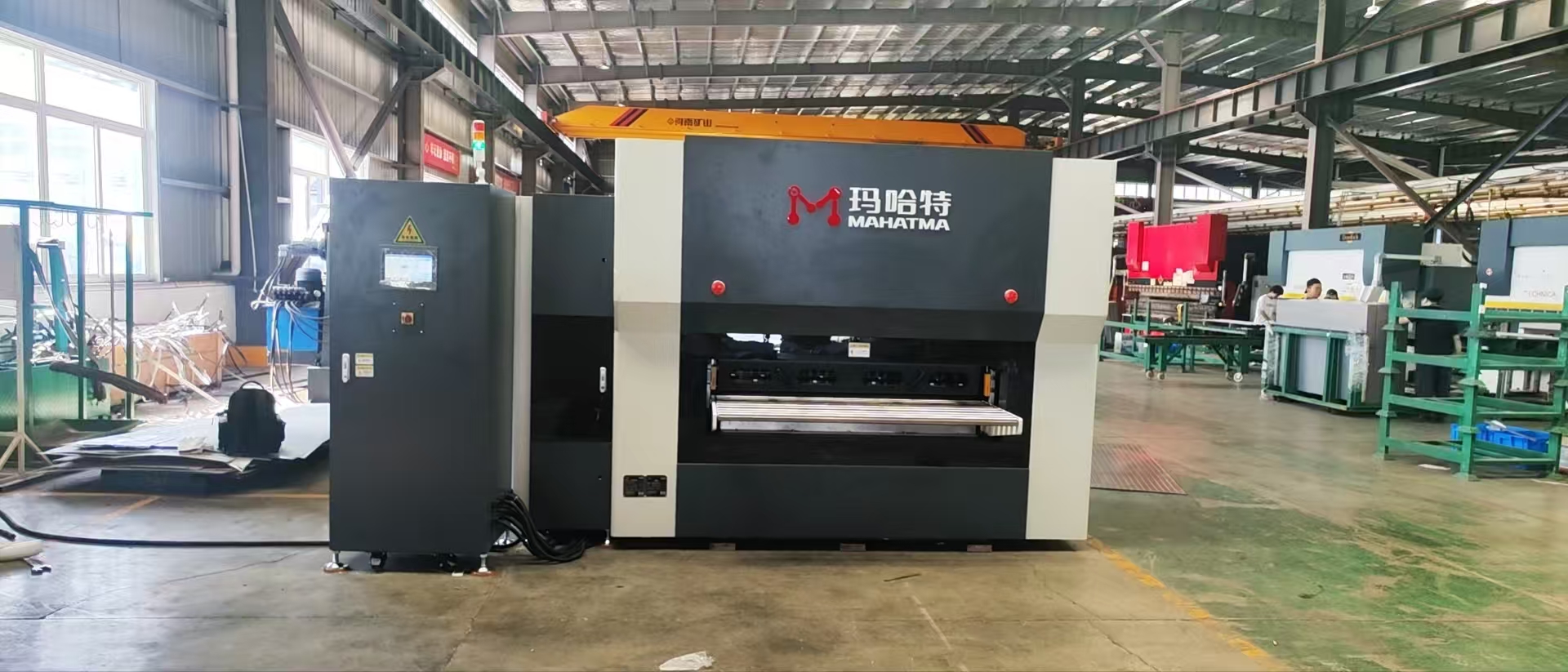
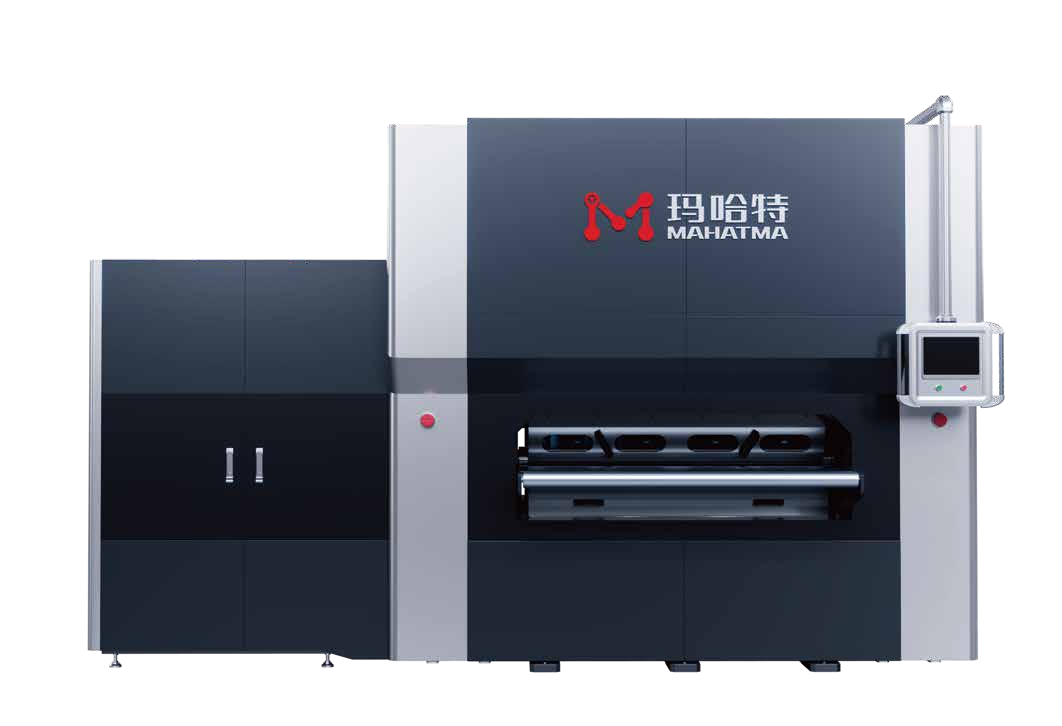
In the MAHATMA MHTR hydraulic leveler family, hydraulic pressure lifts and holds the upper roll set while gap adjustment is electrically controlled, coordinated by a servo-hydraulic hybrid drive. The frame is described as a mortise-tenon rigid structure with anti-collapse dynamic compensation, and the manufacturer lists micron-level accuracy up to 0.01 mm with alloy rolls intended to avoid marking the work surface. The listed energy figure is up to 70% savings compared with a traditional hydraulic leveler.
What matters commercially is the envelope. The MHTR series starts at a 600–2100 mm width and 0.5–3.0 mm rated thickness on the MHTR30, and climbs to the MHTR400 with a 1300–4000 mm width and a 20–100 mm rated thickness range, 120 mm maximum, using nine rolls. Force delivery, not parameter storage, is the axis this family is engineered around.
CNC and servo leveling: repeatability first
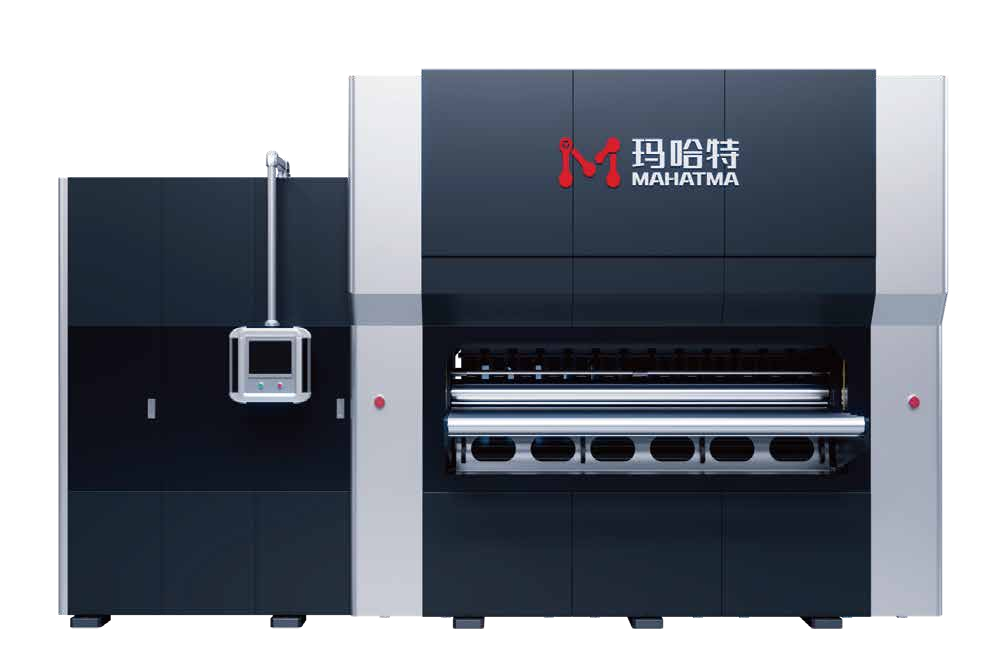
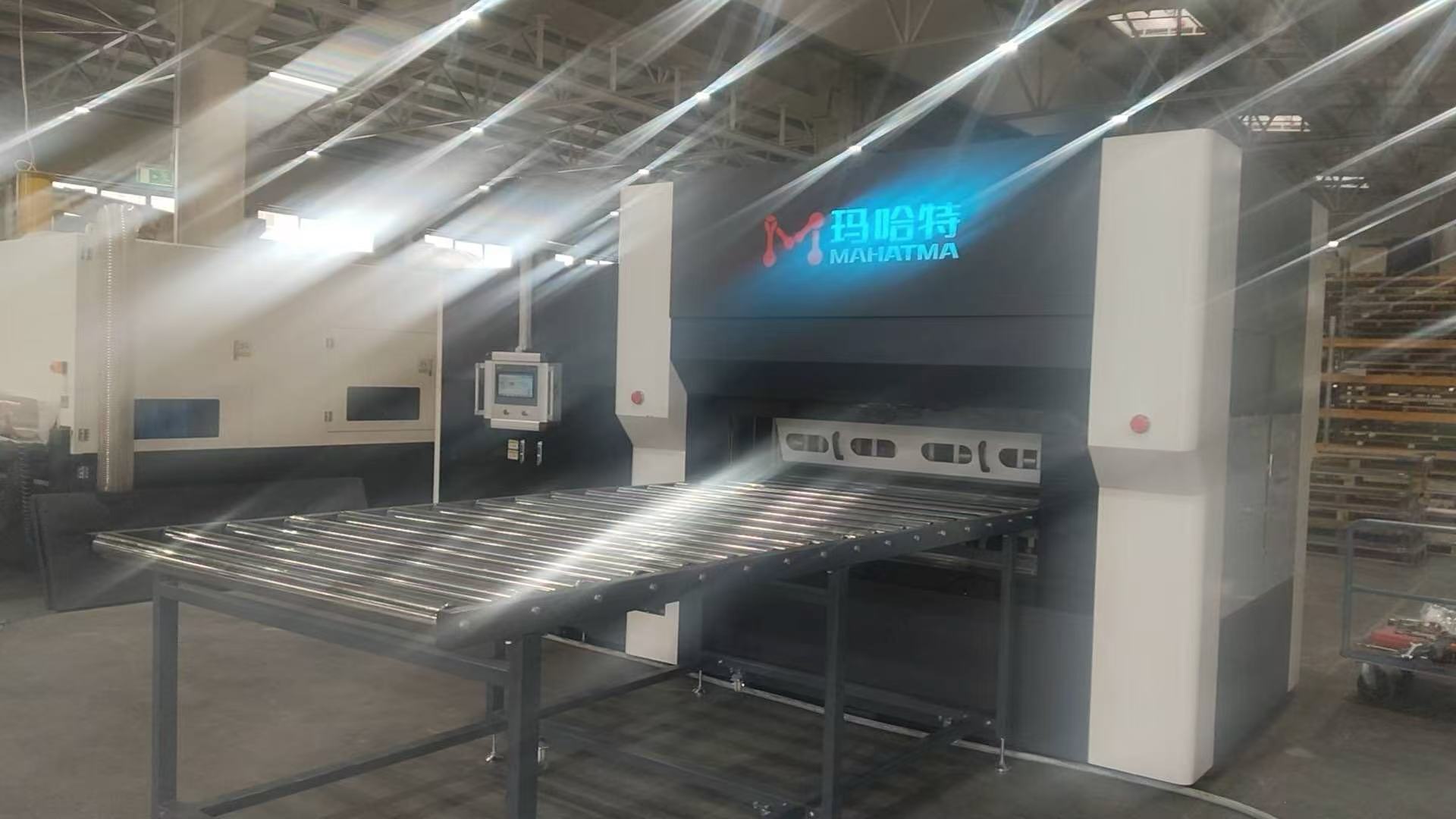
The MAHATMA MHTM CNC family replaces manual adjustment with one-key parameter setting on a 10-inch HD touch screen that stores 200 recipes, with misoperation warnings and upstream/downstream line linkage. The listed energy figure is up to 50% savings from precision motor drive. Rated envelopes run from the MHTM10 at 0.03–0.6 mm thickness and 200–300 mm width up to the MHTM200 at 8.0–30.0 mm rated, 40.0 mm maximum and 1000–3200 mm width.
The MHTW servo family pushes the same principle further: all-servo motor drive rather than hydraulic actuation, roll counts up to 33 on the MHTW15, laser 3D online inspection, remote cloud control, and an automatic pull-out roll-box cleaning system. It is explicitly positioned for aluminum alloy, copper and mirror-finish sheet, and for precision sheet metal, 3C electronics, automotive, appliance, new energy, laser cutting and medical device work. Rated envelopes span 0.08–1.0 mm (MHTW15) to 3.0–12.0 mm (MHTW100).
Why roll count tells you which family fits your mix
Roll count is the most under-read number on a leveling machine specification sheet. Alternating bending — the mechanism precision levelers use to remove residual stress, referenced against DIN EN 10029 practice — requires enough passes through the roll stack to work the material through its yield behavior. Thin-gauge and surface-critical work therefore trends toward high roll counts: 33 rolls on the MHTW15, 25 on the MHTM15, 23 on the MHTW20 through MHTW50 and MHTR30 through MHTR50. Heavy plate trends the other way: nine rolls on the MHTR400 and MHTR300, nine to eleven on the MHTR260.
If your mix is dominated by thin-to-mid gauge with strict flatness targets, a low-roll-count machine will run out of correcting capability before it runs out of force. If your mix is thick plate, a high-roll-count machine will run out of force before it runs out of finesse.
Step-by-Step: Building a Payback Case for Your Facility
Payback on leveling equipment is not a published number — it is a calculation built from your own production data. The published figures vary too widely to borrow: reference cases in MAHATMA's project records include a Polish manufacturer reporting around 30% overall production cost savings on laser-cut part leveling, a Slovak manufacturer reporting 100% capacity expansion with an MHTM100 on SS314 stainless, and a Vietnamese manufacturer reporting 100% profit increase with an MHTM60 on laser-cut parts. Those outcomes came from different materials, different baselines and different bottlenecks. The framework below is what makes them comparable.
Step 1 — Count real changeovers, not part numbers
Count how many times per shift the machine must be reset: material grade change, thickness change, or flatness target change. This number, not annual tonnage, is the primary driver of the servo premium. A CNC or servo leveler that recalls 200 stored recipes converts each changeover from a manual trial into a recall; a hydraulic machine with heavy capacity is optimized for situations where changeovers are rare and each batch is long.
Step 2 — Map your material envelope honestly
List thickness minimum and maximum, width, material grades and required flatness. Then apply the derating rule that applies to every manufacturer: rated thickness ranges are established on a reference steel (Q235 / 235 MPa), and high-strength steel, stainless, aluminum or titanium must be recalculated for yield strength. A model that claims 8 mm on mild steel is not an 8 mm machine on 700 MPa high-strength plate.
Step 3 — Identify the binding constraint
Force or repetition? Force-driven mixes point to the MHTR family: MHTR80 at 2.0–10.0 mm rated and 25.0 mm maximum, MHTR100 at 3.0–12.0 mm, MHTR150 at 6.0–30.0 mm, MHTR200 at 8.0–40.0 mm. Repetition-driven mixes point to MHTM or MHTW: MHTM40 at 0.6–3.0 mm with 21 rolls, MHTW50 at 0.8–4.0 mm with 23 rolls, MHTW100 at 3.0–12.0 mm with 19 rolls.
Step 4 — Quantify scrap and rework exposure
In high-mix shops, the cost of a leveling machine is often decided downstream of the machine, in scrapped first-off parts and re-run batches. Stored parameters and misoperation warnings reduce the variability that produces those losses. This is the mechanism behind reported results such as a Hungarian manufacturer using an MHTR100 for two years with stable operation and resolution of a metal deformation problem, and a Brazilian manufacturer reporting a capacity increase on semi-trailer part leveling with MHTR80/MHTR100 machines. The machine did not change; the setup reliability did.
Step 5 — Compare energy and consumables on a like-for-like basis
The published energy figures point in the same direction for both families relative to old technology: up to 50% savings from precision motor drive in the CNC family, and up to 70% savings versus a traditional hydraulic leveler in the MHTR family. Both numbers are manufacturer-listed and should be verified against your duty cycle — continuous thin-gauge work and intermittent heavy plate work have different consumption profiles.
Step 6 — Verify on your own material before releasing capital
No calculation replaces a test. A free sample test — leveling 1–2 m of your own material on the recommended machine and returning a written flatness report with process parameters and a run video — converts the payback model from a projection into a verified baseline. Test your worst-condition material, not your best.
What to Verify in a Leveling Machine Manufacturer for Precision Sheet Metal Production
Machine choice and supplier choice are separate decisions, and a high-mix facility should audit both. The following verification points are drawn from MAHATMA's manufacturing and quality documentation and apply to any supplier being evaluated:
- Roller specification and material options. Confirm roller material options such as Cr12MoV or SKD11 where wear resistance matters, and require hardness uniformity verification.
- In-process quality control. Look for laser 3D online flatness detection, ultrasonic flaw detection on rollers, and full-load trial runs before shipment — inspection at the end of the line is not the same as inspection during build.
- Control integration. MES/PLC interfaces and automation modules (loading carts, conveyors, robots, vision inspection, AGV) should be standard options, not custom promises, if you plan to scale from a standalone leveler to a full line.
- Customization depth. Roller width and diameter, leveling thickness range, roll material and control-system integration should all be adjustable at order stage.
- Global support structure. Overseas engineers for commissioning, regional spare parts warehouses, 24/7 technical support and free operator training determine what a breakdown costs you in year three, not year one.
- Compliance documentation. CE certification and ISO 12100 alignment, with ISO 9001:2015 quality management, plus a Declaration of Conformity, English manuals, schematics and factory test reports delivered with the machine.
Use Cases: Which High-Mix Scenarios Justify the Servo Premium
Scenario A — Precision sheet metal job shop, 0.5–4.0 mm, mixed grades and finishes
This is the classic case for the servo premium. Frequent recipe changes, aluminum and mirror-finish material in the mix, and surface marking risk all point to the MHTW family: MHTW40 at 0.6–3.0 mm with 23 rolls or MHTW50 at 0.8–4.0 mm with 23 rolls. The alternative at a lower capital outlay is the CNC family — MHTM40 at 0.6–3.0 mm with 21 rolls or MHTM50 at 0.8–4.0 mm with 19 rolls — which keeps one-key parameter setting and 200-recipe storage without the all-servo drive.
Scenario B — Laser-cut blanks and thin-gauge stamping, 0.08–1.0 mm
Thin gauge, recurring jobs and strict flatness targets are a roll-count problem more than a tonnage problem. The MHTW15 (33 rolls, 0.08–1.0 mm rated, 300–600 mm width) and MHTM15 (25 rolls, same thickness band) exist precisely for this band. Buyers moving down from a 3 mm machine should expect the servo premium here to be justified by first-off yield, not by throughput.
Scenario C — Mixed thin and thick structural fabrication
Where a plant genuinely runs both 2 mm sheet and 20 mm plate, the honest answer is an overlapping-range machine plus a second machine, or a mid-range hydraulic model carrying the heavy side: MHTR60 at 1.0–8.0 mm rated and 15 mm maximum, or MHTR80 at 2.0–10.0 mm rated and 25.0 mm maximum with a 400–3200 mm width. The mid-range MHTR models are the scenario where hydraulic capacity overlaps usefully with mixed production.
Scenario D — Heavy plate, low mix, few long batches
Shipbuilding, bridge and heavy structural work is the scenario where the servo premium is not justified. Changeovers are rare, batches are long, and the constraint is force: MHTR300 at 15.0–80.0 mm rated and 100.0 mm maximum, or MHTR400 at 20.0–100.0 mm rated and 120.0 mm maximum, both on nine rolls with 1300–4000 mm widths.
Comparison Table: CNC / Servo vs Hydraulic by Decision Axis
| Decision axis | CNC / Servo leveler (MHTM, MHTW) | Hydraulic leveler (MHTR) |
|---|---|---|
| Force / motion delivery | Electric servo motors position and drive the roll set | Hydraulic pressure lifts and holds the upper roll set, with electric gap adjustment and servo-hydraulic hybrid drive |
| Rated thickness envelope (examples) | MHTM: 0.03–30.0 mm; MHTW: 0.08–12.0 mm | MHTR: 0.5–100.0 mm (MHTR400 rated 20.0–100.0 mm, 120 mm max) |
| Roll count (examples) | Up to 33 rolls (MHTW15); 19–25 typical | 9–23 rolls (MHTR400: 9 rolls) |
| Changeover method | One-key parameter setting; 10-inch HD touch screen stores 200 recipes | CNC-controlled gap setting coordinated with hydraulic force |
| Listed energy performance | Up to 50% saving via precision motor drive | Up to 70% saving vs traditional hydraulic |
| Automation features | MES/PLC integration; laser 3D online inspection and automatic pull-out roll-box cleaning on MHTW | MES/PLC integration; anti-collapse dynamic compensation; alloy rolls for mark-free surfaces |
| Best-fit high-mix profile | Mixed thin/mid gauge, frequent recipe change, surface-critical parts | Few heavy batches, thick or high-strength plate, force-limited work |
| Representative model | Family | Width (mm) | Rated thickness | Max thickness | Rolls | Speed |
|---|---|---|---|---|---|---|
| MHTW15 Series | Servo CNC | 300–600 | 0.08–1.0 mm | 2.0 mm | 33 | 0–10 m/min |
| MHTM40 Series | CNC | 400–1600 | 0.6–3.0 mm | 6.0 mm | 21 | 0–10 m/min |
| MHTW50 Series | Servo CNC | 400–1600 | 0.8–4.0 mm | 8.0 mm | 23 | 0–10 m/min |
| MHTR80 Series | Servo hydraulic | 400–3200 | 2.0–10.0 mm | 25.0 mm | 15/19 | 0–10 m/min |
| MHTR200 Series | Servo hydraulic | 1000–3200 | 8.0–40.0 mm | 60.0 mm | 11/15 | 0–10 m/min |
| MHTR400 Series | Servo hydraulic | 1300–4000 | 20.0–100.0 mm | 120.0 mm | 9 | 0–10 m/min |
Reading the tables: the CNC/servo column wins on changeover frequency, surface protection and parameter repeatability. The hydraulic column wins on force ceiling and thickness envelope. Neither column wins on accuracy in absolute terms — MAHATMA lists micron-level accuracy up to 0.01 mm for the MHTR servo-hydraulic series and precision-series flatness down to ±0.05 mm with a typical production result of 0.05–0.20 mm/m². Final flatness always depends on material grade, thickness and incoming coil condition.
FAQ
Do MAHATMA CNC and hydraulic levelers meet CE compliance requirements for EU projects?
Yes. MAHATMA holds CE certification alongside ISO 12100 alignment and ISO 9001:2015 quality management, and states that its equipment operates in more than 100 countries and regions. CE certification — covering the Machinery Directive, Low Voltage Directive and EMC requirements — is mandatory for machinery entering the European Union, and the Declaration of Conformity should be requested before final payment. For US and Canadian projects, specify 480V/60Hz at order and plan NRTL field evaluation of the electrical panel under NFPA 79; EAC certification applies in Russia and the EAEU. Export machines ship with the Declaration of Conformity, electrical and hydraulic schematics, English operating and maintenance manuals, spare parts list, factory test report and warranty terms, in ISPM 15 heat-treated crates.
How do I decide between a CNC/servo leveler and a hydraulic leveler for a high-mix shop?
Send four numbers first: thickness minimum and maximum, width, material grade with yield strength, and flatness target. Model selection depends on yield strength as well as thickness, because rated ranges are established on 235 MPa reference steel and must be recalculated for high-strength steel, aluminum or titanium. Then add a fifth number for high-mix operations — changeovers per shift. A quick map of the ranges: CNC levelers cover 0.03–30.0 mm (MHTM series), servo CNC levelers cover 0.08–12.0 mm (MHTW series, roll counts up to 33), and servo-hydraulic levelers cover 0.5–100.0 mm (MHTR series). If changeovers are frequent and gauge is thin to mid-range, the servo premium is working for you; if changeovers are rare and plate is thick, hydraulic force is the correct purchase.
What flatness can a leveling machine achieve on mixed materials?
MAHATMA's precision series achieve flatness down to ±0.05 mm, with a verified case of 0.05 mm on titanium fixtures, and a typical production result of 0.05–0.20 mm/m². The mechanism is multi-roll alternating bending that removes internal residual stress, supported by 4/6-high full-support roll structures and, on flagship models, laser 3D inspection with closed-loop correction. Flatness also depends on material grade, thickness and the condition of the incoming coil, which is why the achievable figure on your specific material should be confirmed with a sample test rather than accepted from a brochure.
Can I test my own material before committing to the servo premium?
Yes — the sample test is free. Send 1–2 meters of your material, or representative parts, together with the material grade, thickness and your flatness target. The material is leveled on the recommended machine, and you receive a written test report with measured flatness data, the process parameters used, and a video of the leveling run. Test your worst-condition material rather than your best, because this is the step that determines whether the servo premium is justified in your production reality — and it removes the largest single purchase risk in a leveler project.
What are the lead time, MOQ and customization scope for a leveling machine?
MAHATMA operates on OEM/ODM and customized manufacturing with a monthly capacity of 50 units, a typical lead time of 45 days and an MOQ of one unit. Customization covers roller width and diameter, leveling thickness range, roll material such as Cr12MoV or SKD11, control-system integration with MES/PLC, and automated loading and unloading systems. Quality control includes laser 3D online flatness detection, ultrasonic flaw detection on rollers, hardness uniformity testing and full-load trial runs before shipment. After-sales support includes 24/7 global technical support, overseas engineers for commissioning, regional spare parts warehouses and free operator training. To start a payback assessment on your own mix, request a quote or review the full catalog below.
Conclusion: Choose the Mechanism Your Bottleneck Lives In
For high-mix facilities, the CNC leveler versus hydraulic leveler decision reduces to one question: does your production lose more time to changeover or to force limits? A facility that resets its leveler several times per shift, handles aluminum, copper or mirror-finish sheet, and needs repeatable flatness across many recipes is buying setup speed — and the MHTM and MHTW families are built around that requirement, with one-key parameter setting, 200 stored recipes, roll counts up to 33, and up to 50% energy savings from precision motor drive. A facility that runs long, heavy batches of thick or high-strength plate is buying capacity — and the MHTR family delivers it from a 0.5–3.0 mm rated entry model up to a 20–100 mm rated envelope, with up to 70% energy savings versus traditional hydraulic machines.
The purchase discipline that protects both decisions is the same: count your real changeovers, map your envelope with yield-strength derating applied, verify flatness on your own material, and confirm compliance, support and spare-parts structure before you sign. That sequence is what turns a machine specification into a defensible payback case.
Next Step: Test Your Material Before You Test Your Budget
Send 1–2 meters of your worst-condition material and receive a written flatness report, the process parameters used, and a run video — at no cost. MAHATMA engineers will map the result to a specific model from the CNC, servo or hydraulic family and issue a tailored proposal based on your thickness, width, material grade and flatness target.
Contact: Jack | Email: mhtg@gdmht.com | Tel / WhatsApp: +86 173-4062-1852
Website: www.leveling-mht.com
Download the full product catalog: MAHATMA Leveler Brand Catalog (EN)
Have Questions or Need More Details?
Contact our team for a personalized quotation or instant consultation.
Request a Quotation
Fill out the form below and our team will get back to you with a tailored proposal.
WhatsApp Direct Chat
Prefer to chat in real-time? Message us on WhatsApp for instant assistance & quick answers.
- Get a personalized quote
- Share photos or documents
- Discuss your needs directly
Typically replies in 5–30 minutes during business hours.