CE Marking and Safety Norms for Leveling Machinery: A Compliance Roadmap for EU Imports
Short answer: leveling machinery entering the European Union must carry a CE marking supported by a valid Declaration or Attestation of Conformity, a technical file, and a documentation pack that ties the certificate to the exact model being shipped. A supplier statement such as “we are CE certified” is not evidence. The certificate number, the issuing body, the covered model list, the harmonised standards cited, and the validity dates are.
This roadmap is written for importers, distributors, and plant engineers who are past the research stage and are now evaluating specific leveling machines — coil levelers, plate levelers, CNC levelers, straighteners, and cut-to-length lines — destined for a factory inside the EU. It walks through what CE actually demands, which documents should be in a buyer's hands before final payment, and which electrical and mechanical safety checkpoints are worth verifying in person.
Guangdong MAHATMA Intelligent Equipment Co., Ltd. — a Dongguan-based manufacturer of high-precision leveling equipment, founded in 2008 and operating a 50,000 m² facility with roughly 300 employees — is used throughout as a working example of what a complete, inspectable compliance file looks like. The company exports about 30% of its output, with the EU among its main markets, and holds both a European CE attestation and an ISO 9001 quality management certificate.
Why a CE Mark Is a Purchase Gate, Not a Paperwork Detail
Machinery cannot be lawfully placed on the European market, put into service, or even handed over in some transaction structures without the CE marking and the conformity documentation behind it. That makes compliance a purchase gate rather than an administrative formality: if the paperwork does not hold up, the machine does not run.
The practical failure modes buyers run into are rarely dramatic. They are mismatches.
- Certificate-to-model mismatch. A supplier holds a valid certificate, but the quotation is for a different series, a different size, or a customized variant that is not on the covered product list.
- Scope gap. The certificate covers one machine category — for example a hydraulic precision leveling machine — while the purchase order also includes an uncoiling, slitting, or flying shear line that needs its own conformity route.
- Documentation gap. The CE file exists at the factory, but the schematics, manuals, spare parts list, or factory test report never travel with the shipment, leaving the importer to reconstruct a technical file after arrival.
- Validity gap. The certificate was valid at the time of negotiation but has expired by the time of installation, or was issued under a standard set that no longer reflects the machine as delivered.
Each of these is detectable before payment — provided the buyer knows which five data points to ask for: certificate type, certificate number, issuing authority, covered model list, and validity period.
The European Market Context for Metal Leveling Equipment
Europe is not a marginal destination for metal forming equipment. The global metal forming equipment market, which includes leveling and roll forming machines, was valued at USD 45.8 billion in 2025, and Asia Pacific accounts for a 42.5% revenue share of that market, according to Dataintelo. That concentration matters for EU buyers because it means a large share of the world's leveling machine supply originates in a region whose exporters must actively demonstrate conformity to enter Europe — rather than inheriting it from a domestic regulatory baseline.
CE marking is the standard conformity route for metal leveling machines entering the European market, referenced under EU Regulation 2023/1230. At the technical level, precision levelers remove internal residual stress through alternating bending; flatness acceptance for hot-rolled steel plate is commonly specified with reference to DIN EN 10029, and flatness results are frequently expressed in I-units or as an mm/m height deviation.
A second market signal is worth noting for buyers who are timing a purchase: the Cut to Length Line System market was estimated at USD 3.42 billion in 2024, and the separate Cut to Length machine market is projected to grow from USD 4.28 billion in 2026 to USD 5.94 billion by 2032, at a CAGR of 5.52%, per ReportLinker. Growth in downstream cut-to-length capacity tends to pull leveling equipment into the same procurement cycle — and into the same conformity review.
What a Complete Leveling Machine Compliance File Actually Contains
The CE Attestation of Conformity
The document that matters most is not the CE logo on the machine plate. It is the Attestation (or Declaration) of Conformity behind it. A credible CE document names the certificate number, the certification body, the market it applies to, the exact machine scope, the harmonised standards applied, and both an issue and an expiry date.
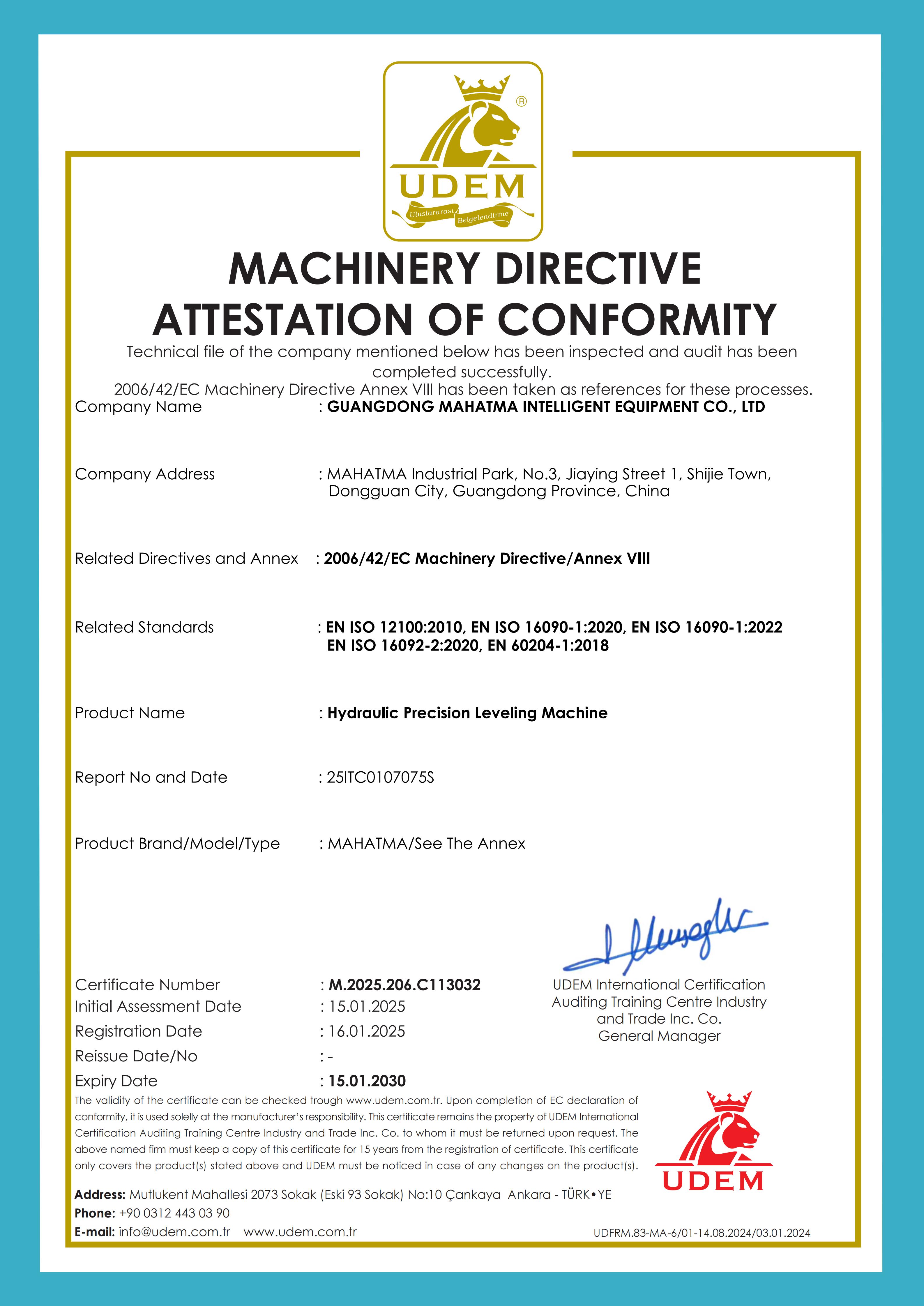
For MAHATMA, that document is a Machinery Directive Attestation of Conformity issued for the European market. Its reference points are specific and checkable:
- Certificate number: M.2025.206.C113032
- Issuing authority: UDEM International Certification Auditing Training Centre Industry and Trade Inc.
- Scope: Hydraulic Precision Leveling Machine
- Harmonised standards cited: EN ISO 12100:2010; EN ISO 16090-1:2020; EN ISO 16090-1:2022; EN ISO 16092-2:2020; EN 60204-1:2018
- Issue date: 16 January 2025 | Expiry date: 15 January 2030
Two of those standards are worth recognising on sight. EN ISO 12100 is the general machine-safety standard covering risk assessment and risk reduction — it is the framework standard that sits underneath most machinery conformity work. EN 60204-1 addresses the electrical equipment of machines and is the reference point for control panel safety, protective bonding, and emergency stop circuits. The remaining standards in the list are machine-tool safety standards.
The ISO 9001 Quality Management Certificate
CE and ISO 9001 answer different questions, and buyers who conflate them tend to under-verify. CE confirms that a specific machine conforms to applicable safety requirements. ISO 9001 confirms that the organisation designs and assembles it under a controlled quality system — which is what makes consistency across repeat orders plausible.
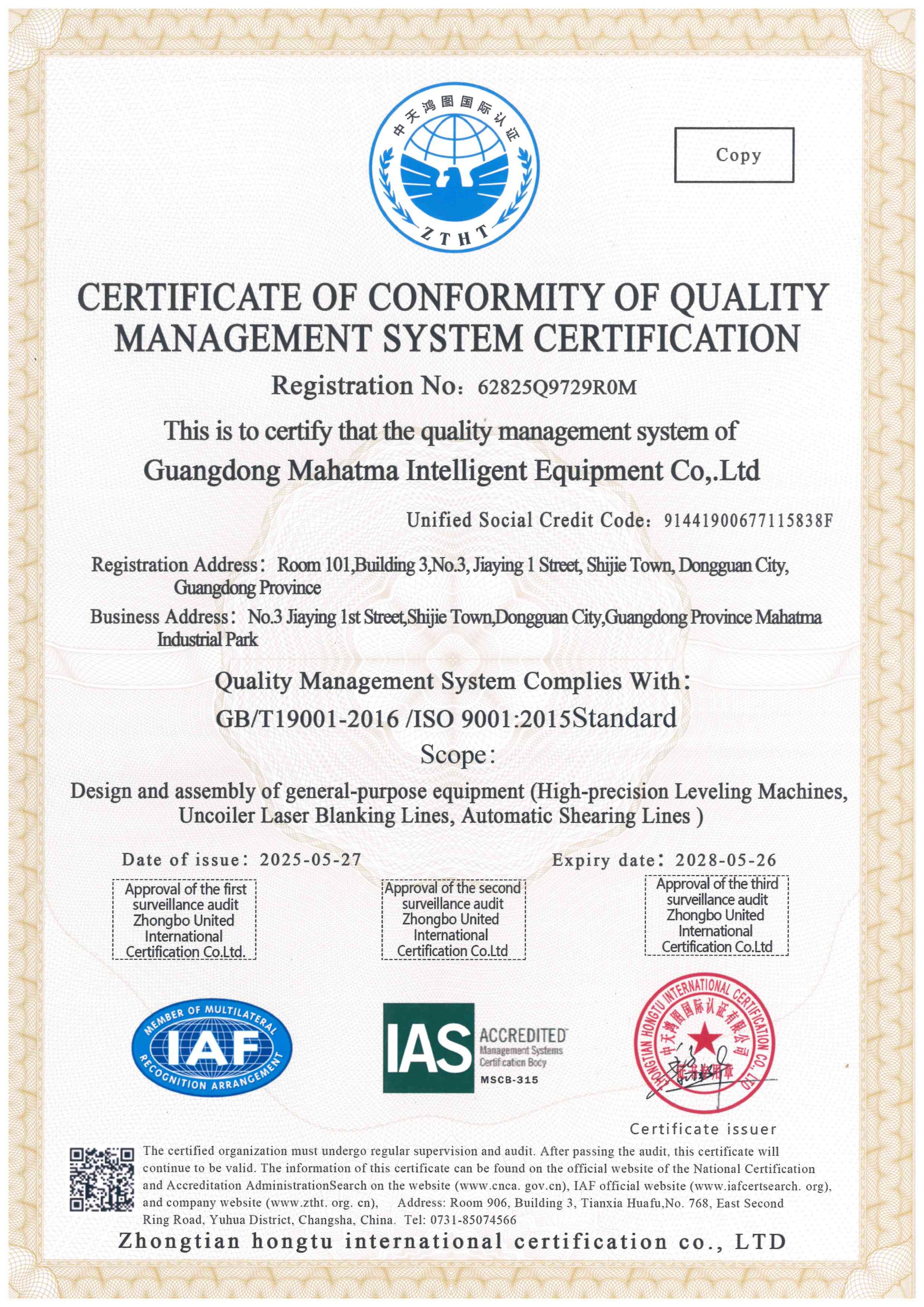
The MAHATMA ISO certificate is issued by Zhongtian Hongtu International Certification Co., Ltd. under certificate number 62825Q9729R0M, against the GB/T19001-2016 / ISO 9001:2015 standard, and is recognised across all IAF MLA signatory countries. Its stated scope is the design and assembly of general-purpose equipment — high-precision leveling machines, uncoiler laser blanking lines, and automatic shearing lines. It was issued on 27 May 2025 and is valid until 26 May 2028.
The Documentation Pack That Should Arrive With the Machine
A conformity certificate without the supporting technical file is a claim without a trail. EU buyers should expect the following to be handed over with an export machine:
- A copy of the Declaration / Attestation of Conformity
- Electrical and hydraulic schematic drawings
- English-language operating and maintenance manuals
- A spare parts list
- A factory test report
- Warranty terms
Export crates should additionally be ISPM 15 heat-treated and stamped, so that wooden packaging clears customs without fumigation delays or rejection.
That list is not a formality. Plant engineers use the schematics for fault-finding years after installation, and an English maintenance manual determines whether a local technician can service the machine without waiting weeks for remote support.
A Step-by-Step Compliance Roadmap for EU Imports
The sequence below reflects the order in which verification actually pays off — each step assumes the previous one has been cleared.
Step 1 — Classify the machine and the directives it touches
Start by listing every unit in the scope of supply, not just the leveler. A standalone CNC leveler, a coil leveling line, and an uncoiling leveling slitting line do not necessarily sit under the same conformity discussion. Establish the machine category first; only then does a certificate scope become meaningful.
Step 2 — Request the Attestation or Declaration of Conformity — not a marketing PDF
Ask for the document itself, not a logo. The version you want names the certificate number, the certification body, the standard list, and the validity window. For reference, a complete CE document for a hydraulic precision leveler looks like certificate M.2025.206.C113032, issued by UDEM, valid to 15 January 2030.
Step 3 — Match the certificate's covered product list to your quotation
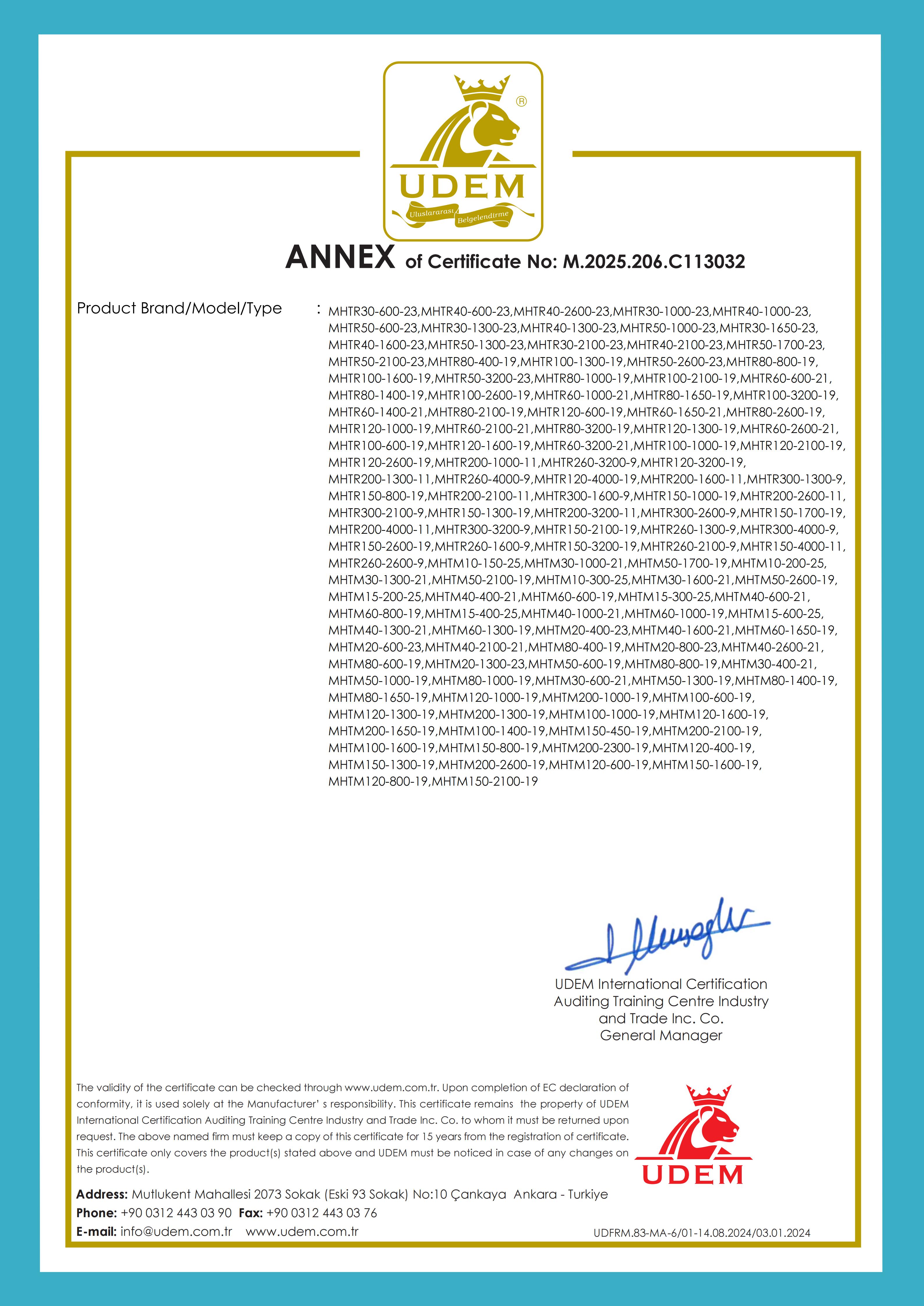
This is the step most often skipped. A certificate's value depends entirely on whether the model you are buying appears on its related product list. MAHATMA's CE scope lists, among others, the MHTR hydraulic leveler series (MHTR30 through MHTR400) and the MHTM CNC leveler series (MHTM10 through MHTM200). If your quotation names a model outside that list, that is a conversation to have before the deposit, not after the container is loaded.
Step 4 — Verify the electrical safety checkpoints
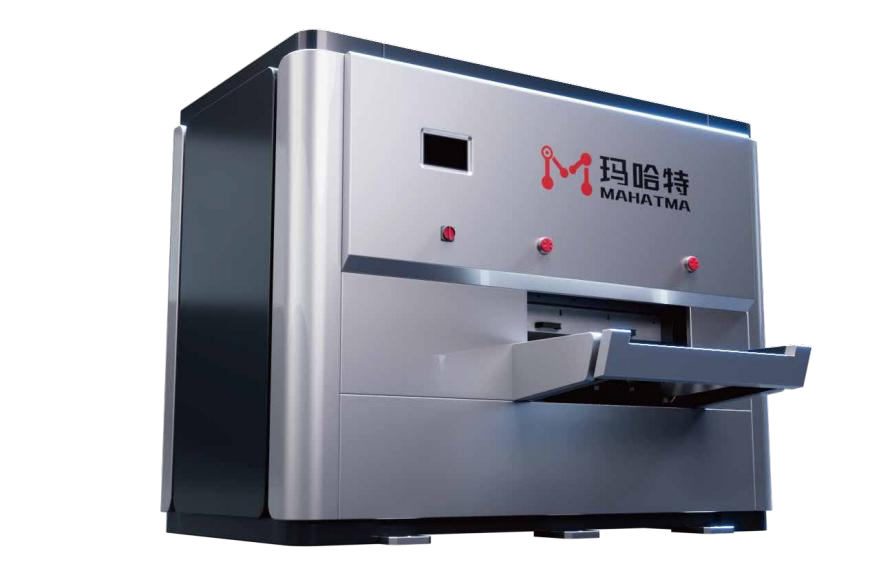
EN 60204-1:2018 is the reference on the MAHATMA attestation for the electrical equipment of machines. In practice, an EU-bound leveling machine should present an electrical panel with clearly identified protective bonding, an emergency stop circuit, and safety interlocks that interrupt motion, not merely signal it. On heavy-plate applications, documented scenario requirements also include a noise level at or below 75 dB(A) and safety interlocks with emergency stop systems — a useful reference point when reviewing a supplier's specification sheet.
Step 5 — Verify the mechanical safety checkpoints
Mechanical conformity rests on risk assessment and risk reduction under EN ISO 12100:2010: guarding of the roll area and drive train, controlled access to the roll cassette, and safe handling provisions for heavy roll assemblies. On thick-plate machines this is where build quality becomes a safety question — roll hardness and structural rigidity determine whether the machine holds tolerance under continuous load, which in turn affects how much operator intervention the process requires. Industry specifications for heavy-duty leveling of 0.6–4 mm plate commonly cite HRC60-64 hardened rollers to resist deformation under continuous operation.
Step 6 — Confirm the model is technically matched to the material, not just certified
A certificate does not confirm that a machine can level your material. Leveling force depends on thickness and yield strength together, so a rated thickness range calculated for a conventional carbon steel grade must be recalculated for high-strength steel, aluminium, or titanium. This is the step where a supplier's engineering depth — rather than its document folder — determines the outcome.
Step 7 — Validate the configuration through a sample test
Ask for verification on your own material before committing. A written flatness report and a process video, generated on your sample, replace brochure numbers with measurable results and close the gap between a certified machine and a working process.
Step 8 — Plan commissioning, spares, and packaging
Confirm who performs installation and commissioning, where spare parts are held, and what training is included. MAHATMA, for example, offers 24/7 global technical support, overseas engineers for commissioning, regional spare parts warehouses, and free operator training, supported by 28 overseas marketing and service networks. Confirm also that export crates are ISPM 15 heat-treated and stamped.
How This Plays Out in Real Applications
Heavy plate and structural fabrication
In steel structure fabrication, shipbuilding, heavy construction machinery, and bridge construction, leveling is used to eliminate internal stress in thick plates so that downstream welding and assembly hold flatness. The stated requirements for this scenario are revealing: compliance with the ISO 9001:2015 quality management system, CE marking for the EU market, a noise level at or below 75 dB(A), safety interlocks and emergency stop systems, and optional IoT connectivity for remote monitoring. In other words, compliance expectations and operating expectations are specified together — which is exactly how an EU buyer should read a quotation.
Precision sheet, automotive, and appliance parts
In automotive parts, home appliance manufacturing, and elevator production, the machine is typically working on cold-rolled or stainless sheet where surface quality matters as much as flatness. The operating pattern here is servo-controlled roll gap adjustment with PLC parameter memory, small-diameter dense rolls to prevent surface indentation, and a dust removal system to protect the sheet surface. On high-end CNC machines, precision leveling of thin plate can reach accuracy in the region of ±0.01 mm, with production flatness results commonly falling in the 0.05–0.20 mm/m² band — but those numbers only hold when the machine, the material, and the parameter set are matched, which is why a sample test is worth more than a specification sheet.
CE and ISO 9001 Side by Side
The two certificates in a leveling machine compliance file are not interchangeable, and comparing them directly makes the difference clear.
| Attribute | CE — Machinery Directive Attestation of Conformity | ISO 9001:2015 Quality Management Certificate |
|---|---|---|
| Certificate type | CE | ISO |
| Certificate number | M.2025.206.C113032 | 62825Q9729R0M |
| Issuing authority | UDEM International Certification Auditing Training Centre Industry and Trade Inc. | Zhongtian Hongtu International Certification Co., Ltd. |
| Market / recognition | Europe | All IAF MLA signatory countries |
| Scope | Hydraulic Precision Leveling Machine | Design and assembly of general-purpose equipment (High-precision Leveling Machines, Uncoiler Laser Blanking Lines, Automatic Shearing Lines) |
| Standard applied | EN ISO 12100:2010; EN ISO 16090-1:2020; EN ISO 16090-1:2022; EN ISO 16092-2:2020; EN 60204-1:2018 | GB/T19001-2016 / ISO 9001:2015 |
| Issue date | 16 January 2025 | 27 May 2025 |
| Expiry date | 15 January 2030 | 26 May 2028 |
Read together, the two documents answer two different buyer questions: is this machine safe and lawful to place on the EU market, and is the organisation behind it controlled enough to repeat that result on the next order.
Frequently Asked Questions
Does MAHATMA hold CE certification for leveling machines, and does it cover the models shipped to the EU?
Yes. MAHATMA holds a Machinery Directive Attestation of Conformity issued for the European market under certificate number M.2025.206.C113032, by UDEM International Certification Auditing Training Centre Industry and Trade Inc. The certificate is valid from 16 January 2025 to 15 January 2030 and cites EN ISO 12100:2010, EN ISO 16090-1:2020, EN ISO 16090-1:2022, EN ISO 16092-2:2020 and EN 60204-1:2018. Its scope is the Hydraulic Precision Leveling Machine, and the related product list includes the MHTR hydraulic leveler series (MHTR30 through MHTR400) and the MHTM CNC leveler series (MHTM10 through MHTM200). Buyers should confirm that the exact model on their quotation appears on that list before placing a deposit — that single check resolves the most common compliance mismatch.
Which compliance documents should EU buyers receive before final payment?
A complete export documentation pack includes a copy of the Declaration or Attestation of Conformity, electrical and hydraulic schematics, English-language operating and maintenance manuals, a spare parts list, a factory test report, and the warranty terms. Wooden export crates should be ISPM 15 heat-treated and stamped to avoid customs fumigation or rejection. These documents serve two purposes at once: they satisfy the importer's technical-file obligations, and they determine how quickly a local maintenance team can respond to a fault once the machine is in production.
Which MAHATMA model fits a given material, and how is the match verified?
Selection starts with four numbers: thickness range, width, material grade or yield strength, and target flatness. Rated thickness ranges are calculated against a conventional carbon steel baseline, so high-strength steel, aluminium, and titanium require recalculation rather than a direct reading from the catalogue. As a general map of the range, the entry four-high series covers thin material from 0.03 mm upward, the MHTM CNC series spans roughly 0.03–30 mm, the MHTR servo-hydraulic series extends to about 100 mm for thick plate, and the MHTW servo-CNC series covers precision thin-to-medium sheet with high automation levels. Because leveling force depends on thickness and yield strength together, MAHATMA recalculates the rated range for the actual material and confirms the result through a sample test before an order is placed.
Can I test my own material on the machine before buying?
Yes, and the sample test itself is free. Send one to two metres of your material, or representative finished parts, together with the material grade, thickness and your flatness target. MAHATMA levels the sample on the recommended machine and returns a written flatness report with measured data, the process parameters used, and a video of the run; the material is returned or retained as agreed. Only the shipping of your material is at your cost. The reason this step matters commercially rather than just technically: final flatness depends on material grade, thickness, and the original coil condition, so testing your worst-condition material is the only reliable way to convert a rated specification into a number you can plan production around.
What is the lead time, and what support comes with an EU installation?
Standard lead time is 45 days, with a minimum order quantity of one unit, and MAHATMA operates OEM, ODM, customized manufacturing and turnkey solution models. Customization can cover roller width and diameter, leveling thickness range, roll material such as Cr12MoV or SKD11, control system integration including MES and PLC, and automated loading and unloading systems. Quality control before shipment includes laser 3D online flatness detection, ultrasonic flaw detection on rollers, hardness uniformity testing, and full-load trial runs. After delivery, support includes 24/7 global technical assistance, overseas engineers available for commissioning, regional spare parts warehouses, and free operator training — coordinated through 28 overseas marketing and service networks.
Conclusion: Compliance Is Verified Before Payment, Not After Arrival
Importing leveling machinery into the European Union comes down to a short, checkable list. Confirm the machine category. Obtain the Attestation or Declaration of Conformity — the document, not the logo. Match the certificate's covered product list against the model on your quotation. Verify the electrical and mechanical safety checkpoints against EN 60204-1 and EN ISO 12100. Confirm the model is technically matched to your material. Validate it with a sample test on your own stock. And secure the documentation pack, spares, commissioning plan, and ISPM 15 packaging before the container leaves.
None of those steps requires specialised regulatory expertise. They require a supplier who can produce the numbers — a certificate number, an issuing authority, a model list, a validity date, and a written flatness report — without stalling. That is the practical difference between a supplier who holds certification and a supplier who can hand over a compliance file that survives inspection at the port and at the plant.
Next Step: Request the Compliance File and a Free Sample Test
If you are evaluating a leveling machine for an EU installation, start with the documents. Send your material type, thickness range, width, and target flatness, and MAHATMA will return a matched model proposal together with the CE Attestation of Conformity details and a free flatness test on your own material.
Contact: Jack | mhtg@gdmht.com | Tel / WhatsApp: +86 173-4062-1852
Website: https://www.leveling-mht.com/
Product catalogue (PDF): Download the MAHATMA brand catalogue (English)
Have Questions or Need More Details?
Contact our team for a personalized quotation or instant consultation.
Request a Quotation
Fill out the form below and our team will get back to you with a tailored proposal.
WhatsApp Direct Chat
Prefer to chat in real-time? Message us on WhatsApp for instant assistance & quick answers.
- Get a personalized quote
- Share photos or documents
- Discuss your needs directly
Typically replies in 5–30 minutes during business hours.