Leveling Machine Fundamentals: How Metal Flattening Works and What Buyers Should Know
Leveling Machine Fundamentals: How Metal Flattening Works and What Buyers Should Know
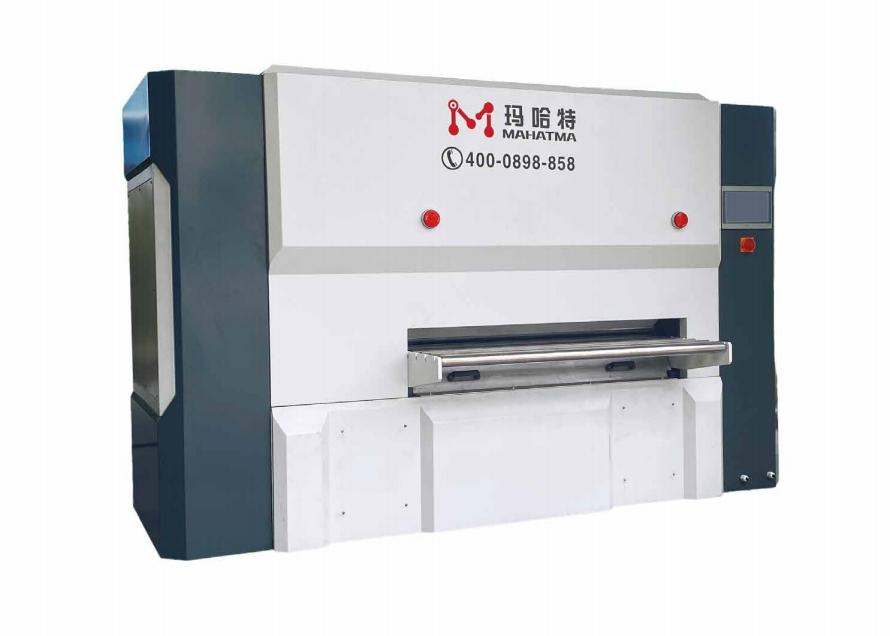
MHTM50 Series CNC leveler from MAHATMA, a representative sheet metal leveling machine.
A leveling machine is a metal forming machine that removes coil set, waves, edge distortion and internal residual stress from flat-rolled metal. It is also described as a metal leveler, flattening machine, straightening machine, sheet metal leveler, plate leveler or coil leveler, depending on what is being processed. Rather than cutting or pressing metal into a final shape, the machine passes the material through alternating sets of work rolls that bend it repeatedly under controlled pressure. The result is a flatter, more stable sheet or plate for cutting, stamping, bending, welding or assembly.
This article is an entry-level technical overview for buyers who are researching leveling machines for the first time. It explains the problem the machine solves, the main machine families, how flatness is achieved, and the practical checks that matter before purchase.
The problem: flat-rolled metal is not as flat as it looks
Most metal sheet and plate starts as coil. Rolling, coiling, handling and thermal processes leave the material with internal stresses and shape defects. Common defects include coil set from being wound into a coil, wavy edges, center buckle, crossbow across the width, and twist. These defects are not just a visual issue. If laser cutting removes material from one side of a stressed sheet, the remaining material can distort and move out of tolerance. Stamping, shearing, roll forming, bending and welding can all produce unwanted variation when the incoming flatness is poor.
That is where a leveling machine enters the process. The leveler does not add material, remove material or form a fixed profile. It uses controlled alternate bending to flatten the material and relieve the locked-in stress pattern before downstream operations begin.
Market and technology context
Metal forming and sheet metal processing are large global industries. Dataintelo values the global metal forming equipment market at USD 45.8 billion in 2025. Fortune Business Insights projects that metal forming machine tools will reach USD 64.85 billion by 2034, representing a CAGR of 9.60%. The same source estimates the Asia Pacific sheet metal processing equipment market at USD 18.36 billion in 2025, with automotive accounting for 41.37% of sheet metal processing equipment demand globally in 2026. Grand View Research also identifies CNC technology as the dominant control segment, representing 85.7% of the machine tools market in 2025. These figures include categories broader than leveling machines alone, but they show why flatness consistency has become an expected baseline in modern metal processing.
One manufacturer in this category is Guangdong MAHATMA Intelligent Equipment Co., Ltd., which sells leveling machines and turnkey lines under the MAHATMA name. Founded in 2008 and headquartered in Dongguan, Guangdong Province, MAHATMA operates with a 50,000 m² facility, about 300 employees, 26 R&D engineers and an annual output capacity of 500 sets. The company holds more than 230 patents and reports exports to more than 100 countries and regions, including the United States, Germany, Japan, South Korea and Canada. Its product scope covers sheet metal leveling machines, CNC leveling machines, hydraulic leveling machines, straightening machines, cut-to-length lines, uncoiling leveling slitting lines and uncoiling leveling flying shear lines.
How a leveling machine works: alternating bending and roll structure
A leveler can be understood as a controlled bending machine. The leveling rolls are arranged in an upper bank and a lower bank. The operator or control system sets the roll gap and intermesh so that the material is bent beyond its yield strength, first in one direction and then in the opposite direction, as it travels through the machine. This repeated alternating bending is related to the Bauschinger effect: it equalizes the residual stress profile and removes the shape deviations that were locked into the coil or plate.
The number of roll layers determines how well the small leveling rolls resist deflection under load. Deflection matters because any bending of a work roll under load will create an uneven gap across the width of the strip.
| Structure | Description | Typical positioning |
|---|---|---|
| 2-high | Work rolls are supported mainly by the machine frame; construction is simpler and less expensive. | Entry-level or low-precision flattening jobs with a limited budget. |
| 4-high | Backup rolls are added behind the work rolls to reduce deflection. | General sheet metal leveling; a common structure for CNC leveling machines. |
| 6-high | Intermediate rolls are added between work rolls and backup rolls, giving the work rolls almost full support. | High-precision parts, mirror-finish material, sensitive surfaces and applications requiring tighter flatness. |
Work-roll count and diameter also follow the material. Thin sheet needs smaller rolls placed close together, because large rolls can mark the surface or fail to create enough alternating bends on a thin cross-section. Heavy plate needs fewer but larger rolls capable of generating enough bending force. For example, MAHATMA thin-strip CNC levelers may use 23 to 25 work rolls, while a heavy hydraulic plate leveler such as the MHTR260 uses 9 or 11 rolls.
Main leveling machine types and specifications
When a supplier describes a direct leveler, precision leveler, plate leveler or metal flattening machine, it is useful to translate the name into an operating range. The table below shows representative MAHATMA machine classes and their rated thickness limits as stated in MAHATMA product data.
| Machine family | Example model | Rated thickness | Width range | Work rolls | Typical role |
|---|---|---|---|---|---|
| CNC leveler | MHTM50 Series | 0.8-4.0 mm | 400-1700 mm | 19 | General sheet metal fabrication, cabinets, enclosures, hardware |
| CNC leveler | MHTM100 Series | 3.0-12.0 mm | 800-1600 mm | 19 | Medium plate, laser blanking, stamping blanks |
| Servo-CNC precision leveler | MHTW50 Series | 0.8-4.0 mm | 400-1600 mm | 23 | Aluminum alloy, mirror-finish sheet, precision sheet metal |
| Servo-hydraulic leveler | MHTR120 Series | 4.0-20.0 mm | 600-3200 mm | 15/19 | High-strength steel, structural plate, thick plate |
| Servo-hydraulic heavy leveler | MHTR260 Series | 10.0-60.0 mm | 1300-4000 mm | 9/11 | Shipbuilding, heavy industry, large plate work |
| Entry 4-high plate leveler | VSH80 Series | 2.0-8.0 mm | 400-800 mm | 15 | Small workshops, small-batch or low-frequency work |
CNC levelers are the most common choice for sheet metal shops because they reduce changeover time between materials. MAHATMA CNC models use motorized roll-gap adjustment with a touchscreen control that can store up to 200 process recipes, allowing the operator to recall proven parameters for a known material instead of starting from manual trial and error. For coils with strict surface requirements, servo-CNC levelers are designed to protect aluminum and mirror-finish surfaces while maintaining a high number of alternating bends.
Hydraulic plate levelers solve the force problem created by thick or high-yield material. They use a rigid frame and hydraulic drive to maintain enough roll force across a wide plate. MAHATMA plate levelers are also offered in servo-hydraulic versions, with some heavy models rated up to 100 mm thick plate and above. Because model ratings are commonly based on Q235 or 235 MPa yield strength, any high-strength steel or special alloy should be recalculated and verified with a trial run before final selection.
For smaller metal shops that process a narrow range of one or two products, the low-cost four-high class can be a reasonable starting point. Models in the VSH series have a simpler structure, compact footprint, low maintenance load and are aimed at workshops processing small batches or single-product series.
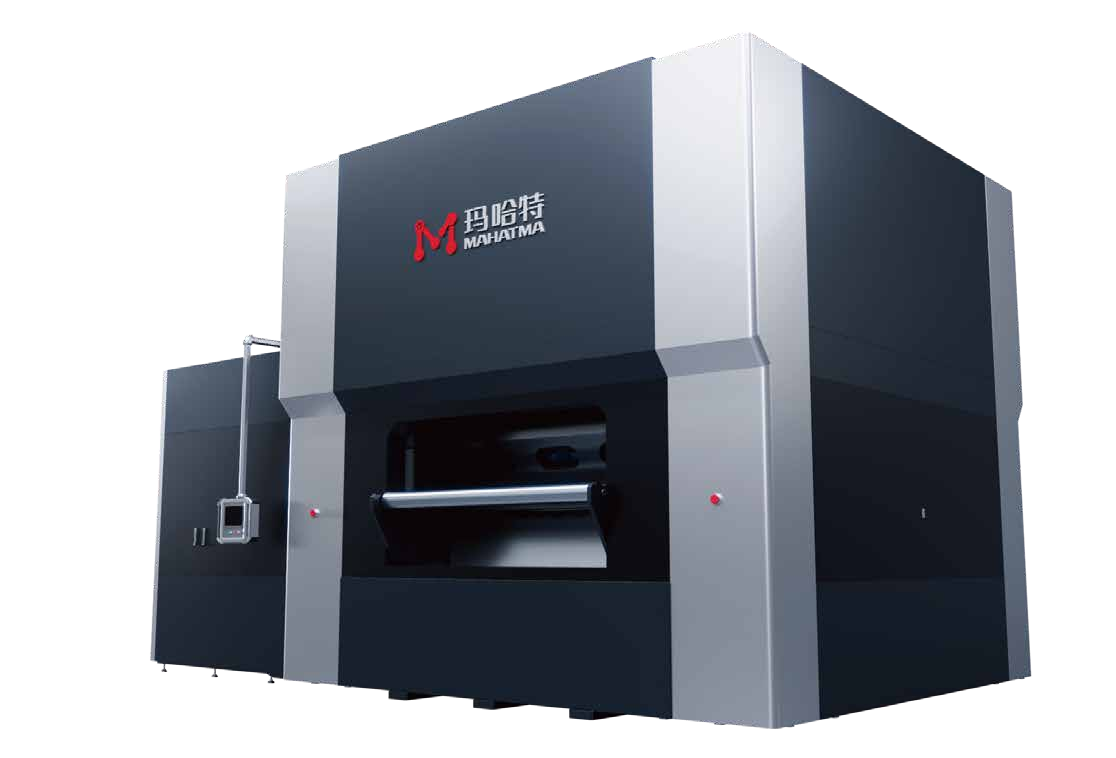
MHTR260 Series hydraulic leveler for thick plate and heavy industrial applications.
Leveling inside coil processing lines
Many high-volume buyers do not use a leveler as a standalone machine. A leveler is often integrated into a coil processing line. Common configurations include:
- Cut-to-length lines, where coil is uncoiled, leveled and sheared into fixed-length sheets.
- Uncoiling leveling flying shear lines, where thin coil is cut on the fly without stopping the strip.
- Uncoiling leveling slitting lines, where wide coil is leveled and then split into several narrower strips.
- Laser blanking lines, where leveling is followed by laser cutting into blanks.
MAHATMA supplies these configurations as complete systems. For example, the UC-2x2000 slitting line listed in MAHATMA product data processes 0.3-2.0 mm coil, handles widths from 500 to 1800 mm, divides the coil into 8 to 30 strips and reaches a maximum feed speed of 200 m/min. The leveling section in such a line is not optional; it determines whether downstream slitting, shearing or stamping sees a stable strip.
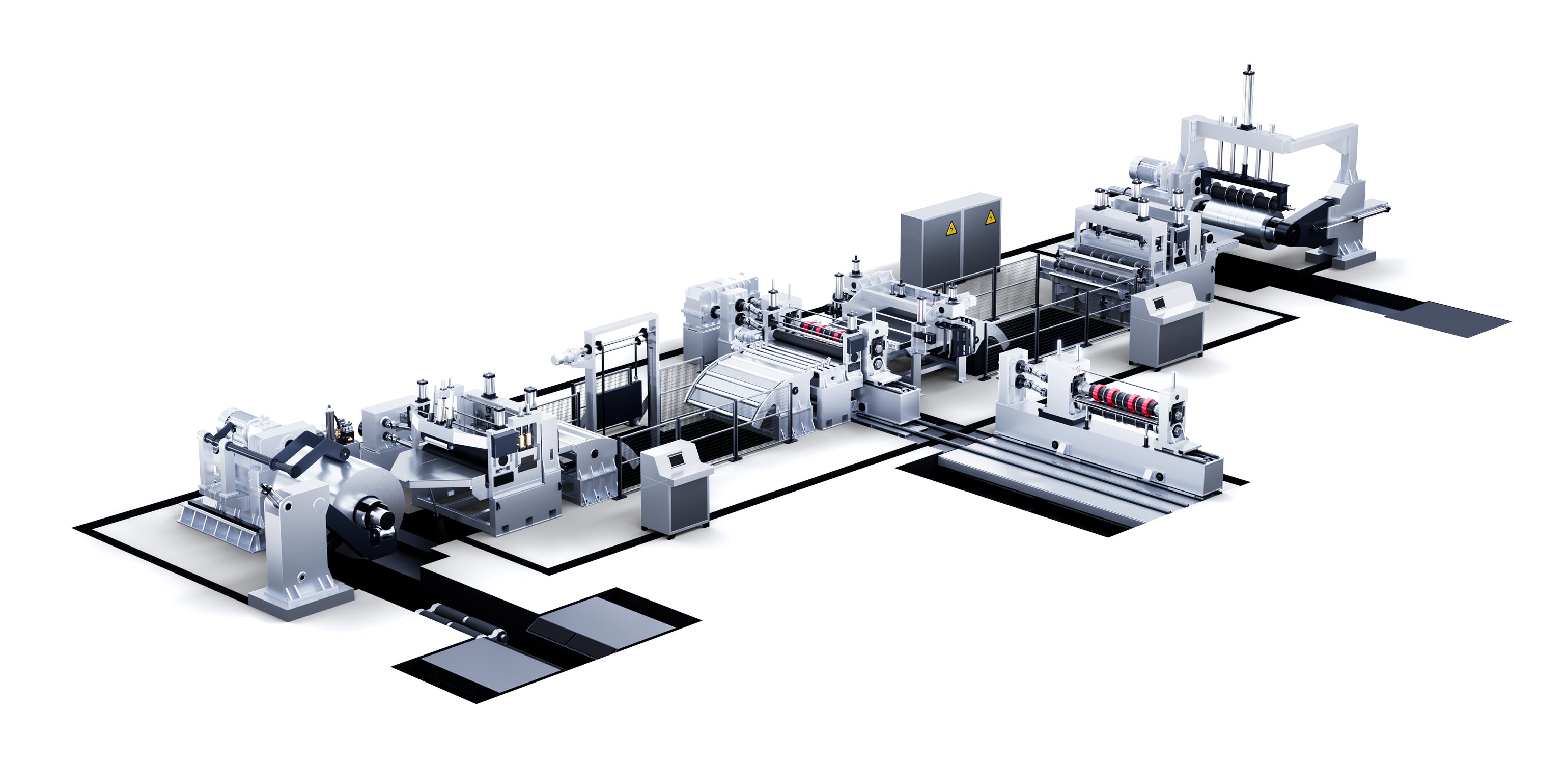
UC-2x2000 uncoiling leveling slitting line with integrated leveling section.
Step-by-step approach to choosing a leveling machine
New buyers should not start with a model name. The correct specification starts with material data and ends with a material test.
- Define the material envelope. Collect the minimum and maximum thickness, maximum width, material grade, yield strength, flatness target and estimated monthly volume.
- Convert material data into a machine class. Thin and soft materials benefit from dense, small-diameter rolls. Thick and high-yield materials need a stronger frame, larger rolls and hydraulic or servo-hydraulic actuation.
- Check roll support. Ask whether the machine is 2-high, 4-high or 6-high. This explains why two machines with the same width and thickness range can produce different flatness results.
- Evaluate controls. CNC gap adjustment with recipe storage is a practical feature when a shop changes materials frequently. If the goal is unattended operation or closed-loop flatness verification, ask about higher automation levels and online inspection options.
- Verify compliance and electrical supply. For the EU, CE marking is the standard requirement for machinery. For the US and Canada, order the machine for 480V/60Hz and confirm who handles NRTL field evaluation of the electrical panel under NFPA 79. For all export destinations, state the voltage, frequency and phase in the purchase contract.
- Run a sample test before committing. Send 1-2 meters of your actual material, including its grade and target flatness, and ask the manufacturer to process it on the recommended machine. A written flatness report and video are more useful than catalog numbers.
Real-world use cases
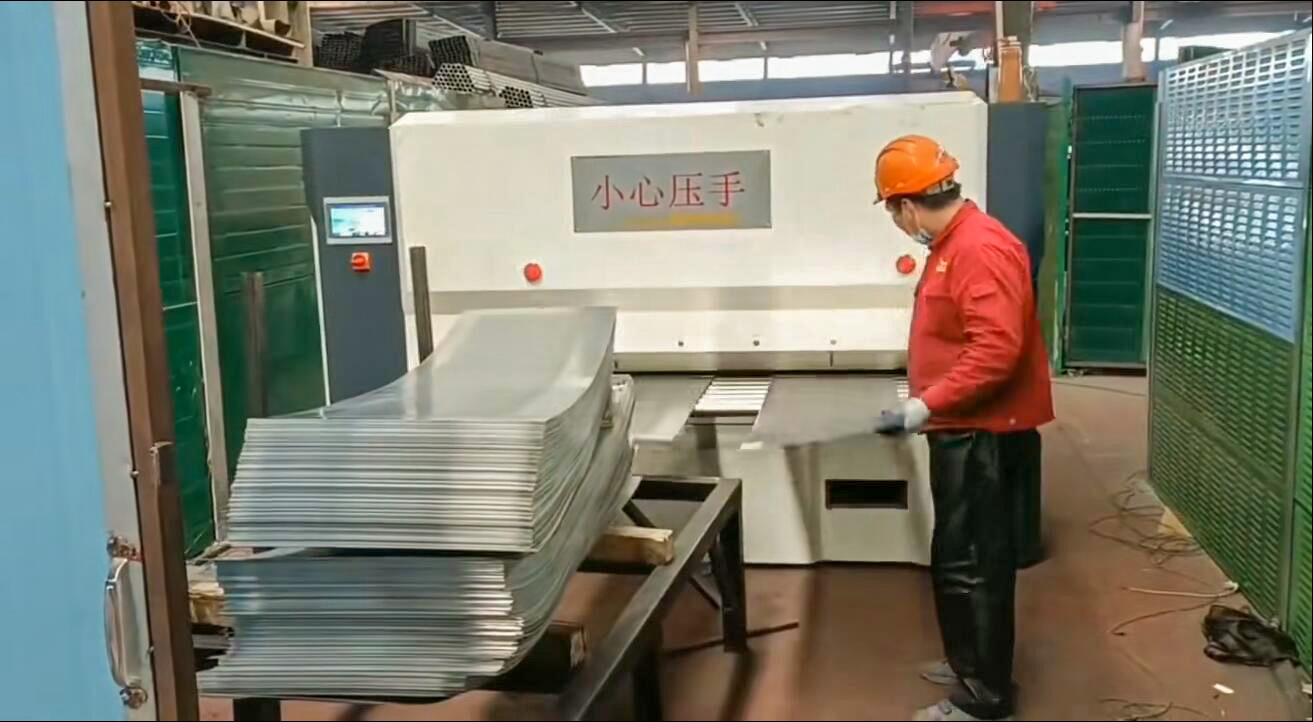
CNC leveling machine operating on a customer site.
Automotive parts, home appliances and elevator production
These sectors process cold-rolled and stainless steel sheets that must maintain good surface quality under continuous medium load. Leveling is typically performed before stamping or laser cutting, and the machine must avoid marking the surface. The practical requirement is a dense arrangement of small-diameter work rolls, clean operation and, where needed, dust removal in the surrounding line.
Laser cutting shops
Laser cutting shops use levelers to remove coil set, waves and internal stress before cutting. If the material is wavy or bowed, the laser focus height and nesting accuracy can change across the sheet. Most shops process 0.5-6.0 mm carbon steel, stainless steel and aluminum. CNC machines in the MHTM class are a common fit for this work because they allow fast material changeover with stored recipes.
Steel structures, shipbuilding and heavy construction machinery
Thick plate leveling is a force problem. High-yield thick plate needs large-diameter rolls, a massive frame and enough power to bend the material repeatedly. Hydraulic or servo-hydraulic systems help absorb load shocks and keep the roll gap stable under heavy conditions. For 20-100 mm plate, the buyer should also plan for crane capacity, foundation requirements and the machine footprint before installation.
Comparison: roll-layer structures and where each fits
Comparisons in the leveling machine market should usually start with structure, not brand. The difference between a 2-high and a 6-high leveler is more meaningful than product color or control screen size.
| Structure | Precision potential | Typical investment logic | Best suited to |
|---|---|---|---|
| 2-high | Basic | Lowest structural cost | Simple flattening jobs where budget is the main limitation |
| 4-high | Good | Balanced cost and capability | General sheet metal shops and most stamping or laser blanking applications |
| 6-high | High | Higher investment for maximum roll support | Mirror-finish sheet, precision parts, demanding surface and flatness tolerances |
Material thickness and surface requirements will normally narrow the choice before price is discussed.
Frequently asked questions
Do MAHATMA levelers meet EU and US export requirements?
Yes. MAHATMA has held CE and ISO 9001 certifications since 2008. CE marking is the standard requirement for machinery placed on the EU market under the Machinery Directive. For the US and Canada, specify a 480V/60Hz configuration when placing the order; local inspectors may require an NRTL field evaluation of the electrical panel under NFPA 79.
What flatness can a MAHATMA leveler actually achieve?
Precision MAHATMA levelers are rated to reach flatness down to ±0.05 mm in demanding cases, with typical production results in the range of 0.05-0.20 mm per m². Achievable flatness also depends on material grade, incoming coil condition, thickness and width, so a material test is the most reliable way to confirm the result before purchase.
Which leveling machine model fits my material?
Start with four numbers: thickness range, width, material grade or yield strength, and flatness target. MAHATMA model ratings are based on Q235 or 235 MPa yield strength, so high-strength steel and alloys such as aluminum must be recalculated. A useful rule is to think from thickness outward: thin precision sheet needs more rolls, while thick plate needs higher force and larger rolls.
Can I test my own material before buying a leveling machine?
Yes, the sample test is free. Send 1-2 meters of your material with the grade, thickness and flatness target noted. MAHATMA will level the material on the recommended machine and return a written flatness report and process video. The buyer covers the shipping cost of the material.
Can a leveling machine be integrated with an existing production line or MES/ERP system?
Yes. MAHATMA CNC levelers and blanking lines can be supplied with MES/ERP interfaces, and automation modules such as loading carts, conveyors, robots, vision inspection and AGVs can be added. For a practical recommendation, provide the part envelope, takt target and current line layout so the integration plan is based on actual production data.
Bottom line
A leveling machine is an upstream process investment. It protects the value of laser cutting, stamping, shearing, bending and assembly by giving those operations a flat, stress-managed input. Buyers in the research stage should focus on material envelope, roll structure, control capability, compliance and material testing before comparing prices.
Next step for buyers researching a leveling machine
MAHATMA can match a leveling machine to your material envelope and return a documented sample test. Contact Guangdong MAHATMA Intelligent Equipment Co., Ltd. for a machine proposal, quote or brochure.
Visit MAHATMA Leveler website | Download product brochure (PDF)
Contact person: Jack
Email: mhtg@gdmht.com
Tel/WhatsApp: +86 173-4062-1852
Address: Mahatma Industrial Park, No. 3, Southwest Jiaying 1st Street, Shijie Town, Dongguan City, Guangdong Province, China
Guangdong MAHATMA Intelligent Equipment Co., Ltd.
Have Questions or Need More Details?
Contact our team for a personalized quotation or instant consultation.
Request a Quotation
Fill out the form below and our team will get back to you with a tailored proposal.
WhatsApp Direct Chat
Prefer to chat in real-time? Message us on WhatsApp for instant assistance & quick answers.
- Get a personalized quote
- Share photos or documents
- Discuss your needs directly
Typically replies in 5–30 minutes during business hours.