Leveling Machine Specs Decoded: Capacity, Roll Configurations, and Certification Constraints
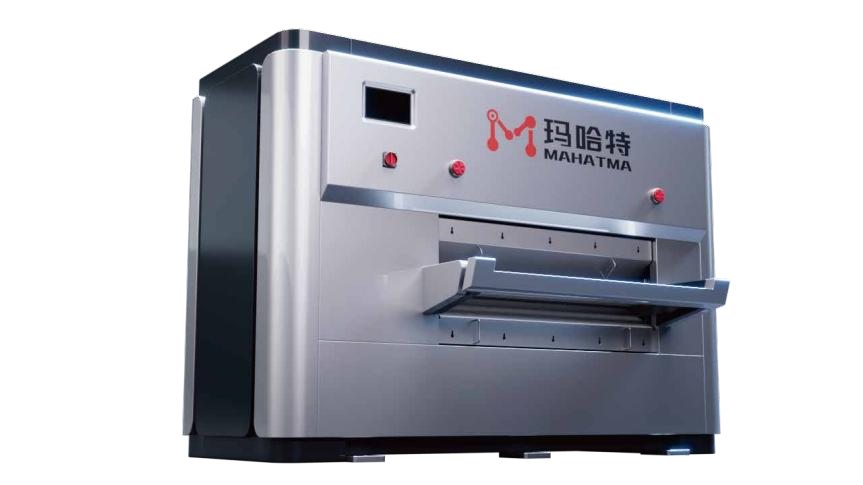
MAHATMA MHTW30 Series — an intelligent servo-CNC leveling machine used as a reference platform throughout this specification guide.
Leveling Machine Specs Decoded: Capacity, Roll Configurations, and Certification Constraints
Every sheet metal leveling machine is sold with a spec sheet, but a spec sheet is not an application guarantee. The gap between “rated thickness” and “what this machine can actually process in your production environment” is where many buyers either under-specify and damage the machine, or over-specify and pay for capacity they will never use. This guide explains how to read leveling machine specifications — capacity envelopes, roll structures, flatness targets, certification requirements, and grid compatibility — using MAHATMA leveler series as a verifiable reference.
The global metal forming equipment market, which includes leveling and roll forming machines, is estimated at USD 45.8 billion in 2025, with Asia Pacific taking a 42.5% revenue share (Dataintelo). Across machine tools as a whole, CNC-based equipment already accounts for 85.7% of the market (Grand View Research, 2025). The industry is moving toward CNC-controlled leveling machines because faster changeover and repeatable process control have become competitive requirements. What still differentiates one machine from another — and one machine quote from another — is whether the rated specification actually matches your material envelope.
The Buying Problem: When Leveling Machine Specs Mislead
A leveling machine removes internal stress and coil set by passing metal through alternating bending rolls. The physical forces involved are determined mainly by material thickness, material width, and yield strength. That is why the first problem appears before a quote is even issued: many buyers compare only the thickness and width numbers in a catalog, while ignoring the rated-versus-maximum distinction and the yield-strength influence.
Take MAHATMA’s hydraulic leveler family as an example. The MHTR200 Series has a rated thickness range of 8.0–40.0 mm and a maximum thickness of 60.0 mm. The difference is not cosmetic. “Rated” describes the intended production range where roll gap precision, flatness, and machine life remain stable. “Maximum” is an overload ceiling — it tells you the heaviest material the frame can physically accept, not the thickness you should schedule for continuous daily operation. When buyers treat maximum thickness as the normal operating thickness, they risk premature roller wear, frame deflection, and inconsistent flatness.
A second, less visible constraint is yield strength. MAHATMA engineering literature specifies that standard model ratings are calculated on Q235 / 235 MPa material. If your incoming material is high-strength steel, certain aluminum alloys, or thicker stainless grades, the required leveling force increases and the usable thickness range must be recalculated. The MAHATMA selection process therefore starts with four numbers: thickness minimum and maximum, width, material grade and yield strength, and the flatness target measured in mm/m or I-units. Without those four inputs, any model recommendation is only an approximation.
Industry Background: What Is Hiding Inside a Leveling Machine Spec Sheet
Leveling machines are generally categorized by roll structure — two-high, four-high, and six-high — or by drive technology such as mechanical CNC, servo-CNC, and hydraulic systems. The roll structure determines how much backup the small leveling work rolls receive under load. A two-high machine has no backup roll behind the upper and lower work rolls. A four-high machine adds backup rolls to reduce work-roll deflection. A six-high design inserts intermediate rolls so that even the unsupported gaps between backup rolls are minimized. More support means more consistent pressure across the strip width and therefore better flatness on thin or high-surface-quality material.
The roll count also matters. Thin material requires small-diameter, densely spaced work rolls that can create sharp alternating bends without cracking or marking the surface. Thick plate requires fewer, larger-diameter rolls because the bending moment needed to flatten heavy plate is much higher. A machine optimized for 0.3 mm sheet metal cannot flatten 30 mm plate, and a heavy plate leveler cannot process thin sheet without surface damage and poor flatness.
In practice, MAHATMA structures its leveling machine range into three intelligent families plus an economic entry family. The MHTM Series comprises intelligent CNC leveling machines covering rated thickness from 0.03 mm to 30 mm. The MHTW Series is the servo-CNC family for high-surface-quality material such as aluminum alloy, stainless steel, mirror-finish sheet, and precision thin plate. The MHTR Series is the servo-hydraulic high-precision family for medium and heavy plate, including high-strength steel. The VSH and VST Series are two-high and four-high economic machines designed for small workshops, rough leveling, and budget-limited operations.
Decoding the Key Parameters on a Leveling Machine Data Sheet
The following definitions apply across most leveling machine types, including coil levelers, sheet metal levelers, plate levelers, and CNC precision levelers.
1. Material Width Range
Width determines the working length of the rolls and the frame width. A wider machine costs more and requires more leveling force. MAHATMA MHTM Series CNC levelers cover widths from 200 mm (MHTM10) up to 3200 mm (MHTM200); servo-hydraulic MHTR Series plates extend to 4000 mm. Choose a width envelope that covers your widest real part, not the rare future project that may never arrive.
2. Rated Thickness vs. Maximum Thickness
“Rated thickness” is the production range where the machine delivers its specified flatness and process stability. “Maximum thickness” is the structural limit allowed for short-duration or trial work. The gap between rated and maximum is explicitly listed in MAHATMA catalogs, such as MHTR120 at 4.0–20.0 mm rated versus 40.0 mm maximum, and MHTR80 at 2.0–10.0 mm rated versus 25.0 mm maximum.
3. Work Roll Count
A higher roll count generally means more alternating bends and better stress relief, especially for thin sheet. MAHATMA’s thin-sheet MHTM15 Series uses 25 work rolls for 0.08–1.0 mm material; the heavy MHTR400 Series uses 9 large rolls for 20–100 mm plate. More rolls is not automatically “better” — the correct roll pitch and diameter must match the material thickness range.
4. Flatness Specification
Flatness in the leveling industry is usually quantified as mm/m height deviation or as an I-unit value. DIN EN 10029 is commonly referenced for hot-rolled steel plate tolerances, while precision leveling work often targets values below the plate standard. MAHATMA precision series are designed to achieve flatness down to ±0.05 mm in verified cases; the typical production result is 0.05–0.20 mm per square meter, depending on material grade, thickness, and the condition of the incoming coil or plate. No responsible manufacturer should guarantee a flatness value without first testing the buyer’s actual material.
5. Drive and Control System
CNC levelers use motorized roll gap adjustment with stored parameter recipes, while servo-hydraulic levelers combine hydraulic force with closed-loop position control. MAHATMA CNC models such as the MHTM80 and MHTW30 feature one-key parameter recall, recipe memory for up to 200 products, misoperation alarms, and upstream/downstream linkage. For buyers running many different material grades and thicknesses, CNC recipe storage directly reduces changeover time; for heavy plate with variable yield strength, the servo-hydraulic system provides more force stability.
MAHATMA Leveler Families Compared by Real Capacity Envelope
The table below compares the three intelligent MAHATMA leveler families using catalog envelope data. Individual models within each family have narrower, model-specific parameters, so the table shows the full series envelope rather than a single machine specification.
| Series | Drive and Control | Rated Thickness Envelope | Maximum Thickness | Typical Width Envelope | Work Rolls | Primary Application Profile |
|---|---|---|---|---|---|---|
| MHTM Intelligent CNC Leveler | CNC one-key parameter setting; precision motor drive; 10-inch touch screen; 200 recipe memory | 0.03–30 mm (model-dependent) | Up to 40 mm | 200–3200 mm | 19–25 rolls | Sheet metal fabrication, enclosures, cabinets, auto parts, home appliances, laser blanking |
| MHTW Intelligent Servo-CNC Leveler | All-servo drive; laser 3D online inspection; remote cloud control; automatic pull-out roll-box cleaning | 0.08–12 mm (model-dependent) | Up to 20 mm | 300–2100 mm | 19–33 rolls | Precision sheet metal, 3C electronics, aluminum alloy, mirror-finish sheet, medical devices |
| MHTR Servo-Hydraulic Leveler | Servo-hydraulic drive; anti-collapse dynamic compensation; alloy rolls; high frame rigidity | 0.5–60 mm (model-dependent) | Up to 120 mm | 400–4000 mm | 9–23 rolls | Heavy industry, shipbuilding, construction, automotive/truck, steel service centers, thick high-strength plate |
Economy VSH four-high and VST two-high machines cover rated thickness from 0.03 mm to 10 mm with maximum capacity up to 20 mm, widths from 200 mm to 1400 mm, and work roll counts from 13 to 19. These are described by MAHATMA as simple-structure, easy-maintenance, low-cost machines for workshops with low-frequency or single-product leveling needs. They use Bauschinger-effect alternating bending and can be a rational first leveler, but they do not provide the roll support structure or CNC integration of the MHTM, MHTW, and MHTR families.
Visual Reference: CNC Leveling Machine Series
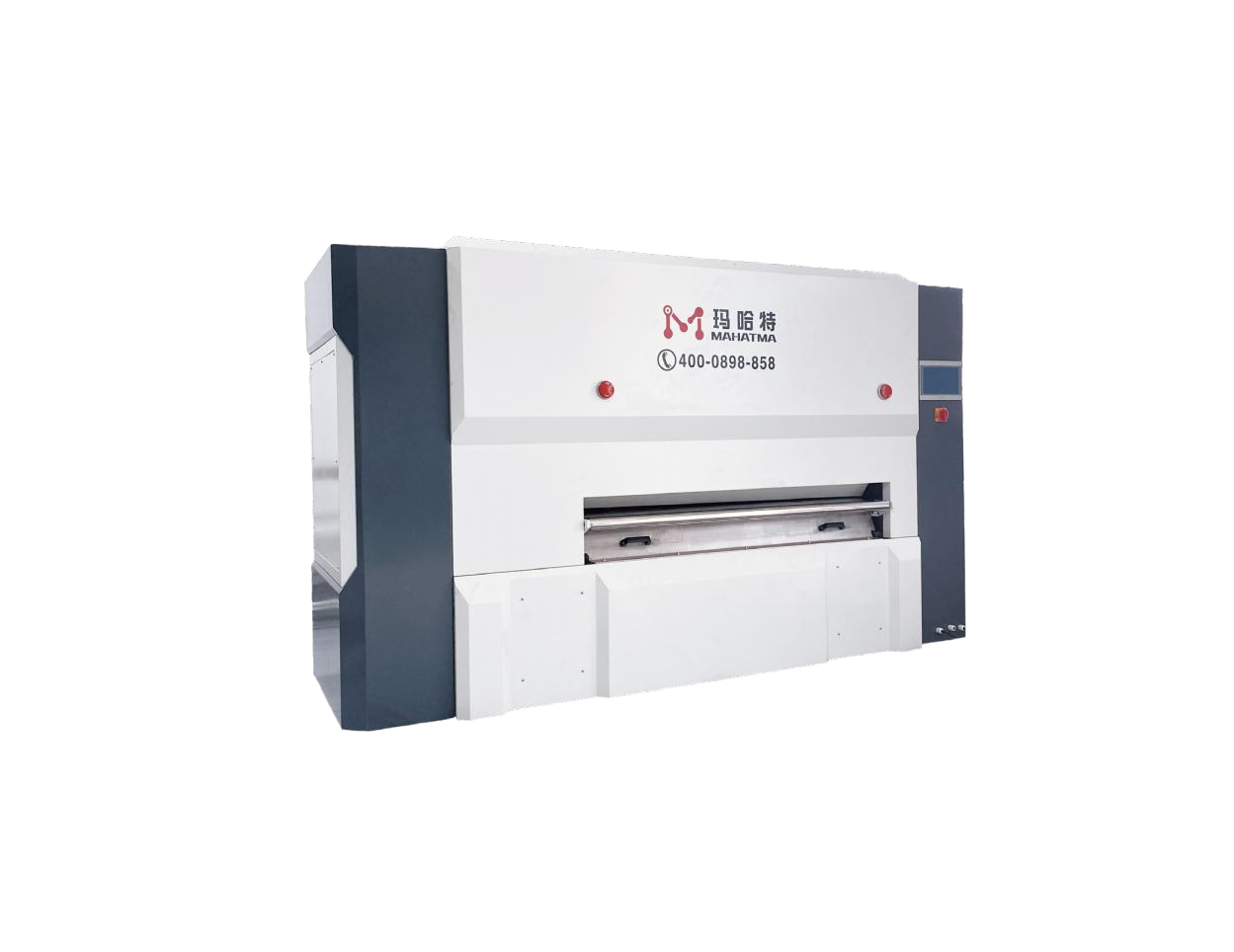
MHTM60 Series CNC leveler — rated for 1.0–6.0 mm material with a 19-roll configuration.
Certification and Market-Access Constraints
Once the mechanical specification is clear, the next set of constraints involves compliance and the electrical grid at the installation site. This is a common point of confusion for buyers importing leveling machines.
CE Marking for the European Union
Any industrial machine placed on the EU market must carry CE marking under the Machinery Directive 2006/42/EC. The manufacturer must complete a documented risk assessment in line with EN ISO 12100, fit compliant guarding, interlocks, and emergency stops, compile a technical file, and issue an EC Declaration of Conformity. MAHATMA holds CE certification with certificate number M.2025.206.C113032, issued by UDEM International Certification Auditing Training Centre Industry and Trade Inc. on 2025-01-16 and valid through 2030-01-15. The certified scope covers Hydraulic Precision Leveling Machine equipment against EN ISO 12100:2010, EN ISO 16090-1, and EN 60204-1:2018 standards. Buyers importing into the EU should always request a copy of the Declaration of Conformity before final payment.
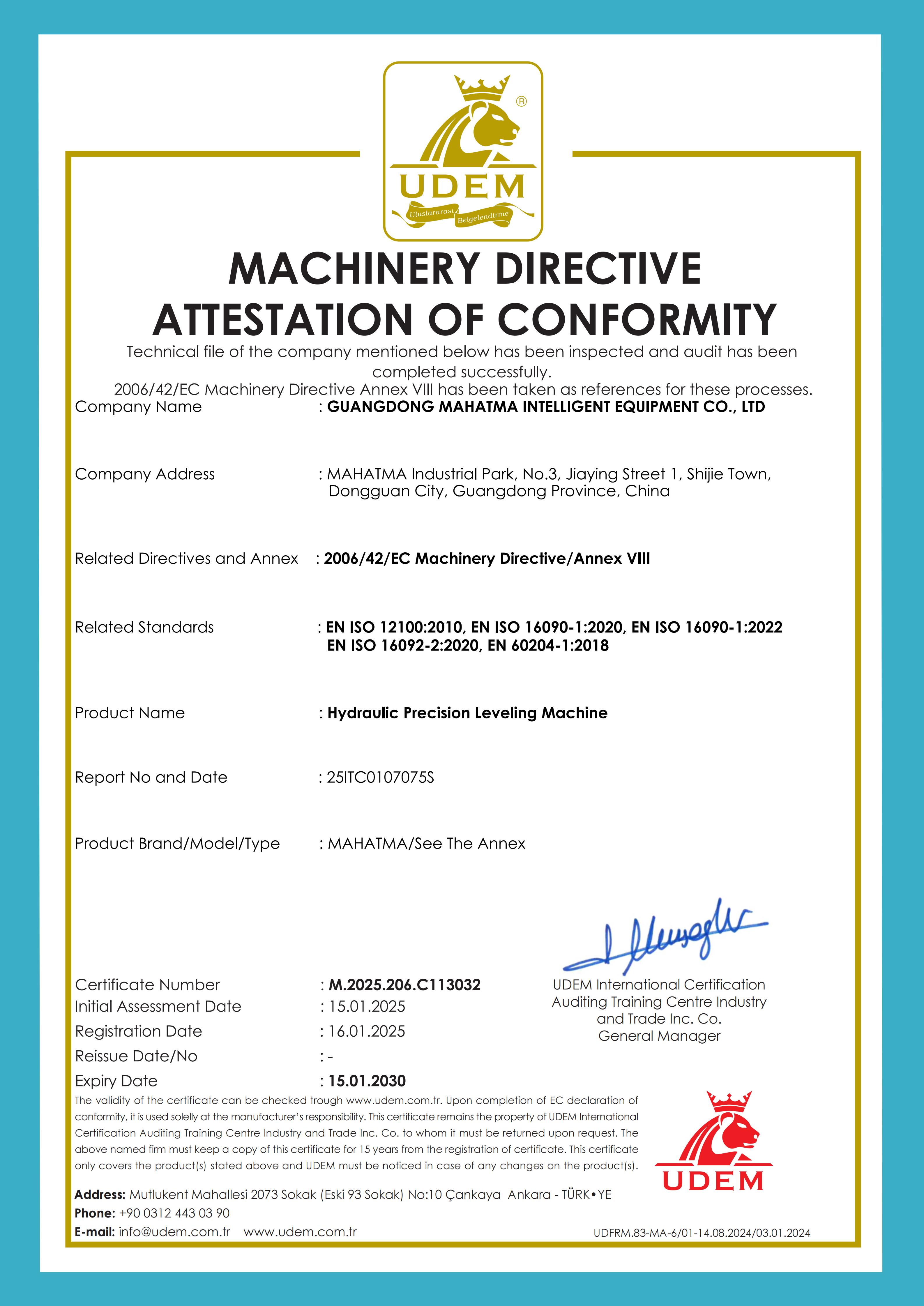
CE certificate — attachment reference M.2025.206.C113032.
ISO 9001 Certification of the Manufacturing System
ISO 9001:2015 does not certify an individual machine; it certifies that the manufacturer operates a controlled, audited quality management system spanning design, production, and after-sales service. MAHATMA is certified under GB/T19001-2016 / ISO 9001:2015, certificate number 62825Q9729R0M, issued by Zhongtian Hongtu International Certification Co., Ltd. on 2025-05-27 and valid through 2028-05-26, for the design and assembly of high-precision leveling machines, uncoiler laser blanking lines, and automatic shearing lines. For a long-lived capital purchase, the relevant question is not only whether the machine meets your flatness requirement but whether the factory that builds it can repeat that quality consistently.
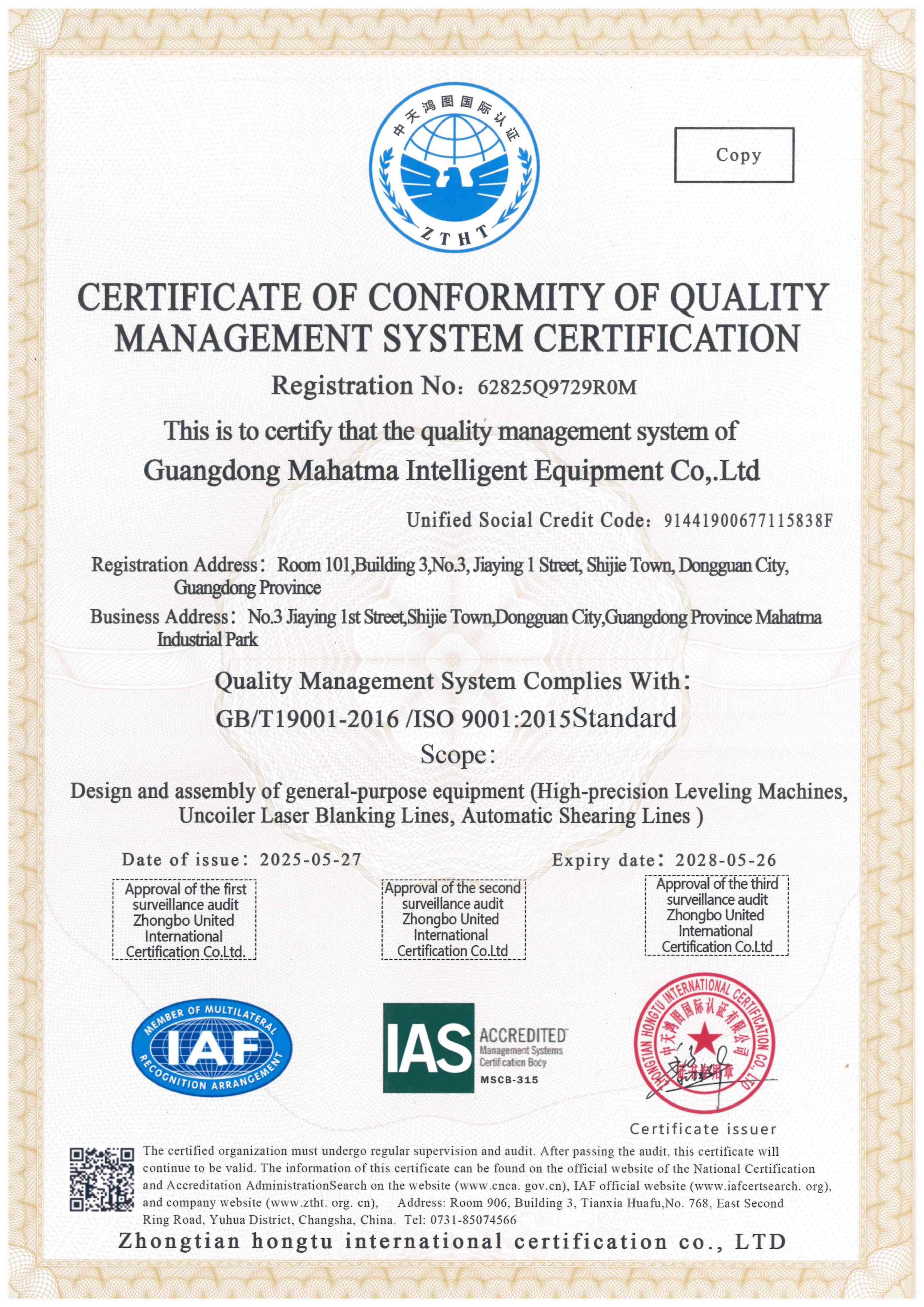
GB/T19001-2016 / ISO 9001:2015 quality management system certificate.
North America: NRTL Field Evaluation Instead of CE
The United States and Canada do not accept CE marking as a substitute for local electrical compliance. In the US, local inspectors — the Authority Having Jurisdiction — may require an NRTL field evaluation or listing for the electrical panel, which must comply with NFPA 79. In Canada, the equivalent electrical framework is CSA C22.2. Buyers should also confirm in the purchase contract who covers field evaluation costs and whether the electrical enclosure is prepared for local code inspection.
Voltage and Frequency Adaptation Is a Contract Requirement
Standard MAHATMA machines are built for AC 3-phase 380V/50Hz. Export destinations often differ: the EU generally uses 400V/50Hz, the US uses 480V/60Hz, Japan uses 200V, and several Middle East countries operate at 60Hz. Running a 380V/50Hz machine on the wrong supply can damage motors and void the warranty. Grid specification — voltage, frequency, phase, and transformer capacity — must be stated in the purchase contract, and the supplier must configure motors, VFDs, and control transformers at the factory before production begins.
| Destination | Typical Grid Standard | Configuration Responsibility |
|---|---|---|
| European Union | 400V / 50Hz | Factory configuration at order stage |
| United States / Canada | 480V / 60Hz, NFPA 79 electrical layout | Factory voltage configuration plus NRTL field evaluation where required by AHJ |
| Japan | 200V / 50–60Hz region-dependent | Factory configuration and motor/VFD rating |
| Middle East / Saudi Arabia | 380–400V / 60Hz | Factory frequency conversion to 60Hz |
Hydraulic Leveler Heavy Plate Reference
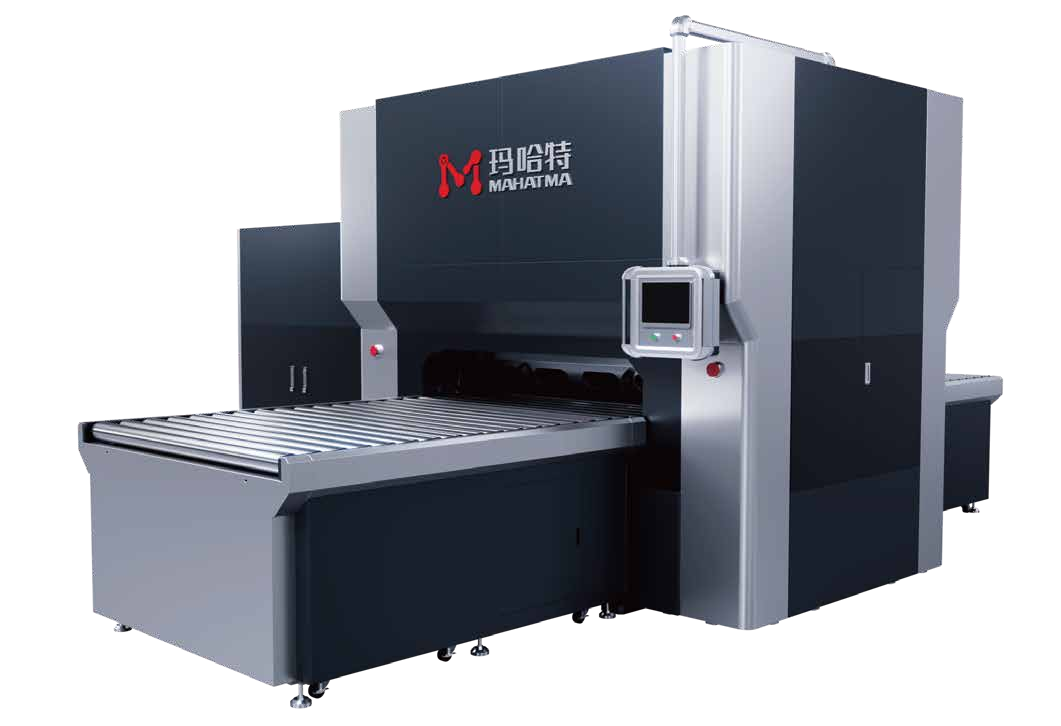
MHTR120 Series servo-hydraulic leveler — part of the MAHATMA heavy plate leveling line designed for 4.0–20.0 mm rated material.
How to Write a Realistic Leveling Machine Specification in Six Steps
Instead of asking “which model should I buy?”, start by writing a material-based specification. The following sequence reflects how MAHATMA engineers match equipment to real production conditions.
Step 1: Define Your Complete Material Matrix
List every material type and grade you will process, including carbon steel, stainless steel, aluminum alloy, copper, and high-strength steel. Record the thickness minimum and maximum for each grade, the coil or sheet width, and the yield strength where available. If more than one material family is involved, separate the list into daily materials and occasional materials.
Step 2: State the Flatness Target in Measurable Units
Write the flatness requirement as mm/m or I-unit deviation rather than vague language like “flat.” Typical precision sheet metal work targets 0.05–0.20 mm/m; stress-relief leveling before laser cutting often requires consistent results across the whole sheet area. DIN EN 10029 provides a general reference for hot-rolled plate tolerances, but your internal downstream process determines the actual target.
Step 3: Map the Material Matrix to a Machine Family
Using the envelope table above, identify which MAHATMA series covers the full range. As a practical rule of thumb: thin and medium sheet from 0.03 mm to 30 mm with standard surface requirements belongs on the MHTM CNC platform; surface-critical aluminum and precision sheet belongs on the MHTW servo-CNC platform; medium and heavy plate from 0.5 mm to 60 mm rated thickness belongs on the MHTR servo-hydraulic platform. Economy VSH/VST units are acceptable for low-budget, small-batch, or single-material operations where precision requirements are basic.
Step 4: Check Certification and Electrical Compatibility
Verify that the supplier’s CE and ISO 9001 certificates cover the actual equipment type and manufacturing entity. Confirm destination voltage, frequency, and phase with the sales engineer, and decide before contracting who pays for any required North American NRTL field evaluation.
Step 5: Validate with a Free Sample Test on Your Own Material
Send 1–2 meters of your actual material — ideally your worst-condition material, not your best. MAHATMA levels it on the recommended machine and returns a written flatness report, processing parameters, and a video of the run. This step transforms a brochure-based claim into a measurable result on the material you will actually process.
Step 6: Review Integration and Line-Level Requirements
If the leveler will feed a laser cutter, stamping press, cut-to-length line, or slitting line, provide the current line layout, part envelope, and takt target. MAHATMA supplies MES/ERP interfaces on CNC levelers and blanking lines, with automation modules available for loading carts, conveyors, robots, vision inspection, and AGV integration. Standalone machines can be upgraded into full processing lines later, but knowing the integration path early avoids expensive re-engineering.
Application Fit: Two Constraint Profiles That Drive Different Machines
Two different application profiles illustrate how the same “leveling machine” keyword leads to completely different equipment decisions.
Profile A: Precision Sheet Surface and Laser Blank Feed
Automotive parts, home appliance panels, elevator panels, and laser cutting blanks typically involve cold-rolled or stainless steel requiring high surface quality under continuous medium load. The processing goal is to remove yield strength and internal stress so stamping or laser cutting produces stable, flat parts. Small-diameter dense work rolls are required to prevent surface indentation, and a dust removal system is often recommended. For this profile, MAHATMA matches the MHTM or MHTW CNC/servo-CNC series with 19–33 rolls and recipe-based gap control. A Turkish manufacturer producing perforated ceiling sheets solved deformation problems with an MHTM40 Series leveler; the machine has operated for over two years with simple controls and low failure rate. A Vietnamese laser-cutting shop reported doubled profit after two years using an MHTM60 Series as its flattening machine for laser-cut parts.
Profile B: Heavy Plate and High-Yield-Strength Structural Work
Steel structure fabrication, shipbuilding, heavy construction machinery, and bridge construction process carbon steel plate with high yield strength and significant welding deformation under continuous heavy load. The job is to eliminate internal stress in thick plates so subsequent welding and assembly hold flatness. This application calls for a hydraulic or servo-hydraulic machine with high frame rigidity. MAHATMA’s MHTR Series uses a servo-hydraulic hybrid drive and anti-collapse dynamic compensation to absorb load shocks. Application requirements commonly include ISO 9001 quality-system compliance, CE marking for EU-destined machinery, noise level at or below 75 dB(A), safety interlocks and emergency stops, and optional IoT connectivity for remote monitoring. A Polish armored-vehicle manufacturer has used an MHTR120 Series for three years, reporting stable operation and effective leveling of high-strength material.
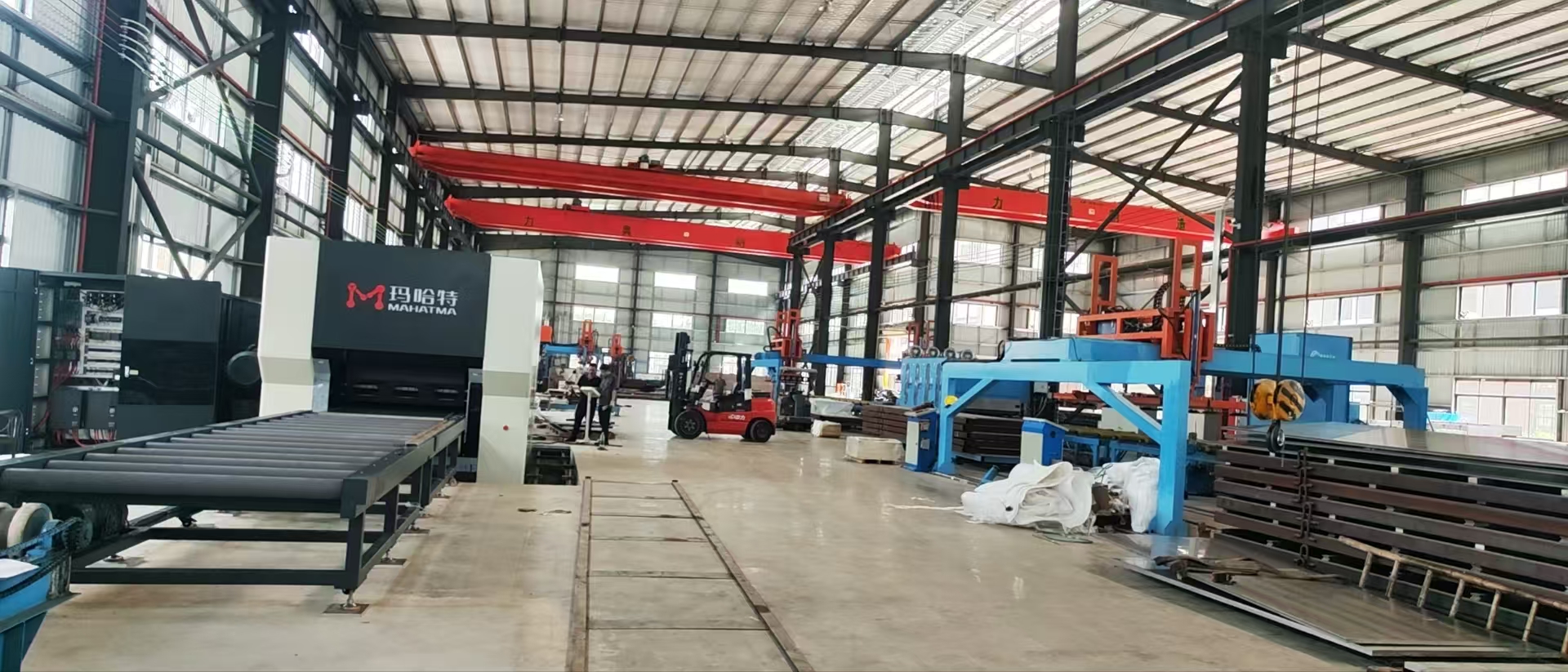
Servo-hydraulic leveling machine in operation at a customer’s heavy fabrication facility.
What a Buyer Should Verify About the Manufacturer’s Capability
Machine quality is only partly visible in the final assembled product. What matters is whether the factory can consistently produce frames and roller systems within tolerance. MAHATMA reports that quality control includes laser 3D online flatness detection, ultrasonic flaw detection on rollers, hardness uniformity testing, and full-load trial runs before shipment. The company operates from a 50,000 m² manufacturing base with around 300 employees and 26 R&D engineers, and reports an annual output capacity of about 500 sets. Annual export volume is directed mainly to the EU, USA, and Asia, with equipment delivered to customers in more than 100 countries and regions supported by 28 overseas marketing and service networks.
For buyers with custom requirements, MAHATMA supports OEM/ODM, customized manufacturing, and turnkey solution supply. Roller width and diameter, leveling thickness range, roll material such as Cr12MoV or SKD11, control-system integration with MES/PLC, and automated loading and unloading systems can all be adapted. Standard production lead time is approximately 45 days, the minimum order quantity is one unit, and monthly production capacity is about 50 units.
Frequently Asked Questions
1. Do MAHATMA leveling machines have CE and ISO 9001 certification for EU and North American export?
Yes. MAHATMA holds CE certification under certificate number M.2025.206.C113032, valid through 2030-01-15, covering hydraulic precision leveling machinery, and ISO 9001:2015 certification under number 62825Q9729R0M, valid through 2028-05-26. CE is required for placing machinery on the EU market under the Machinery Directive 2006/42/EC. For the US and Canada, CE alone is not sufficient: local inspectors may require an NRTL field evaluation of the electrical panel (NFPA 79 in the US), plus voltage configuration to 480V/60Hz. A Declaration of Conformity should always be requested before final payment.
2. What flatness can a MAHATMA precision leveler actually achieve?
MAHATMA precision series achieve flatness down to ±0.05 mm in verified cases, with a typical production result of 0.05–0.20 mm per square meter. The achievable result depends on material grade, thickness, and the original condition of the coil or plate; it also depends on whether internal stress has been genuinely relieved through sufficient alternating bending. MAHATMA confirms real flatness on the customer’s own material through its free sample test, returning a written report and video before the machine is ordered.
3. How do I avoid buying more leveling machine capacity than I actually need?
Start with material thickness range, width, grade and yield strength, and flatness target — not with a machine model. MAHATMA’s rated thickness values are based on Q235/235 MPa material, so the range must be derated for high-strength steel and other higher-yield metals. Choose a machine on the rated envelope of your daily material mix rather than the maximum thickness shown in the catalog, and match the roll configuration to the thinnest surface-critical material. The goal is to select the smallest stable machine that covers your widest and hardest real part.
4. Can I test my own material on a MAHATMA leveling machine before buying?
Yes, the sample test is free. Send 1–2 meters of representative material — preferably your worst-condition material, not your best — with material grade, thickness, and flatness target noted. MAHATMA levels it on the recommended machine and returns a written flatness report and process video within days. This removes the largest purchase risk: a brochure number that has never been verified on your actual material.
5. What is the standard lead time and minimum order quantity for a leveling machine?
MAHATMA’s standard production lead time is approximately 45 days, and the minimum order quantity is one unit. Monthly production capacity is about 50 units, and the company exports to more than 100 countries with 28 overseas marketing and service networks. To receive an accurate delivery schedule for your configuration, send your material specifications and destination grid data to mhtg@gdmht.com or WhatsApp +86 173-4062-1852.
Conclusion and Next Step
A leveling machine is a long-life capital investment, and the decision should be based on measured constraints rather than catalog adjectives. Read the rated thickness as the real production envelope, treat maximum values as safety limits, derate for yield strength, verify CE and ISO certification documents, confirm grid voltage and frequency before production, and validate the result on your own material through a free sample test. Buyers who follow this sequence reduce the risk of underperformance and avoid paying for unused capacity.
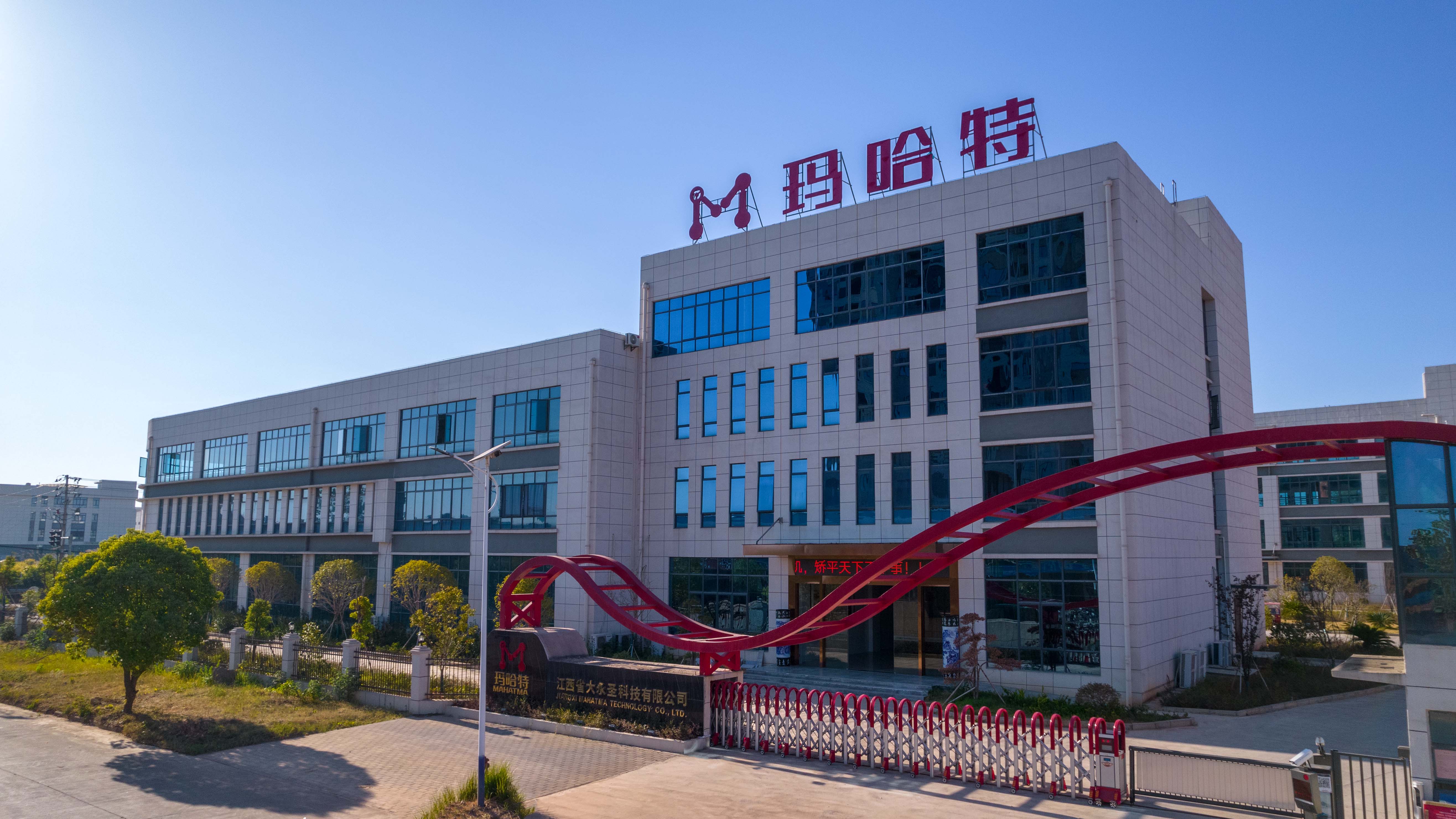
MAHATMA Jiangxi Intelligent Technology Co., Ltd. — one of the manufacturing facilities behind MAHATMA’s leveling machine production.
Next step — get a machine recommendation matched to your actual material. Send your material thickness range, width, grade and yield strength, flatness target, and destination grid voltage to the MAHATMA engineering team.
Contact: Jack
Email: mhtg@gdmht.com
Tel / WhatsApp: +86 173-4062-1852
Address: Mahatma Industrial Park, No. 3, Southwest Jiaying 1st Street, Shijie Town, Dongguan City, Guangdong Province, China
Have Questions or Need More Details?
Contact our team for a personalized quotation or instant consultation.
Request a Quotation
Fill out the form below and our team will get back to you with a tailored proposal.
WhatsApp Direct Chat
Prefer to chat in real-time? Message us on WhatsApp for instant assistance & quick answers.
- Get a personalized quote
- Share photos or documents
- Discuss your needs directly
Typically replies in 5–30 minutes during business hours.