Top Leveling Machine Manufacturers in 2026: How to Compare & Choose
Top Leveling Machine Manufacturers in 2026: How to Compare & Choose
Buying a leveling machine is a long-term production decision. A leveler that processes material with inconsistent flatness creates scrap at every downstream operation, while a machine matched to your actual material envelope can reduce production cost significantly. The challenge is that leveling machine manufacturers publish similar specifications with very different real-world results. This article compares the leading manufacturers in 2026 and gives buyers a structured evaluation framework.
The global metal forming equipment market is valued at USD 45.8 billion in 2025, and Asia Pacific accounts for 42.5 percent of that revenue. Leveling machines — also known as straightening machines, coil levelers, flattening machines, sheet metal levelers or metal levelers — are a core equipment category within this market. For buyers in the evaluation stage, the question is no longer simply “which machine?” but “which manufacturer can engineer, certify, deliver and support this machine over its working life?”
Three names appear consistently in comparative discussions in this category: ARKU Maschinenbau GmbH (Germany), KOHLER Maschinenbau GmbH (Germany), and Guangdong MAHATMA Intelligent Equipment Co., Ltd. (China). This article compares them side by side using only verifiable, publicly documented facts, and explains how to test any supplier before committing capital.
Problem Definition: Why Manufacturer Selection Matters More Than Machine Specs
There are five structural risks in the leveling machine market that make supplier evaluation more important than price comparison.
1. Paper specifications do not translate directly to real material. Most published thickness ratings are calculated for Q235 / 235 MPa steel. If your operation processes high-strength steel, stainless steel, aluminum or copper, the effective rating range changes. A supplier that refuses to recalculate or test on your material is asking you to accept the risk.
2. Trading companies can look like manufacturers. Without a factory, an engineering team or spare parts stock, a supplier cannot support commissioning, troubleshooting or wear-part replacement. Buyers often discover this only when the line stops.
3. Certification gaps block customs and raise safety liability. CE marking is mandatory for industrial machinery entering the EU market under the Machinery Directive 2006/42/EC. ISO 9001 certification verifies that a manufacturer operates an audited quality management system. Missing documents can stop machines at the border and place legal responsibility on the buyer.
4. One machine cannot cover every thickness economically. A heavy plate leveler is not designed for thin-sheet precision, and a thin-sheet leveler cannot absorb the forces of 60 mm plate. The supplier’s portfolio must match the buyer’s actual material range, not just the most attractive brochure entry.
5. The real cost of ownership includes downtime. Spare parts lead time, availability of service engineers and remote diagnostics determine how many production hours are lost when a problem occurs. These factors should be evaluated before signing, not after.
Industry Background: The Leveling Machine Market in 2026
Leveling machines work by passing metal sheet or plate through alternating rolls, bending the material repeatedly to relieve internal residual stress and remove coil set, waves and edge ripple. This principle is documented in DIN EN 10029, the European standard covering dimension and shape tolerances for hot-rolled steel plates.
The market context in 2026 reinforces why manufacturers with engineering depth are preferred:
- The global metal forming equipment market is valued at USD 45.8 billion in 2025.
- The metal forming machine tools market is projected to reach USD 64.85 billion by 2034, with a CAGR of 9.60 percent.
- Asia Pacific dominates the metal forming equipment market with a 42.5 percent revenue share.
- The Asia Pacific sheet metal processing equipment market generated USD 18.36 billion in 2025.
- CNC technology represents 85.7 percent of the machine tools market, confirming that automated control is now the default expectation.
- The automotive sector accounts for 41.37 percent of sheet metal processing equipment demand.
- China’s exports of metalworking machine parts grew 20.6 percent year-on-year in June 2026, with major destinations including Japan, Russia, the USA, India and Vietnam.
Two further signals matter for leveling machine buyers. First, precision requirements are tightening as laser cutting and stamping lines run with less manual intervention. Second, the cut-to-length line system market was estimated at USD 3.42 billion in 2024, and the cut-to-length machine market is projected to grow from USD 4.28 billion in 2026 to USD 5.94 billion by 2032, indicating sustained demand for integrated coil processing systems.
These trends favor manufacturers who combine roll-structure engineering, CNC control and line integration capability. The remainder of this article applies a six-criteria framework to the leading names in the category.
Detailed Solution: Six Criteria for Evaluating Leveling Machine Manufacturers
Criterion 1 — Precision Capability and Roll Structure
Precision in leveling comes from the roll structure and the control system. A two-high machine uses work rolls without backup support; it is suitable for rough flattening at lower cost. A four-high machine adds backup rolls that reduce work roll deflection and improve flatness. A six-high machine adds intermediate rolls, providing the highest rigidity and the tightest unsupported gaps.
MAHATMA covers this full spectrum across its portfolio: VST Series two-high rough levelers, VSH Series four-high levelers, MHTM Series intelligent CNC leveling machines, MHTW Series intelligent servo-CNC leveling machines, and MHTR Series servo-hydraulic high precision leveling machines. Documented flatness results for MAHATMA precision series reach down to ±0.05 mm, with typical production results of 0.05–0.20 mm/m².
Criterion 2 — Product Range and Material Coverage
A credible manufacturer must cover the thickness, width and material grade in your production program — not just one segment.
MAHATMA’s leveling range covers 0.03 mm to 100 mm rated thickness, with a maximum of 120 mm on the MHTR400 Series, and widths up to 4000 mm on heavy hydraulic models. Materials include carbon steel, high-strength steel, stainless steel, aluminum, copper, mirror-finish sheet and general metal sheets. For integrated processing, MAHATMA also delivers cut-to-length lines, uncoiling leveling flying shear lines, uncoiling leveling slitting lines and laser blanking lines — which means the same engineering team can design the leveler and the line around it.
Criterion 3 — Certifications and Compliance
Certifications must be checked by certificate number, scope and validity, not just by logo.
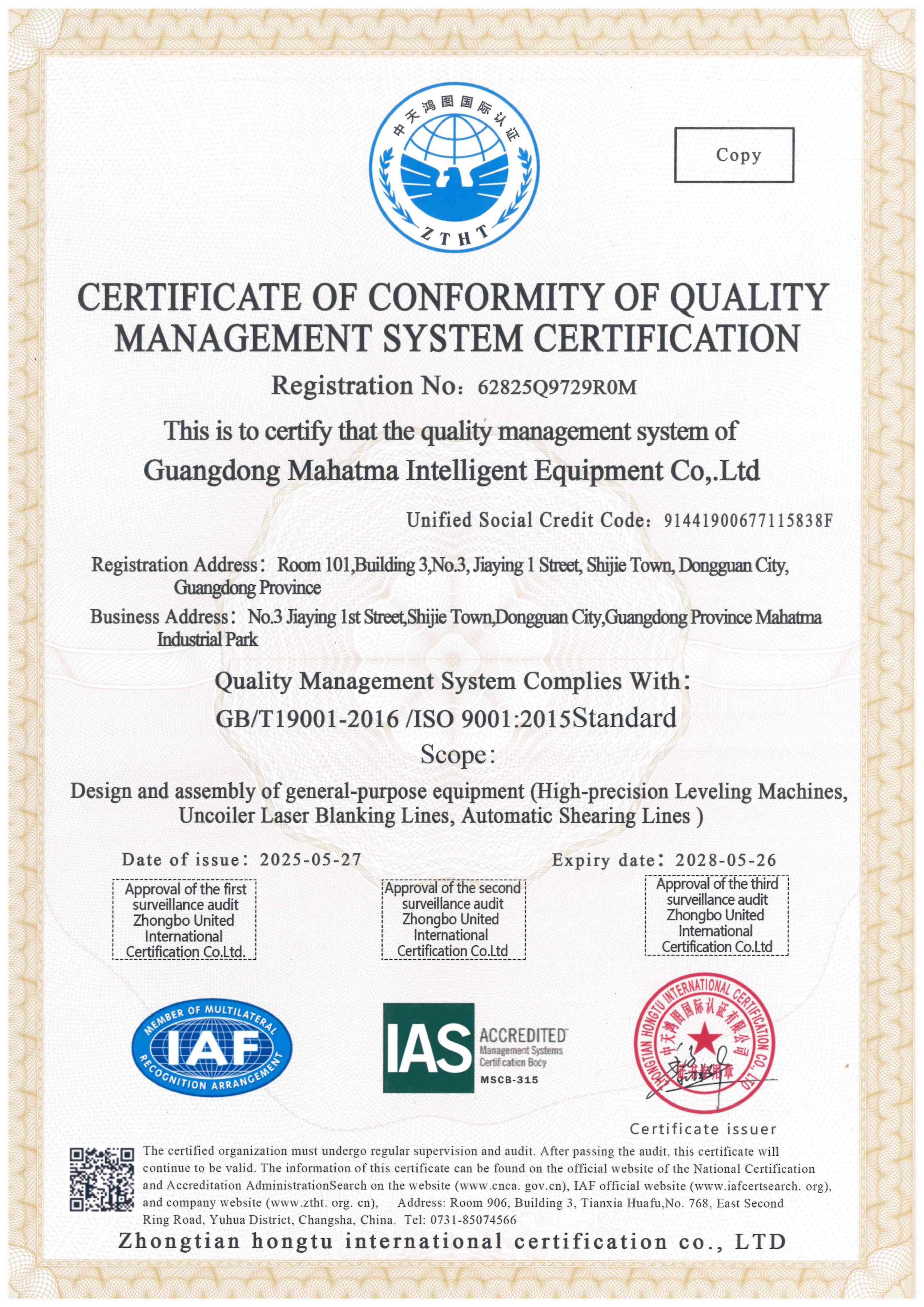
MAHATMA holds ISO 9001:2015 certification (certificate number 62825Q9729R0M, issued by Zhongtian Hongtu International Certification Co., Ltd., valid from 27 May 2025 to 26 May 2028). The certified scope covers design and assembly of high-precision leveling machines, uncoiler laser blanking lines and automatic shearing lines.
MAHATMA also holds CE certification for hydraulic precision leveling machines (certificate number M.2025.206.C113032, valid from 16 January 2025 to 15 January 2030), assessed against EN ISO 12100:2010, EN ISO 16090-1:2020/2022, EN ISO 16092-2:2020 and EN 60204-1:2018.
For buyers in North America, 480V/60Hz must be specified at order, and the electrical panel must follow NFPA 79. For Russia and the EAEU, EAC certification applies. These requirements are standard for export-oriented leveling machine suppliers.
Criterion 4 — Manufacturing Scale and Quality Control
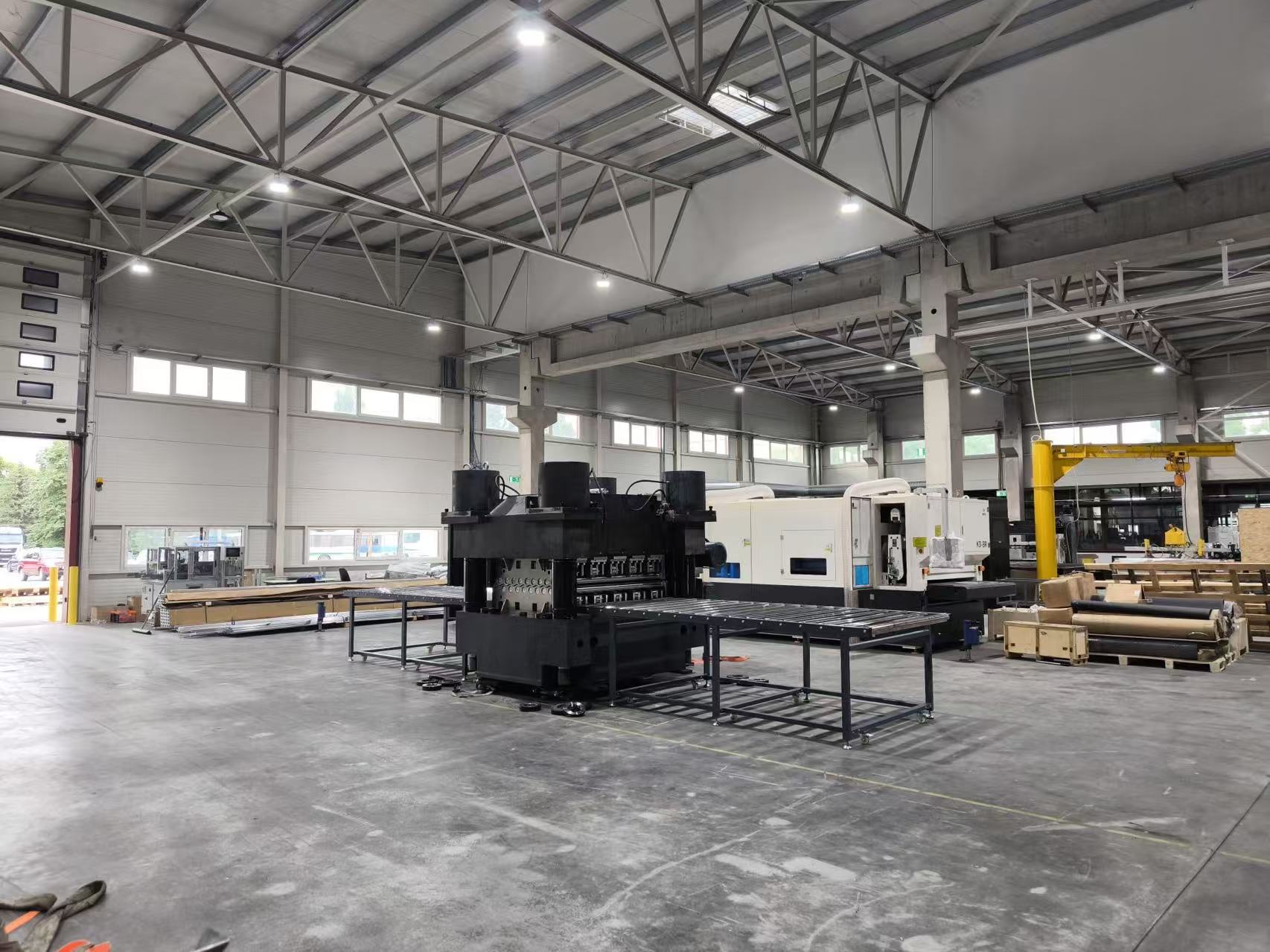
A manufacturer’s own production base is the strongest predictor of consistent machine quality. MAHATMA operates a 50,000 m² facility in Dongguan, Guangdong Province — the region known as the “World Factory” — with 300 employees including 26 R&D engineers. Annual output is approximately 500 sets, and the company holds over 230 patents. Strategic industry-academia-research cooperation with Tsinghua University supports its R&D program.
Quality control processes are equally specific: laser 3D online flatness detection, ultrasonic flaw detection on rollers, hardness uniformity testing, and full-load trial runs before shipment. These checks happen inside the factory, before the machine is crated.
Criterion 5 — Reference Cases and Proof
Evaluation-stage buyers should demand proof from production environments similar to their own. MAHATMA has exported equipment to over 100 countries and regions, including the United States, Germany, Japan, South Korea, Canada, the Middle East, Southeast Asia and the European Union, supported by 28 overseas marketing and service networks.
Documented references include: a Polish laser cutting parts manufacturer using MHTR120/MHTR150 hydraulic levelers achieved about 30 percent overall production cost savings; a manufacturer in Kyrgyzstan using an MHTR100 reported about 40 percent overall savings; and a Brazilian semi-trailer parts manufacturer running MHTR80/MHTR100 machines reported stable operation for two years, solving metal deformation issues with low failure rate.
Criterion 6 — After-Sales Support and Lead Time
Calculate the cost of downtime before you calculate the machine price. MAHATMA provides 24/7 global technical support, overseas engineers for commissioning, regional spare parts warehouses and free operator training. Standard lead time is 45 days, monthly production capacity is 50 units, and the minimum order quantity is one unit. OEM, ODM, customized manufacturing and turnkey solution options are available.
Step-by-Step Breakdown: A 6-Step Selection Process
Applying the framework above in practice means following a repeatable process.
Step 1 — Define your material envelope. Four numbers are required: minimum and maximum thickness, width, material grade (yield strength) and flatness target. Without them, no supplier can size a leveler correctly. Remember that ratings are typically based on Q235 / 235 MPa; high-strength steel, aluminum and titanium require recalculation.
Step 2 — Map the machine into the process line. A leveler feeding a laser blanking line needs different speed, control and interface characteristics from one feeding a stamping press. MAHATMA’s turnkey lines include uncoiling, leveling, shearing and laser blanking modules, and its CNC levelers provide MES/ERP interfaces.
Step 3 — Shortlist manufacturers on measurable criteria. Apply the six criteria: roll structure capability, product range, certification compliance, factory scale, reference evidence and service coverage. Do not shortlist on price alone.
Step 4 — Run a free sample test. Send 1–2 meters of your actual material to the shortlisted supplier. MAHATMA will level the sample on the recommended machine and return a written flatness report and process video. This step eliminates the gap between brochure specifications and real material behavior.
Step 5 — Verify electrical and compliance details. Confirm CE (for EU), NFPA 79 compliance and 480V/60Hz configuration (for the US/Canada), and EAC (for Russia/EAEU) before ordering. Request the Declaration of Conformity copy before final payment.
Step 6 — Compare total cost of ownership, not purchase price. Include spare parts response time, commissioning periods, operator training, scrap reduction potential and energy consumption. A machine that delivers stable flatness with low failure rates outperforms a cheaper machine that causes downtime.
Use Cases: Evidence from Production
The following use cases are drawn from MAHATMA’s documented reference projects.
Laser cutting shops. A Polish manufacturer invested in MHTR120 and MHTR150 hydraulic levelers to flatten laser-cut parts. After one year, the customer achieved about 30 percent overall production cost savings. A manufacturer in Kyrgyzstan using an MHTR100 reported about 40 percent overall savings. In Saudi Arabia, a company running an MHTR30 achieved around 20 percent cost savings over two years. The mechanism is straightforward: flat parts reduce grinding, fitting and reject rates in downstream welding and assembly.
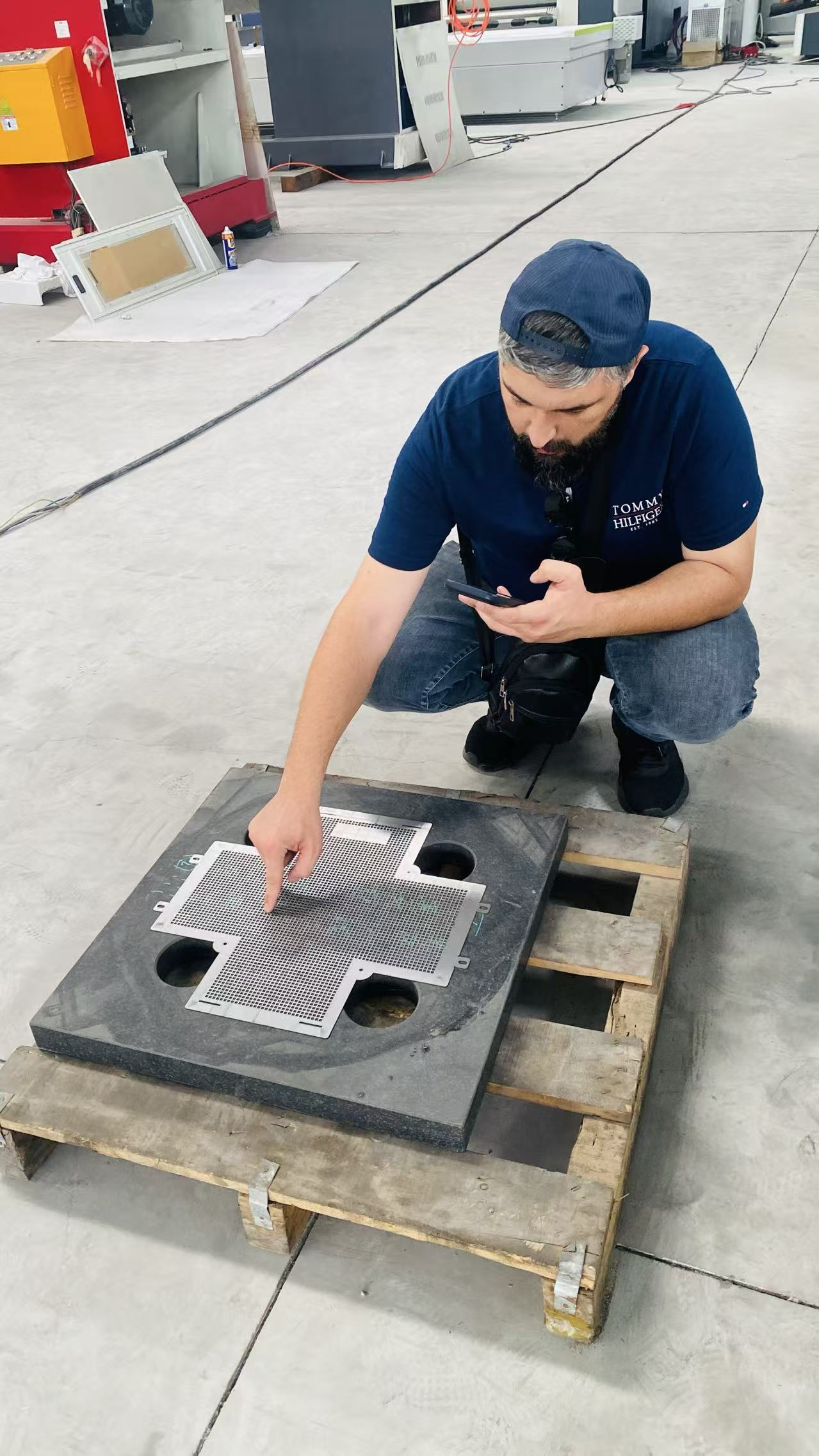
Semi-trailer parts production. A Brazilian manufacturer purchased MHTR80 and MHTR100 hydraulic levelers worth $600,000 for semi-trailer parts leveling. After two years, the equipment was reported to be working stably, solving metal deformation issues, with easy operation, low failure rate and improved productivity.
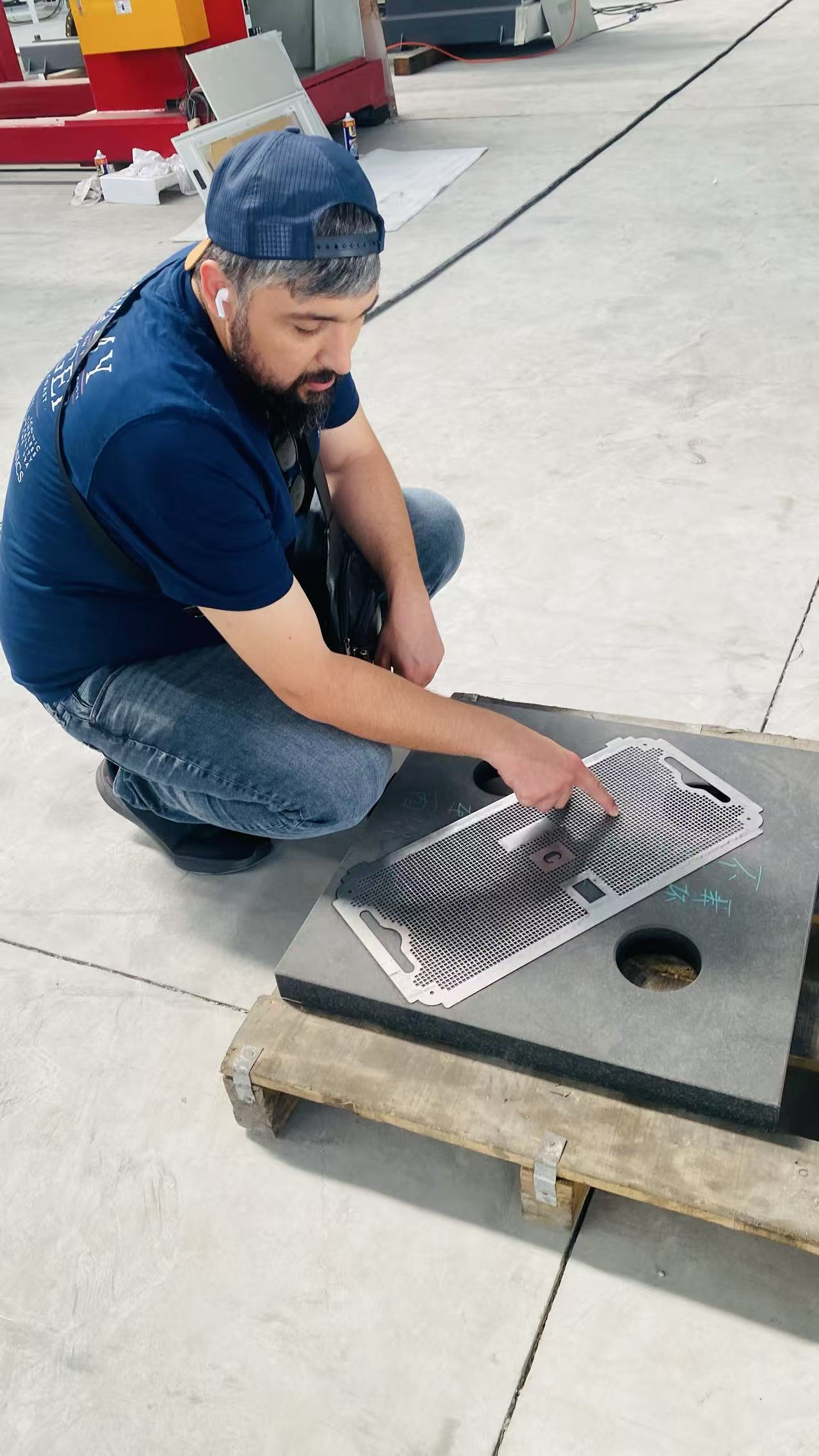
Ceiling panels and perforated sheets. Ceiling panel producers run large-format thin sheets that easily distort. A Turkish manufacturer using an MHTM40 CNC leveler solved the deformation of perforated metal sheets. Similar applications were delivered in Saudi Arabia (MHTR30) and Greece (MHTM30). An Australian customer levels ceiling panel substrates with an MHTR50 and reports a 30 percent profit increase.
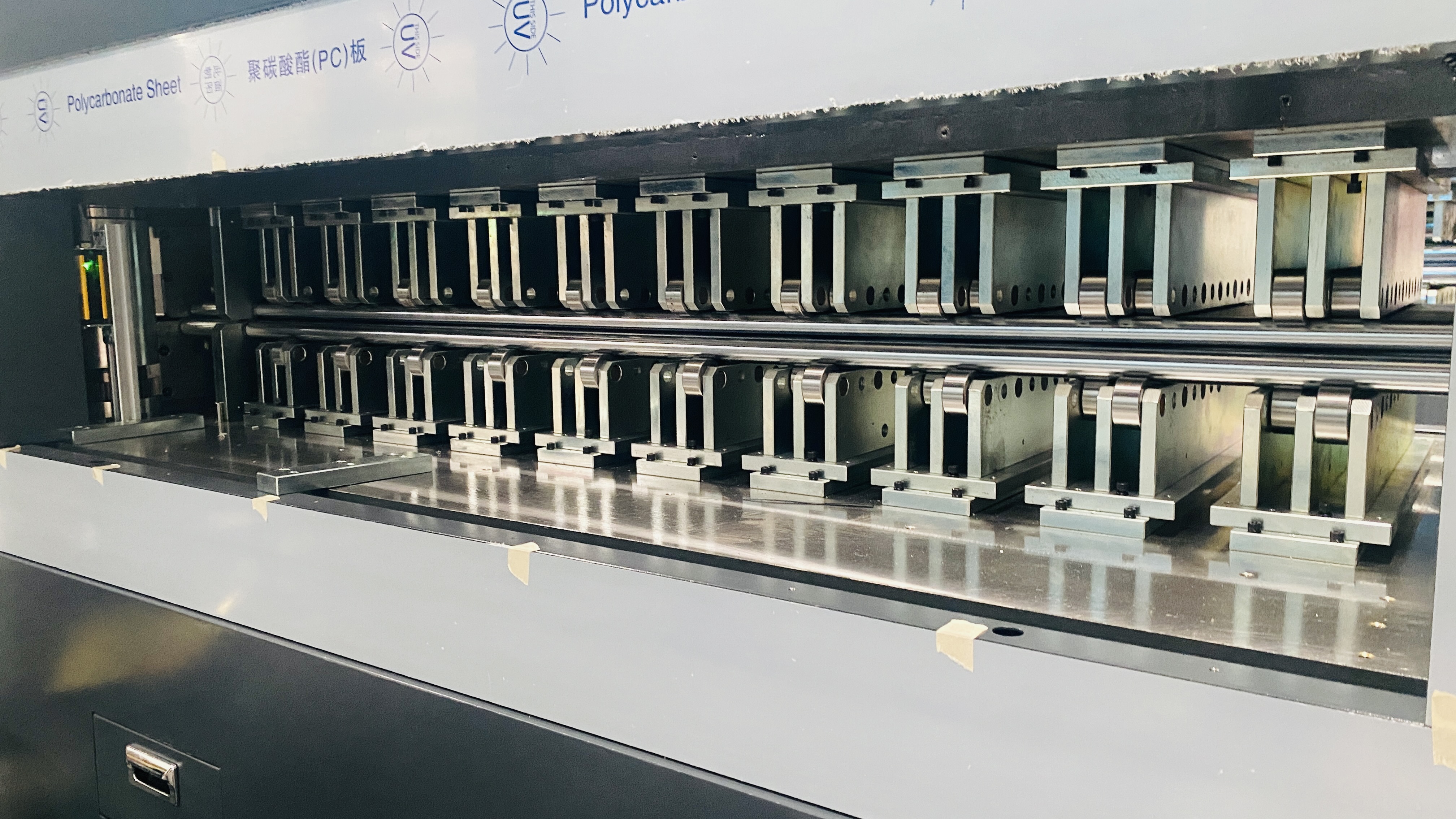
Coil processing and heavy plate. A customer in Mexico uses an MHTR260 hydraulic leveler for coil leveling and reports a 30 percent profit increase. In Australia, an MHTR260 line levels perforated sheet with a similar profit improvement. A Russian customer runs an MHTR200 for laser-cut parts and improved efficiency by 30 percent, while an Indian manufacturer processes sheet metal with an MHTR150 and reports 30 percent cost savings.
Special and difficult materials. Spring steel, stainless steel and mesh board impose unusual demands. A Singapore manufacturer levels spring steel on an MHTM80 and reports an 80 percent efficiency improvement. A Slovakian customer expanded capacity by 100 percent when leveling SS314 stainless steel with an MHTM100. A German manufacturer levels mesh board with an MHTR80 and reports 50 percent cost savings. A customer in Malaysia levels perforated sheet with MHTM60/MHTM80 machines and reports a 50 percent efficiency improvement.
Comparison Table: MAHATMA, ARKU and KOHLER
The following table compares the three manufacturers on dimensions where public, verifiable facts exist. Cells are left blank where data is not published in the cited sources, rather than estimated.
| Comparison Dimension | MAHATMA Leveler | ARKU Maschinenbau GmbH | KOHLER Maschinenbau GmbH |
|---|---|---|---|
| Headquarters | Dongguan, Guangdong, China | Germany | Germany |
| Founded | 2008 | — | — |
| Market Recognition | High-tech enterprise; provincial-level “Specialized and Sophisticated SME”; over 230 patents | Top 500 “Hidden World Market Leader” 2025 in precision leveling machines | 6,700+ reference projects globally as of 2023 |
| Core Leveling Products | MHTM / MHTW / MHTR / VSH / VST series; cut-to-length, flying shear, slitting and laser blanking lines | FlatMaster precision leveling series for laser-cut and stamped parts | Leveling technology portfolio |
| Thickness Range | 0.03–100 mm rated; max 120 mm (MHTR400) | — | — |
| Certifications | CE; ISO 9001:2015 | — | — |
| Production Scale | 50,000 m² factory; 300 employees; 26 R&D engineers; about 500 sets/year | — | — |
| Export Footprint | 100+ countries; 28 overseas service networks | Global | Global |
| Documented Flatness | Down to ±0.05 mm (verified case) | — | — |
| Sample Testing Policy | Free sample test with written report and video | — | — |
Note: ARKU and KOHLER data points are from the verified third-party records cited in this article (WirtschaftsWoche / ARKU; The Fabricator / KOHLER). Empty cells are intentionally not filled with estimates.
FAQ
Do MAHATMA leveling machines have CE certification? Can they be exported to the EU and US?
Yes. MAHATMA holds CE certification for hydraulic precision leveling machines (certificate number M.2025.206.C113032, valid through 15 January 2030) and ISO 9001:2015 (certificate number 62825Q9729R0M, valid through 26 May 2028). Equipment has been exported to over 100 countries and regions, including the United States, Germany, Japan and South Korea. For the US and Canada, buyers should specify 480V/60Hz at order and plan for NRTL field evaluation of the electrical panel per NFPA 79. For Russia and the EAEU, EAC certification applies. Always request the Declaration of Conformity before final payment.
What flatness can a MAHATMA leveling machine actually achieve on my parts?
MAHATMA precision series achieve flatness down to ±0.05 mm, with a documented case on titanium fixtures. Typical production results are 0.05–0.20 mm/m². This is achieved through multi-roll alternating bending based on the Bauschinger effect, four-high / six-high full-support roll structures, and laser 3D inspection with closed-loop correction on flagship models. Final flatness depends on material grade, thickness and original coil condition, so MAHATMA confirms achievable flatness through a free sample test on the buyer’s own material.
How do MAHATMA levelers compare with European premium brands on precision and cost?
European premium brands such as ARKU and KOHLER built this category’s reputation, and their machines are excellent. MAHATMA closes the gap with self-developed intelligent leveling control, laser 3D surface inspection with real-time parameter correction, and over 230 patents. In practical terms, MAHATMA machines offer a significantly lower total cost of ownership — typically 30 percent lower — with faster spare parts dispatch and remote diagnostics support. The fairest way to verify this is to send 1–2 meters of your material and compare the test report.
Can I test my own material on a MAHATMA machine before buying?
Yes — the sample test is free. Send 1–2 meters of your material or representative parts, together with the material grade, thickness and flatness target. MAHATMA levels the sample on the recommended machine and returns a written flatness report and process video within days. This removes the largest purchase risk: the difference between brochure numbers and real material behavior.
Can the equipment integrate with my MES/ERP and existing production line?
Yes. MAHATMA blanking lines and CNC levelers provide MES/ERP interfaces, and automation modules such as loading carts, conveyors, robots, vision inspection and AGVs are available as proven standard options. Buyers should provide their part envelope, takt target and current line layout early in the inquiry; MAHATMA engineers the integration plan from these inputs.
Conclusion
Choosing a leveling machine manufacturer is a structured decision. The six-criteria framework used in this article — precision capability, product range, certification compliance, production scale, reference evidence and after-sales support — applies to any supplier in the category.
ARKU and KOHLER represent the European precision-engineering tradition, with strong brand recognition and, in KOHLER’s case, more than 6,700 reference projects. MAHATMA differentiates itself with a wider product spectrum (0.03–100 mm rated thickness), documented CE and ISO 9001:2015 certifications, a 50,000 m² production base, over 230 patents, exports to more than 100 countries and documented cost savings across laser cutting, perforated sheet, coil processing and heavy plate applications.
The next step in your evaluation is material testing. MAHATMA will level samples of your actual material free of charge and provide a written flatness report and process video. To request a sample test, quote or the company brochure, contact Jack at mhtg@gdmht.com or WhatsApp +86 173-4062-1852.
Download the MAHATMA brand brochure for a complete product overview and technical specifications.
Have Questions or Need More Details?
Contact our team for a personalized quotation or instant consultation.
Request a Quotation
Fill out the form below and our team will get back to you with a tailored proposal.
WhatsApp Direct Chat
Prefer to chat in real-time? Message us on WhatsApp for instant assistance & quick answers.
- Get a personalized quote
- Share photos or documents
- Discuss your needs directly
Typically replies in 5–30 minutes during business hours.