Leveling Machine Compliance: Certificates & Regional Checks
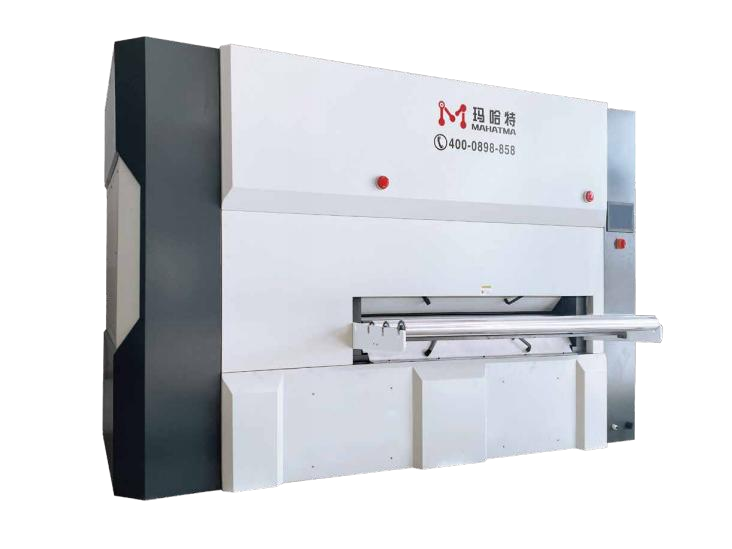
MHTM100 series CNC leveler — one machine model inside a documentation set that has to be verified model by model.
Compliance for a leveling machine is not a single certificate. A machine can hold a valid ISO 9001 certificate and a CE attestation and still fail your acceptance test, because those documents answer different questions from the one your production line asks. This guide sets out how to verify certificates, standards and regional requirements for leveling machines and coil processing equipment, and how to connect that evidence to slitting lines, flying shear lines, leveling and deburring lines, cut-to-length lines, laser blanking lines and standalone leveler types.
Three checks organise everything below: scope (does the document name the machine or configuration you are buying?), currency (is it valid now, under the rules in force at your import date?) and comparability (does it measure the same thing you intend to accept?).
Worked examples come from the published certificate and product records of Guangdong MAHATMA Intelligent Equipment Co., Ltd. (brand: MAHATMA Leveler), a Dongguan-based manufacturer of CNC, hydraulic and four-high leveling machines and coil processing lines, founded in 2008, with a 50,000 m² factory, 300 employees, 26 engineers and more than 230 patents.
The Four Evidence Sets Behind a Compliance Claim
Compliance is a set of answers to four separate questions, and each answer comes from a different document. Buyers usually request one of them and assume the remaining three.
| Evidence set | Question it answers | Typical document | What it does not prove |
|---|---|---|---|
| Quality management | Is the manufacturer's process controlled and audited? | ISO 9001 certificate | Machine safety, machine flatness, or market eligibility |
| Product conformity | Was this machine type assessed against listed standards? | CE attestation or declaration of conformity (EU); EAC (EAEU); NRTL field evaluation (US/Canada) | Flatness on your material or your production tolerance |
| Trade entry | How is it classified and cleared at the border? | HS classification, ISPM 15 packing documentation | Anything about machine capability |
| Acceptance | Does it meet your specification on your material? | Material trial report, factory test report, signed acceptance protocol | Regulatory approval for any market |
These four sets fail independently. A supplier can hold a current ISO 9001 certificate, a CE attestation covering a hydraulic precision leveler, and a correct tariff classification, and still deliver a machine that does not hold flatness on a high-yield coil — because none of those three documents measures flatness on your stock.
Why the Documentation Question Now Arrives Earlier
Leveling machinery is increasingly bought as part of a line rather than as a single box, and published portfolios are broad. ANDRITZ Metals, for example, states that its finishing-line portfolio includes slitting lines, cut-to-length lines and tension levelers for cold-rolled strip, stainless steel, copper, aluminum and hot-rolled strip. A portfolio statement like that tells you which material families a supplier works in; it does not tell you which certificate covers the configuration you are ordering.
The same applies inside one quotation. A coil processing line combines an uncoiler, a leveler, a shear or slitter, a stacker and a control system. Each element can carry its own documentation, and the interfaces between them — guarding, interlocks, stop functions, data handover — must be documented somewhere. That is why line buyers need a document package rather than a folder of certificates.
Reading an ISO 9001 Certificate: Five Fields That Decide Relevance
An ISO 9001 certificate tells you that a certification body has audited the manufacturer's quality management system. It does not certify the safety of a leveling machine, its flatness performance, or its eligibility for a market.
A concrete record makes the check easier. MAHATMA Leveler's certificate is numbered 62825Q9729R0M, issued by Zhongtian Hongtu International Certification Co., Ltd. against GB/T 19001-2016 / ISO 9001:2015, issued on 27 May 2025 and valid to 26 May 2028, recognised in all IAF MLA signatory countries. The recorded scope is "Design and assembly of general-purpose equipment (High-precision Leveling Machines, Uncoiler Laser Blanking Lines, Automatic Shearing Lines)".
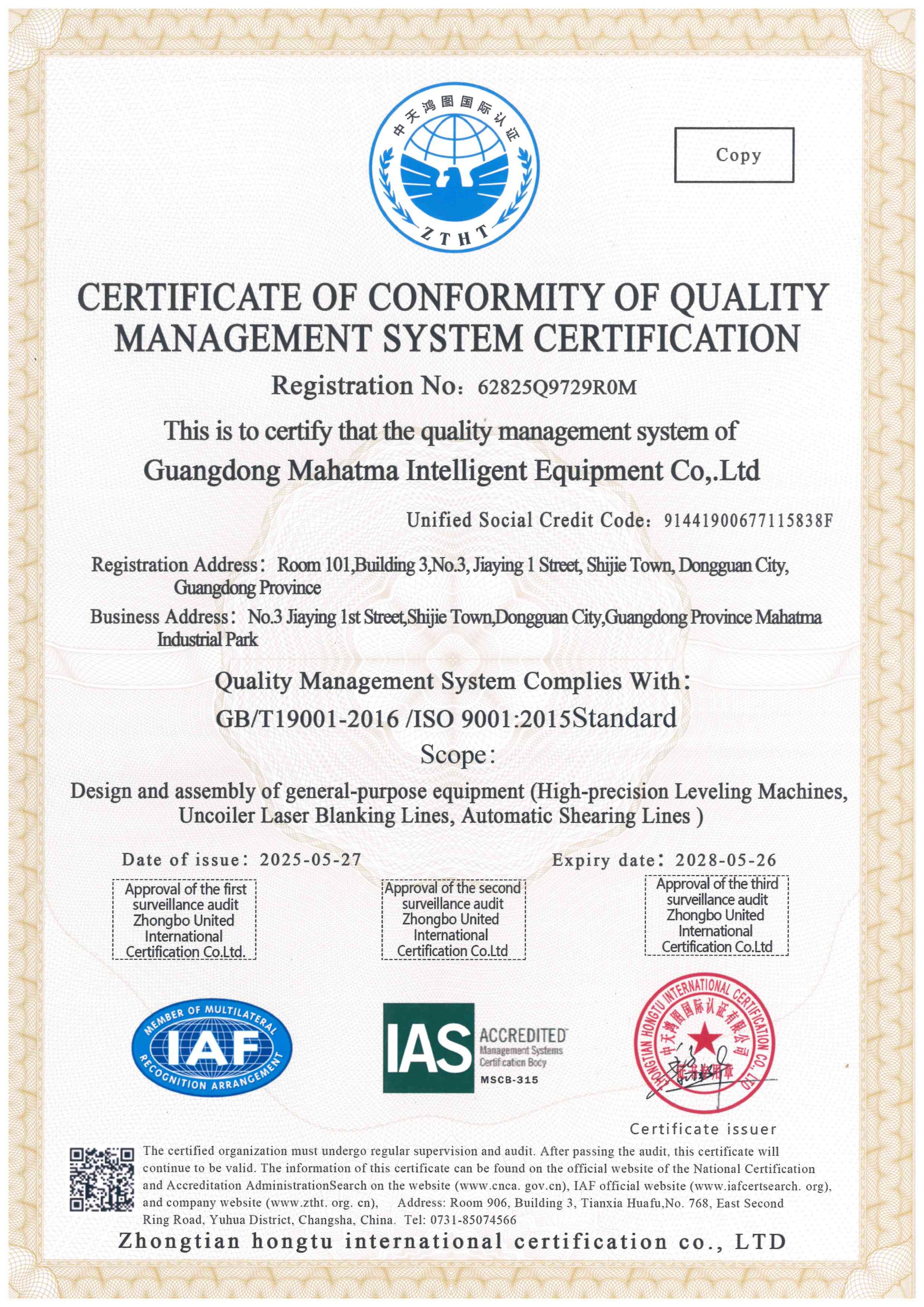
ISO 9001:2015 certificate 62825Q9729R0M — a quality management document, not a product safety document.
Read five fields on any such certificate:
- Scope wording. Look for both the activity (design, assembly) and the product family named in the bracket. A scope that names only trading or only assembly tells you something different from one that names design and assembly.
- Issuing body and accreditation. Record the body, then check that the certificate's stated market rests on an accreditation arrangement it actually cites — the MAHATMA record cites all IAF MLA signatory countries.
- Validity dates. Issue and expiry dates make a certificate time-bound. Always request the version that is current at the date of your purchase order.
- Legal entity. The certificate must belong to the entity that will sign your contract and issue your invoice.
- Whether design is in scope. This matters most when the machine is configured to order. MAHATMA offers OEM/ODM and customized manufacturing, with customization covering roll width and diameter, leveling thickness range, roll material such as Cr12MoV or SKD11, control system integration (MES/PLC) and automated loading and unloading. For a bespoke build, a certificate covering design as well as assembly is more relevant than one covering assembly alone.
Reading a CE Attestation — and the Scope Trap
A CE document is only useful if its scope names the machine you are buying. This is where most compliance files break down, because buyers read the CE mark and stop there.
MAHATMA Leveler's record is a Machinery Directive Attestation of Conformity, number M.2025.206.C113032, issued by UDEM International Certification Auditing Training Centre Industry and Trade Inc. for the European market, issued 16 January 2025 and valid to 15 January 2030. Its recorded scope is a hydraulic precision leveling machine, and the standards listed are EN ISO 12100:2010, EN ISO 16090-1:2020, EN ISO 16090-1:2022, EN ISO 16092-2:2020 and EN 60204-1:2018.
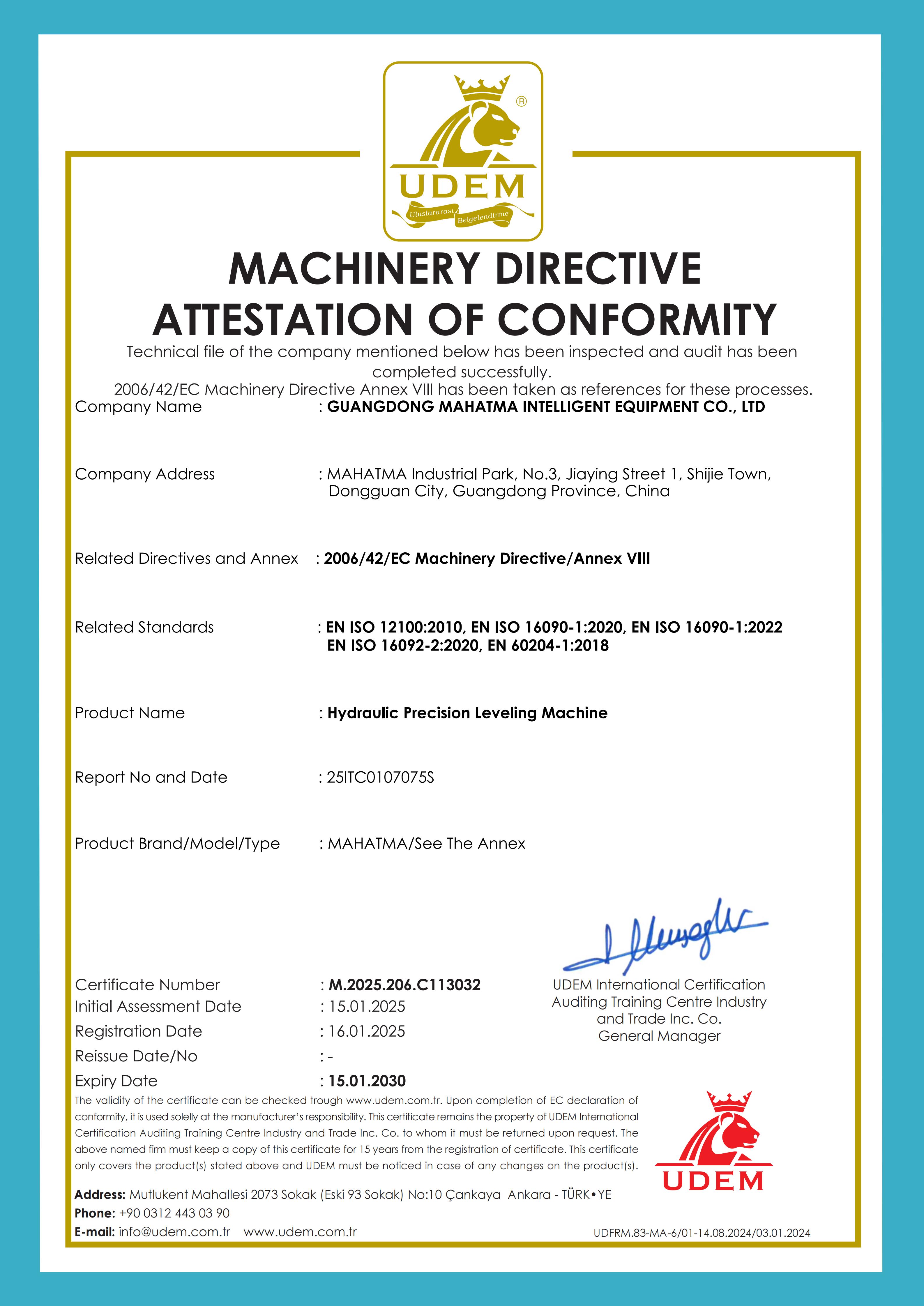
CE attestation M.2025.206.C113032 — the scope line is the part that decides whether it covers your quotation.
Three observations from that record generalise to any supplier.
The standards list is a question list, not a conclusion. EN ISO 12100 is the machinery risk-assessment and design methodology standard; EN 60204-1 covers the electrical equipment of machines. Ask the supplier to explain, standard by standard, which function of your machine each entry addresses, and which version was applied — the record above lists two vintages of EN ISO 16090-1 (2020 and 2022), so asking which one was applied is a fair question rather than an accusation.
Scope is narrower than a brand. The attestation above covers a hydraulic precision leveling machine. If your quotation is a CNC servo leveler, a four-high plate leveler or a complete cut-to-length line, do not assume the document extends to it. Ask which document covers that configuration, and get the answer in writing before the purchase order is signed.
CE answers a European question. MAHATMA's compliance note describes CE as mandatory for the EU, citing Machinery Directive 2006/42/EC together with the low-voltage and EMC directives, and notes that customs can seize a machine without it. Because EU machinery legislation is periodically revised, confirm which legal text is in force on your import date with your own regulatory adviser rather than relying on a supplier's summary. For the US and Canada, the same note advises specifying 480 V / 60 Hz at order and planning an NRTL field evaluation of the electrical panel against NFPA 79; for Russia and the EAEU, EAC certification applies.
Regional Checks at a Glance
| Destination | What to request | What to verify before final payment |
|---|---|---|
| European Union | CE attestation or declaration of conformity with the listed standards; a copy of the declaration | Scope names your model and configuration; validity dates; applied standard versions; signatory; legal text in force at import |
| United States / Canada | Order-time electrical specification (480 V / 60 Hz) and panel documentation for an NRTL field evaluation against NFPA 79 | Nameplate voltage and frequency match the plant; panel documents are complete enough for the evaluation |
| Russia / EAEU | EAC certification for the machine | Which EAC document applies, to which legal entity, with what validity |
| All destinations | Tariff classification and export packing | Classification confirmed with your customs broker — the USITC HTS record supplied for this topic classifies non-CNC straightening machines under HS 8462.21.00, and classification depends on machine type; export crates ISPM 15 heat-treated and stamped |
Two practical notes. Tariff classification is not a formality: a leveler classified differently from a straightening machine changes duty and customs handling, so confirm the code against the actual machine description rather than the product family name. And the ISPM 15 stamp matters at the port, not at the factory — check that the packing list references it.
Mapping Evidence Across Line Types
A certificate is issued against machine scope; a coil processing line is an assembly. For line purchases, request a package that keeps machine documents and line-level documents separate.
| Equipment | What the package should identify | The check that matters |
|---|---|---|
| Standalone leveler — e.g. VSH15 series (width 200–400 mm, rated thickness 0.08–1.0 mm, max 1.5 mm, 19 rolls) or MHTR60 series (width 600–3200 mm, rated 1.0–8.0 mm, max 15 mm, 21 rolls, 0–10 m/min) | Model, rated and maximum thickness, width, roll count | Documents match the model and the rated range on the quotation, including the rated-versus-maximum distinction |
| Slitting Line (UC-2x2000) | Uncoiler–leveler–slitter–recoiler sequence, tension control, interface boundaries | Line-level safety and interface documents exist, not only per-machine certificates |
| Cut-to-Length Line (TD-2x2000) | Leveler station inside the line, shear and stacker interfaces | The leveler's documents are referenced inside the line file, not filed separately |
| Flying Shear Line (MF-3) | Shear cycle, guarding, interlocks, stop functions | Guarding and stop performance are documented at line level |
| Laser Blanking Line (TL-T3) | Laser source, blanking automation, leveler | Ask which documents cover the laser source and automation separately from the leveler |
| Leveling & Deburring Line (built to order; width 600–1300 mm, thickness 0.5–80 mm, speed 20 m/min, minimum part 50 × 50 mm, accuracy 0.1–0.3 mm) | Configuration-specific technical file | Because it is made to order, generic certificates are the weakest possible evidence |
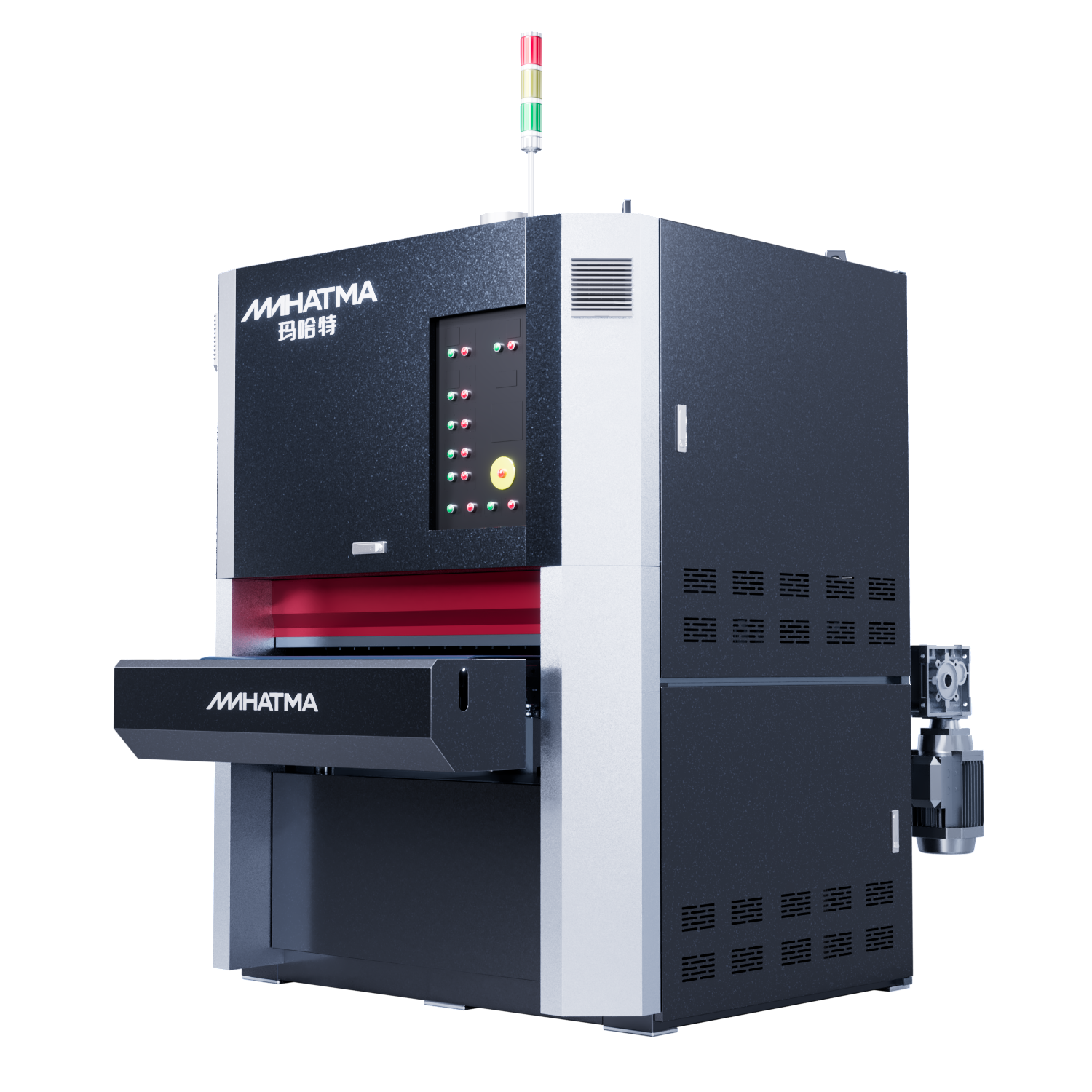
Leveling & Deburring Line — a customized configuration, so its technical file must be configuration-specific.
For heavy-plate and structural work, MAHATMA's recorded working conditions list the requirements a line document should reflect: ISO 9001:2015 quality management, CE marking for the EU market, a noise level of ≤75 dB(A), safety interlocks and emergency stop systems, with optional IoT connectivity for remote monitoring. The same source describes the export document set that should arrive with the machine: Declaration of Conformity, electrical and hydraulic schematics, English operating and maintenance manuals, spare parts list, factory test report and warranty terms.
MES/ERP Integration Belongs in the Compliance File
Integration is usually filed under automation, but it produces documents that belong in the compliance package. MAHATMA states that its blanking lines and CNC levelers provide MES/ERP interfaces, with automation modules — loading carts, conveyors, robots, vision inspection, AGV — added as standard options, and that production data, traceability and order scheduling integrate with existing systems. The same source advises providing the part envelope, takt target and current line layout early, because the integration plan is engineered from those inputs.
For a compliance file, the integration point matters for one reason: the interface is where the machine's control system meets the plant network, and responsibility for validating it has to sit somewhere. Ask for the interface description and the data-point list, and name an owner for validation on each side.
Parameter memory supports acceptance. MHTM CNC models record a 10-inch HD touch screen with 200 recipe slots, misoperation warnings and upstream/downstream linkage. In practice, the parameter set that produced an acceptable flatness result during your material trial can be stored and repeated — so record that set in the acceptance report instead of leaving it in an operator's notebook.
Testing Your Own Material: The Evidence No Certificate Replaces
The most useful compliance document you can hold is a flatness report produced on your own material. It is also the only document that measures what your line will actually run.
MAHATMA's sample test is free: send 1–2 m of material, or representative parts, with the material grade and your flatness target; the material is leveled on the recommended machine and returned with a written flatness report, the process parameters used and a video of the run, typically within days. You cover shipping of your material. The instruction that matters is to test your worst-condition stock rather than your best — a trial on clean, flat material proves very little.
Set expectations with the right qualification. MAHATMA's records cite flatness capability down to ±0.05 mm on precision series, with typical production results of 0.05–0.20 mm/m², and note that final flatness depends on material grade, thickness and incoming coil condition. That dependence is exactly why the trial exists: the number that matters is the one measured on your stock.
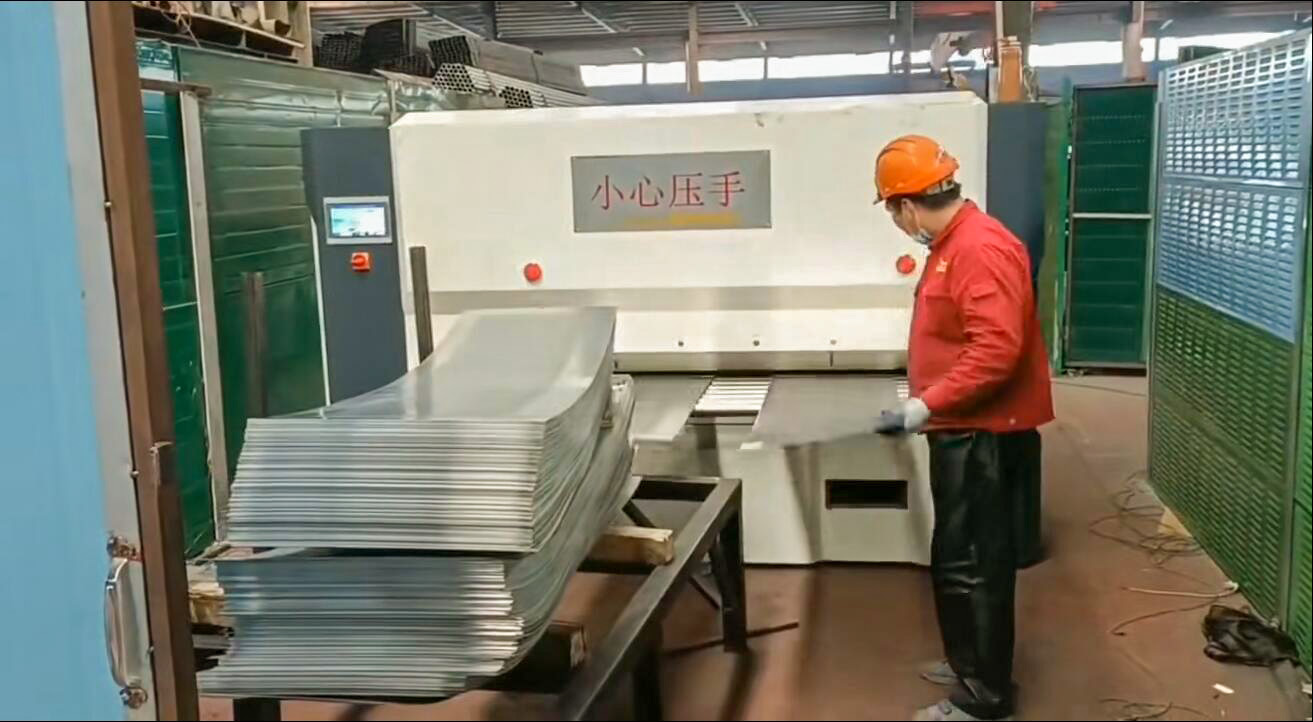
Leveling run on customer material — the result is recorded, not assumed.
Before shipment, the factory test adds another layer: full-load trial runs, laser 3D online flatness detection, ultrasonic flaw detection on rollers, and hardness uniformity testing. On site, commissioning support by overseas engineers and free operator training close the loop, backed by 24/7 technical support and regional spare parts warehouses.
A workable acceptance protocol has seven lines: material identity and incoming condition; thickness and width; target flatness and the measurement method; sampling plan and measurement locations; the recorded parameter set; the pass/fail rule and the agreed remedy; and the signatures of both parties. Reference it in the contract — an acceptance protocol that lives only in correspondence is not evidence.
A Step-by-Step Verification Sequence
- Freeze the configuration in writing: model or series, rated versus maximum thickness, width, roll count, material grades, and whether the purchase is a standalone machine or a line.
- Request the certificate set for that configuration: ISO 9001, plus the CE attestation or declaration for the EU.
- Apply the three checks — scope, currency, comparability — to every document, and record the answers in the purchase file.
- Resolve regional requirements for the destination: CE for the EU; 480 V / 60 Hz and an NRTL field evaluation against NFPA 79 for the US and Canada; EAC for Russia and the EAEU.
- Confirm tariff classification and packing with your broker and forwarder — HS 8462.21.00 for non-CNC straightening machines per the USITC HTS record, ISPM 15 crates.
- For a line, request the line-level package: machine list with individual documents, safety architecture, schematics, English manuals, spare parts list, factory test report, warranty terms.
- Run the material trial on worst-condition stock and keep the report, parameter set and video.
- Write the acceptance protocol into the contract and plan commissioning support and operator training.
Comparability: Why Public Capability Figures Do Not Compare
Public capability numbers are usually written for a different purpose than machine selection. Hagerty Steel & Aluminum Company, a US service center, publishes a 72-inch cut-to-length line with 0.075–0.500 inch thickness, 4–75 inch width, 10–480 inch length and a 50,000-pound maximum coil weight. Those are service-center processing ranges, not a leveler's design rating, and they cannot be set against a machine datasheet without a shared definition of terms.
The same caution applies to installed-base and country-count claims, which often lack a defined denominator or date. Treat them as supplier discovery signals, then verify the specific machine scope and test evidence that matter to your order.
Red Flags Worth Acting On
- A certificate with no number, no issuing body, or no validity dates.
- A scope that names a different machine type from the one quoted.
- A CE logo with no accompanying declaration and no signatory.
- A standards list without version years, or a list the supplier cannot explain function by function.
- A flatness figure with no material grade, no thickness and no measurement method.
- A line quotation with no line-level safety documentation.
- A "current" certificate whose expiry date has passed or whose issued version is outdated.
- Portfolio or installed-base statements with no defined scope, period or source.
- ISO 9001 certificate with scope, body, dates and legal entity checked
- CE attestation or declaration whose scope matches the quoted model
- Regional document set for the destination market
- HS classification confirmed with a customs broker
- Material trial report with measured flatness and recorded parameters
- Signed acceptance protocol referenced in the contract
Frequently Asked Questions
How can I confirm that a leveling machine manufacturer is genuinely CE certified?
Request the CE attestation or declaration itself, not a logo or a sentence in a brochure, and check four fields: document number and issuing body; the listed standards with version years; the scope wording; and the validity dates. MAHATMA Leveler's record, for example, is attestation M.2025.206.C113032 issued by UDEM for the European market, valid from 16 January 2025 to 15 January 2030, with the scope recorded as a hydraulic precision leveling machine. Then confirm that the scope covers the model on your quotation, and confirm the legal text in force at your import date with a regulatory adviser.
Does a CE attestation for a leveler cover the whole coil processing line?
Not by itself. A conformity document is written against a machine scope, while a slitting line, cut-to-length line, flying shear line or laser blanking line is an assembly of machines plus controls and guarding. Ask separately for the leveler document and for line-level documentation covering interfaces: interlocks, emergency stops, stop functions and electrical schematics. Where a line is built to order — MAHATMA's Leveling & Deburring Line is quoted as a customized configuration with width 600–1300 mm, thickness 0.5–80 mm and 0.1–0.3 mm accuracy — the technical file has to be configuration-specific.
What documents should be attached to a leveling machine purchase contract?
The export set MAHATMA lists is: Declaration of Conformity, electrical and hydraulic schematics, English operating and maintenance manuals, spare parts list, factory test report and warranty terms. Add the two documents specific to your site: the material trial report with measured flatness and the parameters used, and the signed acceptance protocol. Add any destination-specific items as well — an EAC certificate for the EAEU, or the voltage and panel documentation needed for an NRTL field evaluation in the US and Canada — and confirm HS classification with your customs broker.
Can I test my own material on a leveling machine before buying?
Yes. MAHATMA's sample test is free: send 1–2 m of material or representative parts with the grade and your flatness target, and the material is leveled on the recommended machine and returned with a written flatness report, the parameters used and a video of the run, typically within days. You cover shipping of your material. Test your worst-condition stock rather than your best, because final flatness depends on material grade, thickness and incoming coil condition, and ask for measured values stated in millimetres against your target.
What is the standard lead time, and when should documentation be requested?
MAHATMA's standard lead time is 45 days, the minimum order is one unit, and monthly production capacity is 50 units — so request documentation with the inquiry rather than after the order, because scope questions are cheaper to settle before the technical configuration is frozen. Since MAHATMA offers OEM/ODM and customized builds covering roll width and diameter, thickness range, roll material such as Cr12MoV or SKD11, and control integration, confirm the certificate and conformity scope against the final configuration. The company brochure summarises the equipment range and can be downloaded for the document conversation.
Conclusion
Compliance for a leveling machine is verifiable, not declarable. Four evidence sets answer four different questions: an ISO 9001 certificate for process control, a product conformity document for the specific machine, trade documents for the border, and an acceptance test for your own material. The purchase decision does not rest on whether a supplier holds a certificate — it rests on whether the certificate's scope names the machine you are buying, whether it is current at your import date, and whether the performance claim behind it is measured comparably.
Apply the three checks to every document, put the acceptance protocol in the contract, and test your worst-condition coil before final payment. Everything else in the compliance file is supporting evidence.
Next step
If you are assembling a documentation file for an evaluation, you can request the certificate records and arrange a material trial through Guangdong MAHATMA Intelligent Equipment Co., Ltd. Send 1–2 m of your worst-condition material with the grade and flatness target, and the run is returned with a written flatness report and the parameters used. Country-specific document questions — CE scope, US voltage and panel documentation, EAC coverage — can be addressed in the same exchange.
Download the company brochure: MAHATMA brand brochure (English edition)
Email: mhtg@gdmht.com | Tel / WhatsApp: +86 173-4062-1852
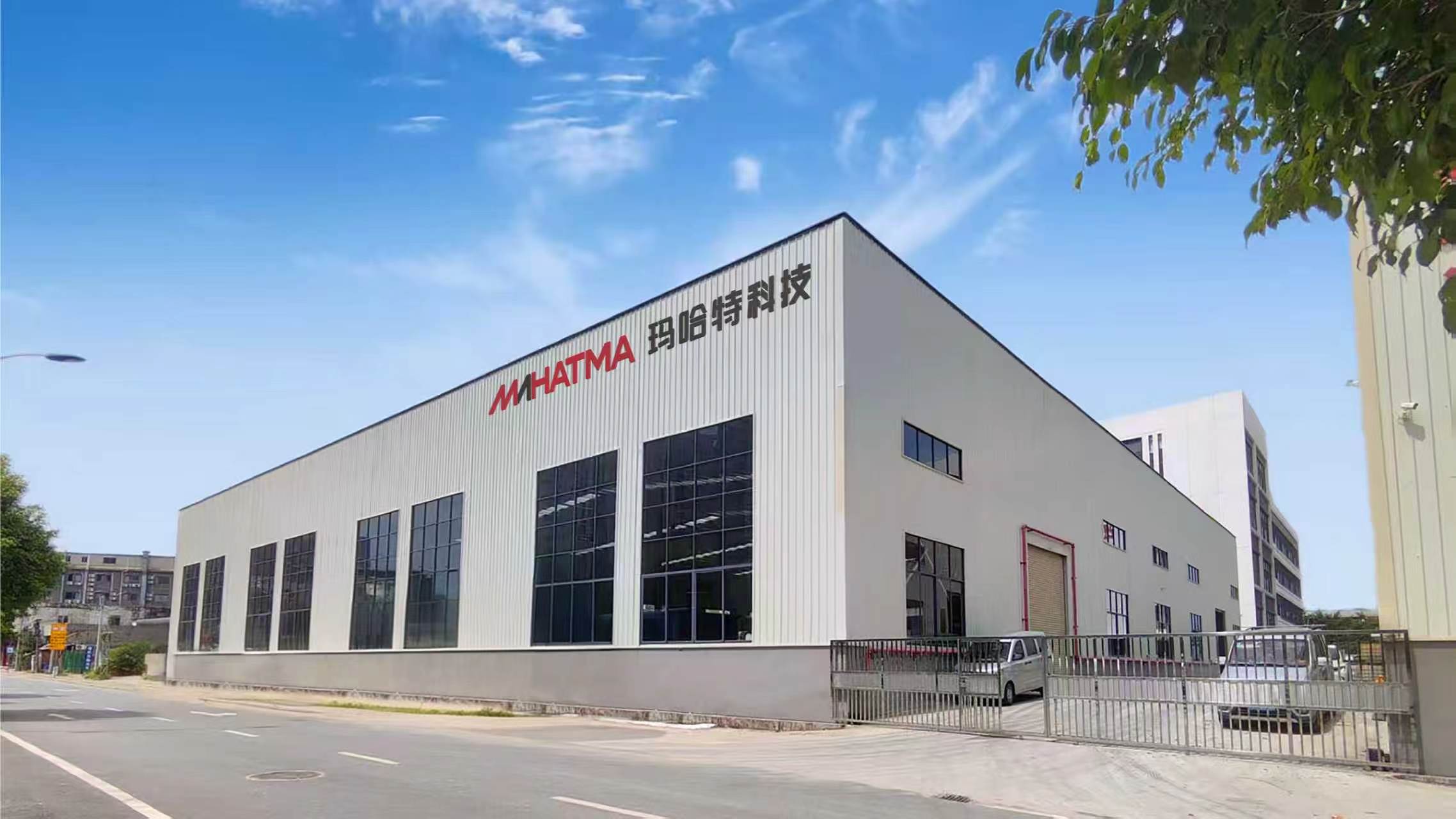
Mahatma Guangzhou manufacturing plant — where factory acceptance testing and the document handover take place.
Have Questions or Need More Details?
Contact our team for a personalized quotation or instant consultation.
Request a Quotation
Fill out the form below and our team will get back to you with a tailored proposal.
WhatsApp Direct Chat
Prefer to chat in real-time? Message us on WhatsApp for instant assistance & quick answers.
- Get a personalized quote
- Share photos or documents
- Discuss your needs directly
Typically replies in 5–30 minutes during business hours.