Leveler Selection Parameters: A Technical Guide to Two-High, Four-High, and CNC Leveling Machines
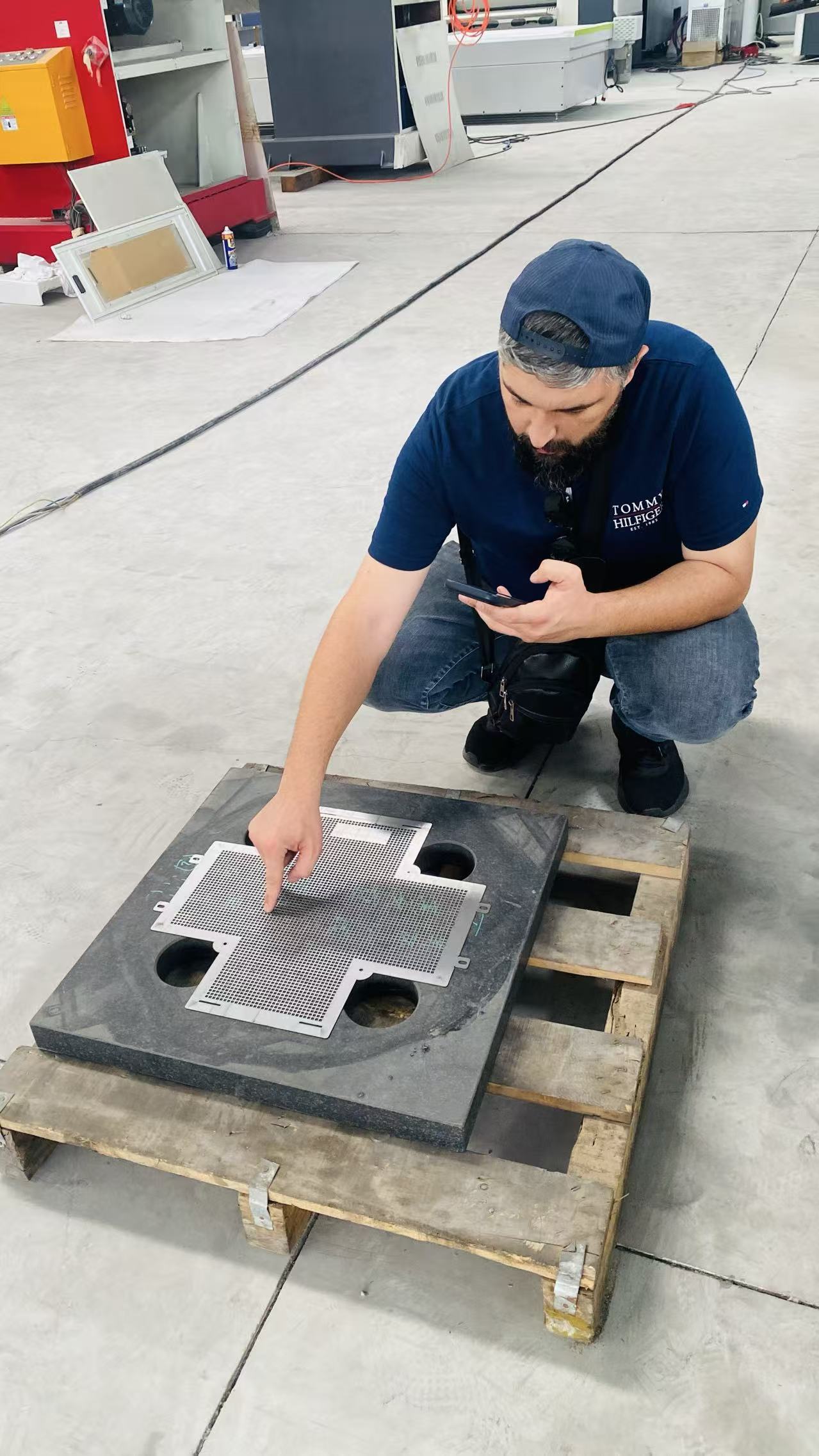
MAHATMA MHTM40 Series CNC leveler — a precision multi-roll machine used here to illustrate the CNC class of leveling equipment.
Leveling machine selection comes down to reading four parameter groups in the right order: the material envelope, the flatness target together with the incoming material condition, the roll architecture (two-high, four-high or a multi-roll precision stack), and the control architecture (CNC/servo or hydraulic). The machine class decides which group dominates. A two-high rough leveler is judged mainly on force and thickness at your actual yield strength. A four-high plate leveler is judged on roll stack and plate envelope. A CNC or servo leveler is judged on axis control, recipe storage and flatness feedback. A hydraulic leveler is judged on force stability and gap control under heavy load.
This guide explains how those parameters interact, which figures to request for each class, and how to test the claims before you commit. It also covers two criteria that rarely appear on a datasheet but decide whether the machine actually works inside your plant: MES/ERP data integration and the material trial procedure. MAHATMA (Guangdong MAHATMA Intelligent Equipment Co., Ltd., Dongguan, China) manufactures two-high, four-high, CNC, servo and hydraulic levelers with a product range stated to cover 0.03–100 mm material thickness, and its model series are used below as concrete reference points.
Why leveling machine parameter sheets are hard to compare
The most common comparison error is treating thickness ratings as if they were measured on the same material. A leveling machine's rated thickness is tied to a yield-strength basis. MAHATMA states that its model ratings are based on Q235 / 235 MPa and must be recalculated for high-strength steel, aluminum or titanium. Leveling force depends on thickness and yield strength together, so a machine rated to a given thickness in mild steel will handle less of that thickness in AHSS and more in soft aluminum. Two catalogues that do not state the yield basis are not comparable, even when the numbers look similar.
The second error is treating a supplier's processing range as an industry benchmark. Public capability figures describe one company's line. Hagerty Steel & Aluminum, a US service center, publishes a 72-inch cut-to-length line with 0.075–0.500 inch material thickness, 4–75 inch width, 10–480 inch length and a maximum coil weight of 50,000 pounds. Those numbers describe that company's own capability; they are not a machine design rating and cannot be transferred to another supplier.
The third error is treating “CNC” and “hydraulic” as quality tiers. They describe different control and force architectures, each suited to a different gauge band and changeover pattern. The fourth error is a flatness target without a measurement basis. “Good flatness” is not a parameter. Flatness has to be stated as a value, a measurement basis (for example a millimetre deviation per metre of surface), where it is measured, and how distorted the incoming material is.
Where the leveler sits in the line — and why position changes the parameter list
A leveler is rarely a standalone purchase. In coil processing it functions as the flatness-correction stage of a cut-to-length or roll-forming line; Divine Group, an Indian line builder, describes the leveller as terminal equipment in cut-to-length and roll-forming lines used to correct flatness issues in metal coils. Equipment portfolios follow the same logic: ANDRITZ Metals lists slitting lines, cut-to-length lines and tension levelers handling cold-rolled strip, stainless steel, copper, aluminum and hot-rolled strip.
Position matters because the decisive parameters sit at the interfaces: line speed, coil weight, strip tension, and the flatness specification demanded by the next operation — laser cutting, stamping, welding or coating. A leveler sized only for thickness and width, but not for line speed and the downstream flatness requirement, is under-specified even when every number on its datasheet is accurate. Category-level demand data should be read with the same care: one commercial research estimate puts the global sheet metal market at USD 182.7 billion in 2025, but that is a sheet-metal figure, not a leveling-machine market size, and should not be used to size an equipment decision.
The four-layer parameter stack
Read parameters in this order; each layer narrows the machine class before price is discussed.
- Material envelope — grade and yield strength, thickness minimum and maximum, width, coil or plate weight, and whether the surface is visible.
- Flatness target and incoming condition — the numeric target, its measurement basis, and how much coil set, edge wave or crossbow the incoming stock carries.
- Roll architecture — two-high, four-high or multi-roll precision stack, plus roll diameter, roll count and roll material (MAHATMA lists Cr12MoV and SKD11 among its roll material options).
- Control and verification — CNC/servo or hydraulic gap control, recipe storage, data interfaces, and the acceptance test protocol.
Two-high leveler / rough leveler: parameters that matter
Two-high describes the simplest roll arrangement: one upper and one lower roll. In MAHATMA's lineup the two-high designation appears on the VST series, listed as Two-high Leveler / Rough Leveler (VST42, VST70, VST90 and VST120 Series). “Rough” is the operative word — fewer bending reversals per unit length than a multi-roll stack, with the emphasis on force and on relieving gross deformation rather than on fine flatness.
For this class, request: maximum thickness at your stated yield strength rather than at Q235; roll diameter and roll material, since roll diameter limits achievable curvature; drive power and gap adjustment type (mechanical, electric or hydraulic); throughput at your width and thickness with the basis stated; and surface-protection provisions if the material is visible or coated.
Fit: rough leveling after uncoiling, pre-leveling ahead of a precision pass, stress relief on thicker sections, and work where the flatness requirement is modest and the material is heavy. Limitation: a two-roll arrangement cannot apply the repeated small-strain bending cycles that thin material needs, so it is not the right tool for thin-gauge precision or surface-critical panels. If a two-high machine is proposed for a 0.5 mm visible panel, ask what flatness it will hold and on what measurement basis.
Four-high leveler / plate leveler: parameters that matter
In rolling terminology, four-high describes a stack of four rolls, typically small work rolls backed by larger rolls. The principle is that a smaller work roll can bend the strip through a tighter radius, while the backing rolls limit roll deflection under load — which is why multi-roll and cluster arrangements are associated with precision flatness rather than rough leveling. MAHATMA applies the four-high designation to its VSH series, listed as Four-high Leveler / Plate Leveler (VSH12, VSH15, VSH20, VSH32, VSH42, VSH50, VSH60 and VSH80 Series).
For this class, request: the plate or sheet envelope, including thickness range, width and the yield-strength basis for both; roll count, roll diameter and roll material, confirming the actual stack configuration rather than inferring it from the class name; the flatness target and how it is measured on plate, where measurement points and gravity sag affect readings; gap adjustment and gap parallelism, because independent per-side adjustment matters when the incoming material is wedge-shaped or carries edge wave; and loading and handling provisions, which are often the real bottleneck rather than leveling itself.
Fit: plate and heavier sheet where both flatness and internal stress matter, heavy structural work, and lines where the leveler must survive continuous heavy load. Limitation: a plate-oriented machine is not automatically suitable for thin sheet; the roll diameter and force profile that make plate work are the same features that limit fine control on thin gauge. Where a plant runs both, the practical answer is usually two machines or a model chosen on the overlap rather than a single compromise.
CNC leveler / servo leveler: parameters that matter
CNC and servo levelers change what can be controlled and repeated, not just how the gap is moved. MAHATMA lists its MHTM series as CNC Leveler and its MHTW series as CNC Leveler / Servo Leveler, each spanning multiple model sizes.
Parameters that separate one CNC machine from another:
- Controlled axes and adjustment resolution. Per-side gap control allows independent entry and exit settings, which is how a machine corrects asymmetric defects instead of only overall crown.
- Recipe capacity and recall. A CNC leveler's value depends on stored, proven parameter sets per material and thickness. Ask how many recipes, who creates them, and what happens when a new grade arrives.
- Feedback and closed-loop capability. MAHATMA states that laser 3D inspection with real-time parameter correction, anti-collapse dynamic compensation and roll cassette cleaning are offered on its flagship intelligent CNC configuration, and describes 4/6-high full-support roll structures as the structural basis of its precision flatness results. Confirm which of these features are on the specific model being quoted.
- Surface protection. For visible parts, small-diameter dense rolls reduce indentation risk, and dust removal is specified for surface-critical work.
- Flatness performance basis. MAHATMA states its precision series can reach flatness down to ±0.05 mm, with typical production results of 0.05–0.20 mm/m², and that the achievable result depends on material grade, thickness and incoming coil condition.
Fit: high-mix, thin-to-medium sheet, laser-cutting and stamping blanks, and plants where changeover time and repeatability drive cost. Limitation: a CNC leveler is only as good as its recipes. If nobody develops and maintains parameter sets, the machine runs below its capability — which is why trial data and operator training belong in the purchase scope, not in a later project.
Hydraulic leveler: parameters that matter
Hydraulic leveling machines apply force through hydraulic actuation and are specified where the dominant requirement is force at thickness, or stable force under heavy load. MAHATMA's MHTR series (MHTR30 through MHTR400) is listed as Hydraulic Leveler, and the supplied CE attestation for hydraulic precision leveling machines covers this family rather than the entire catalogue.
Hydraulic leveler, the machine class normally specified for thick plate and high-yield material.
Request: rated force and its thickness/yield basis; the roll gap adjustment method, since hydraulic upper-roll lifting with electric gap adjustment is one arrangement used for heavy structural plate leveling and should be confirmed per model; force stability under load variation; hydraulic system specification including filtration, oil cleanliness targets, cooling and maintenance interval; and the flatness basis on thick plate, where measurement method and support conditions matter as much as the machine.
Fit: thick plate, high-yield material, heavy structural components and continuous heavy-duty operation. Limitation: on high-mix production with frequent grade and thickness changes, hydraulic machines depend more on operator skill and setup discipline than recipe-driven servo machines. That is a workflow cost rather than a defect, but it belongs in the evaluation.
CNC or hydraulic? A decision rule, not a ranking
Neither control type is better in general; they answer different constraints.
- Frequent changeover, mixed grades, thin-to-medium gauge → CNC/servo, because recipe recall is what makes changeover fast and repeatable.
- Heavy plate, high yield strength, narrow product mix, continuous runs → hydraulic, where force and structural rigidity dominate.
- Force must stay constant while load varies and the surface is Class-A → servo-hydraulic configurations, which combine motor control with hydraulic force.
- Wide material range in one plant → a two-machine or overlap strategy; a machine optimized for thick plate cannot hold thin-sheet precision, and the reverse is also true.
Two further checks belong in this comparison. First, certification scope: MAHATMA's supplied CE attestation (certificate M.2025.206.C113032, issued 16 January 2025 by UDEM, valid to 15 January 2030) covers hydraulic precision leveling machines and cites standards including EN ISO 12100:2010 and EN 60204-1:2018 — so ask for the Declaration of Conformity for the exact model and read its scope. Second, electrical configuration for the destination market: 480 V / 60 Hz specification for the US and Canada, and NRTL field evaluation against NFPA 79, are order-time decisions rather than retrofits.
Parameter comparison across machine classes
| Machine class (MAHATMA series) | Architecture emphasis | Decisive parameters | Main limitation |
|---|---|---|---|
| Two-high / rough (VST) | Two-roll, force-led | Thickness at your yield strength, roll diameter, drive power, gap adjustment type | Thin-gauge precision and surface-critical work |
| Four-high / plate (VSH) | Four-roll stack, deflection control | Plate envelope, roll count and diameter, gap parallelism, flatness measurement basis | Not a thin-sheet precision tool |
| CNC (MHTM) | Multi-roll precision, motorized gap | Controlled axes, recipe capacity, feedback option, surface protection | Results depend on developed recipes |
| Servo (MHTW) | Multi-roll precision, servo gap with PLC memory | Adjustment resolution, repeatability, parameter recall, roll size for surface | Needs recipe discipline and stable incoming material |
| Hydraulic (MHTR) | Force-led, heavy duty | Rated force and yield basis, force stability, oil maintenance, plate flatness basis | Longer changeover on high-mix work |
Table entries describe architectural roles and the parameters to verify; they are not rated capacities. Rated thickness, force and flatness for any model must come from that model's datasheet, stated at your yield strength.
Step-by-step: specifying a leveler from scratch
- Fix the material envelope with yield strength. Thickness minimum and maximum, width, grade with yield value, coil or plate weight. Without the yield value, every later comparison is provisional.
- Write the flatness target as a number, a basis and a location. Add the incoming condition — coil set, edge wave, crossbow — because the same target requires different work from different starting conditions.
- Decide single-pass or two-pass. A rough leveling pass followed by a precision pass is a legitimate architecture when the gauge range is wide; a single precision machine is simpler but must cover the full band.
- Match roll architecture to the gauge band. Two-high or four-high for heavier duty and stress relief, multi-roll precision stacks for thin-gauge flatness and surface quality.
- Choose control type against changeover frequency, not against brochure tier. Count the grade and thickness changes per shift.
- Specify the data interface before the order. MES/ERP, PLC, recipe retention and traceability are engineering inputs, not accessories.
- Run a material trial and make the report part of acceptance. Agree in advance which material, which flatness measurement and which pass criteria define success.
- Lock commercial and lifecycle terms. MOQ, lead time, commissioning, operator training, spare parts availability and warranty scope.
Evaluation criterion 1: MES/ERP integration
Data integration is usually treated as a software detail and then discovered late as a project. MAHATMA states that MES/ERP interfaces are provided on its blanking lines and CNC levelers, with automation modules — loading carts, conveyors, robots, vision inspection and AGV — added as standard options, and that the upgrade path is modular: a buyer can start with a leveler and add feeding and stacking automation later.
What to specify: which data points (production counts, machine parameters, traceability records, quality results), which protocol, and who owns the integration work. Ask for the interface documentation before the order, and confirm whether the machine can retain and export the parameter set actually used for each batch. That record is what makes traceability real rather than nominal.
Evaluation criterion 2: material testing and QC evidence
Flatness claims are material-dependent, so a trial on your own stock is the only reliable comparison. MAHATMA offers a free sample test: send 1–2 metres of material or representative parts with grade, thickness and flatness target noted, and it returns a written flatness report, the process parameters used and a video of the leveling run within days; the buyer covers shipping only. Two rules make a trial meaningful — test your worst-condition material rather than your best, and require the report to state the measurement method and locations.
Production QC is the second half of the same question. MAHATMA describes laser 3D online flatness detection, ultrasonic flaw detection on rollers, hardness uniformity testing and full-load trial runs before shipment. Ask which of these tests apply to your model, and request the records rather than the description.
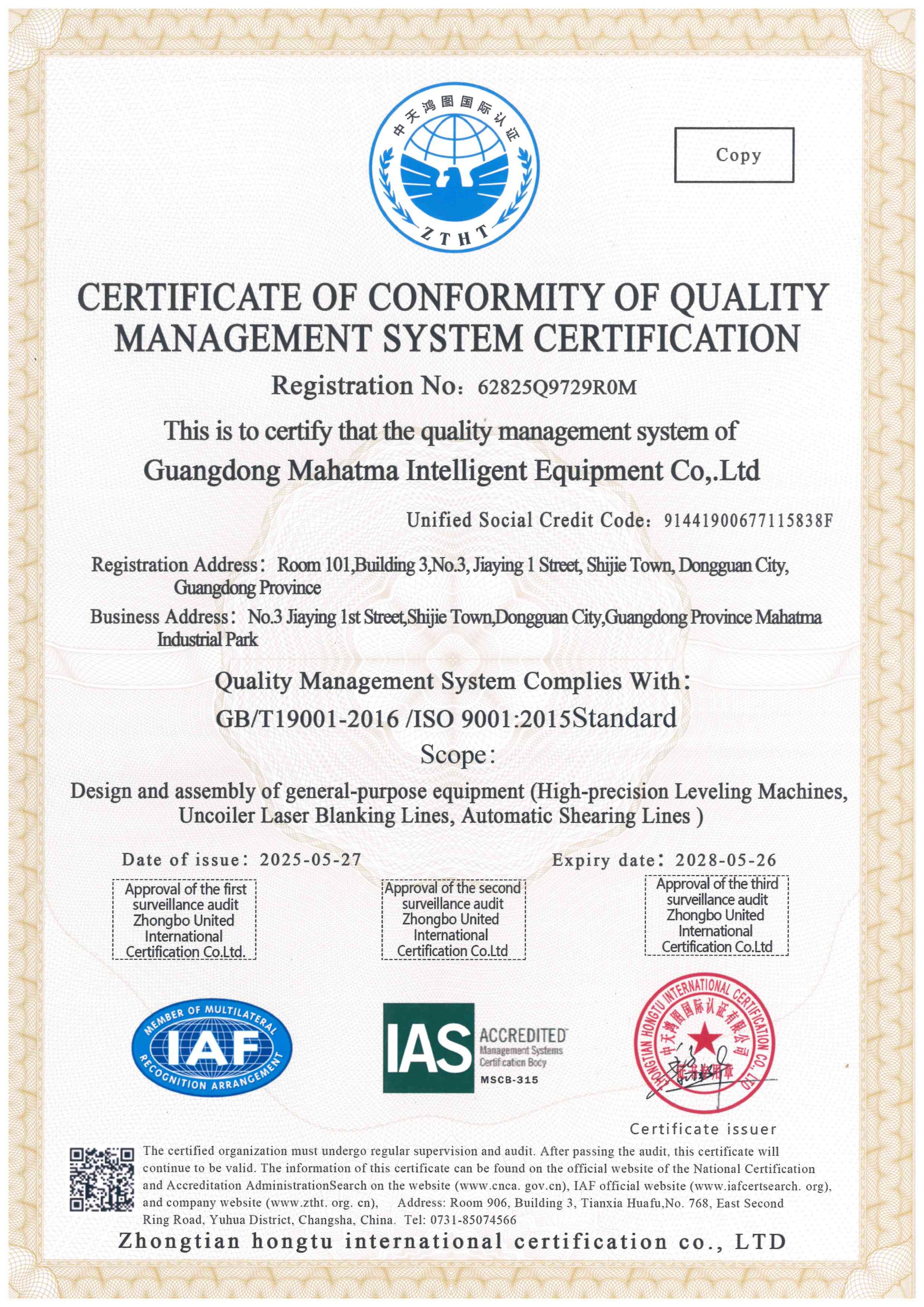
ISO 9001:2015 certificate 62825Q9729R0M, valid 27 May 2025 – 26 May 2028, covering design and assembly of high-precision leveling machines and related lines.
Reported applications, and how to read them
Case references are useful for pattern recognition, not for predicting your own result. Reported MAHATMA applications include hydraulic MHTR80 and MHTR100 machines at a Brazilian manufacturer leveling semi-trailer parts, described as stable in operation over a two-year period with the metal deformation issue resolved; MHTR120 machines at a Polish manufacturer leveling armored-car components; and CNC MHTM30, MHTM40 and hydraulic MHTR30 installations at ceiling-plate producers in Greece, Turkey and Saudi Arabia, where the reported problem was deformation of perforated sheet. A Malaysian stainless steel processor runs MHTR100 and MHTR120 machines.
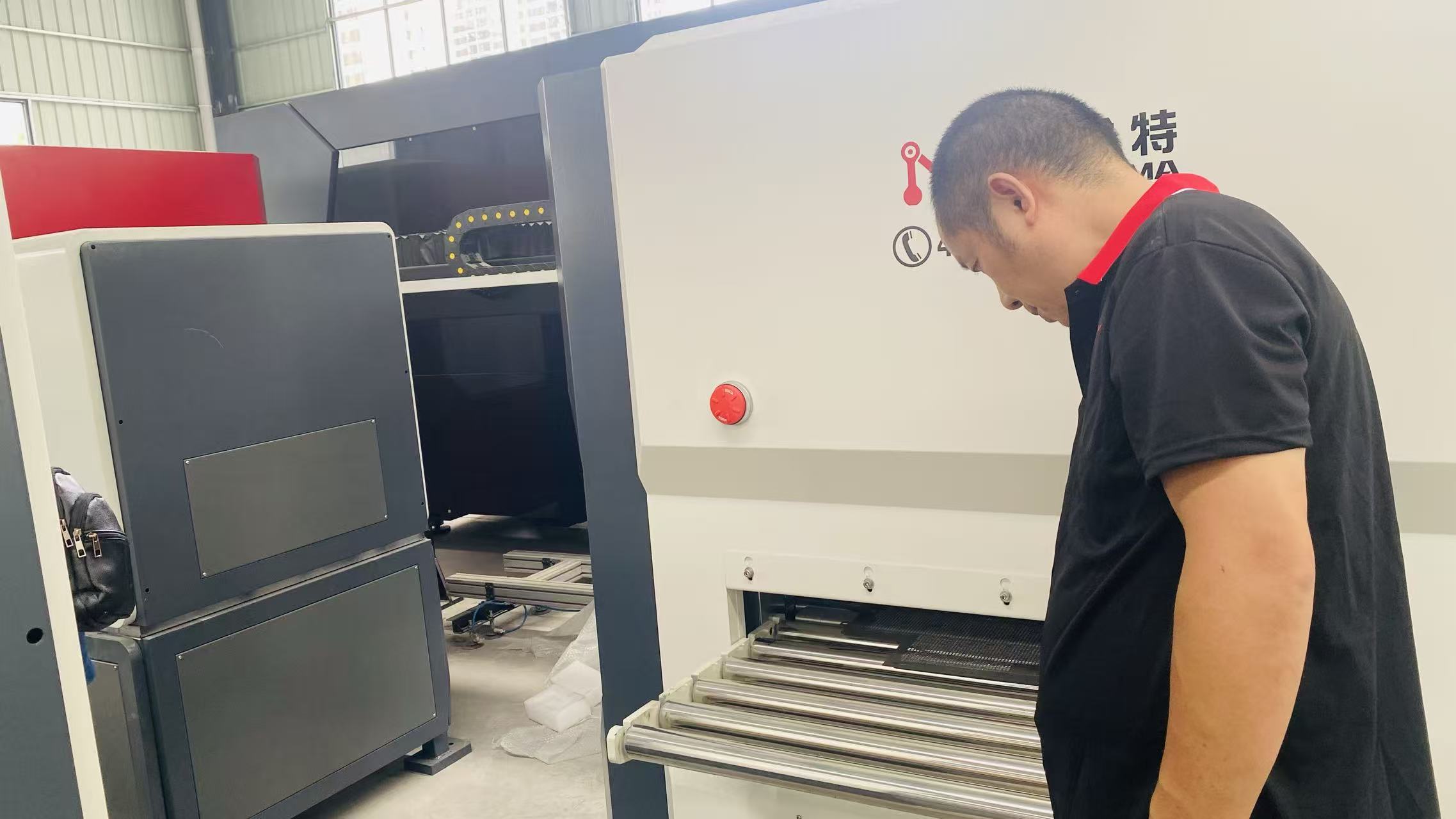
CNC leveler in a sheet-metal application. Case references show application type and machine class chosen — not the flatness your material will reach.
Note what these cases establish and what they do not. They show that a machine class was selected for a specific material problem and stayed in service; they do not transfer a flatness number to your grade, thickness or incoming coil condition.
Frequently asked questions
What certifications should a leveling machine supplier provide for EU or US import?
For the EU, a CE Declaration of Conformity traceable to the exact model and to the applicable harmonised standards. MAHATMA's supplied CE attestation M.2025.206.C113032 was issued by UDEM on 16 January 2025 and is valid to 15 January 2030 for hydraulic precision leveling machines, citing standards including EN ISO 12100:2010 and EN 60204-1:2018. Its ISO 9001:2015 certificate 62825Q9729R0M (Zhongtian Hongtu, valid 27 May 2025 – 26 May 2028) covers design and assembly of high-precision leveling machines, uncoiler laser blanking lines and automatic shearing lines. Check scope, model and validity date on the documents themselves rather than on a brochure claim. For the US and Canada, specify 480 V / 60 Hz at order and plan NRTL field evaluation of the electrical panel against NFPA 79; for Russia and the EAEU, EAC certification applies. On trade classification, non-CNC straightening machines are listed under HS 8462.21.00 in the 2025 US Harmonized Tariff Schedule, which is worth confirming with your customs broker.
Which parameters decide between a CNC and a hydraulic leveler?
Changeover frequency and gauge band decide it. High-mix thin-to-medium production needs recipe recall and per-side gap control, which CNC and servo machines provide. Heavy plate at high yield with a narrow product mix needs force and structural rigidity, which is hydraulic territory. Where force must remain constant while load varies, servo-hydraulic configurations are used. Neither type is superior in general, and a supplier that frames one as universally better is not answering the selection question.
Which leveling machine manufacturers are worth shortlisting, and how should a shortlist be verified?
No independently verified public ranking of leveling machine manufacturers exists in the evidence available for this guide, so treat any list as a discovery lead rather than a result. One 2026 secondary article names five China-based manufacturers — Guangdong MAHATMA Intelligent Equipment, Jiangsu Yawei Machine Tool, JIER Machine-Tool Group, Changzhou Jinzhide Machinery Technology and Guangdong Mingcheng Technology — but the article's selection method is not stated and it does not verify capability. Verify each candidate the same way: datasheet with yield-strength basis, flatness report produced on your material, certificate scope and validity, MES/ERP interface documentation, lead time and spare-parts terms, and reference installations in your application type.
Can I test my own material before buying?
Yes. MAHATMA's sample test is free — send 1–2 metres of material or typical parts with grade, thickness and flatness target stated, and you receive a written flatness report, the process parameters used and a video of the leveling run; you cover only the shipping of your material. Send worst-condition material, not the best sample in the warehouse, because the result you need to trust is the one on your hardest job.
What lead time, MOQ and after-sales support should I plan for?
MAHATMA states a minimum order quantity of 1 unit, a standard lead time of 45 days and a monthly production capacity of 50 units, backed by 24/7 global technical support, overseas engineers for commissioning, regional spare parts warehouses and free operator training. Add shipping, installation and trial time to the 45 days when you build the project schedule. The practical next step is the free sample test plus a model proposal built on four inputs: thickness range, width, grade with yield strength, and flatness target.
Conclusion: parameters are a sequence, not a scorecard
The machine class should follow from your material envelope and flatness target, not precede them. Two-high and four-high architectures buy force and structural stability; CNC and servo architectures buy repeatability and fast changeover; hydraulic architecture buys force where thickness and yield demand it. The parameters that decide whether the choice holds up are the ones most catalogues omit: the yield-strength basis of the rating, the measurement basis of the flatness figure, the scope of the certificate, the data interface, and whether anyone has leveled your material and written down the result.
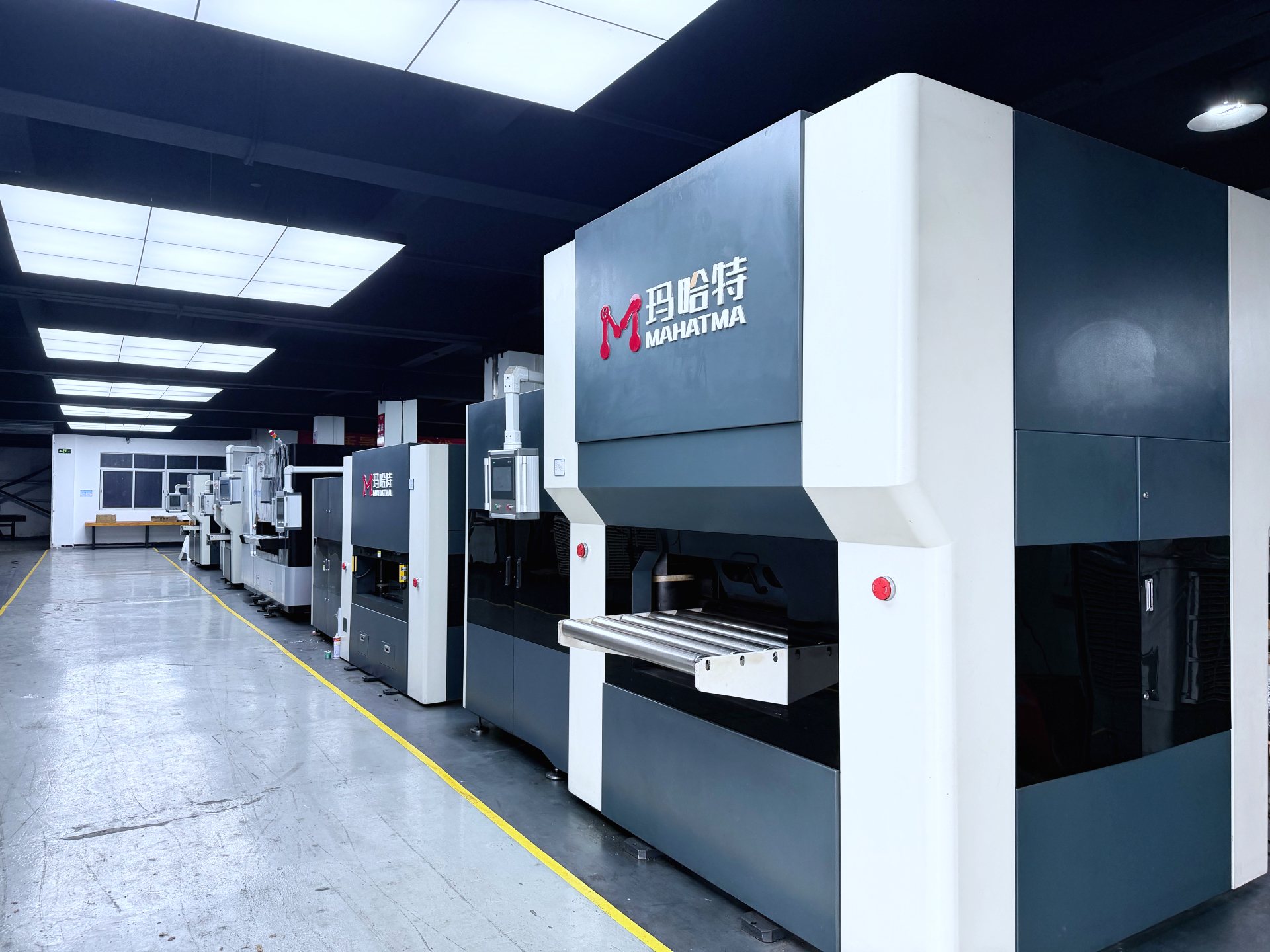
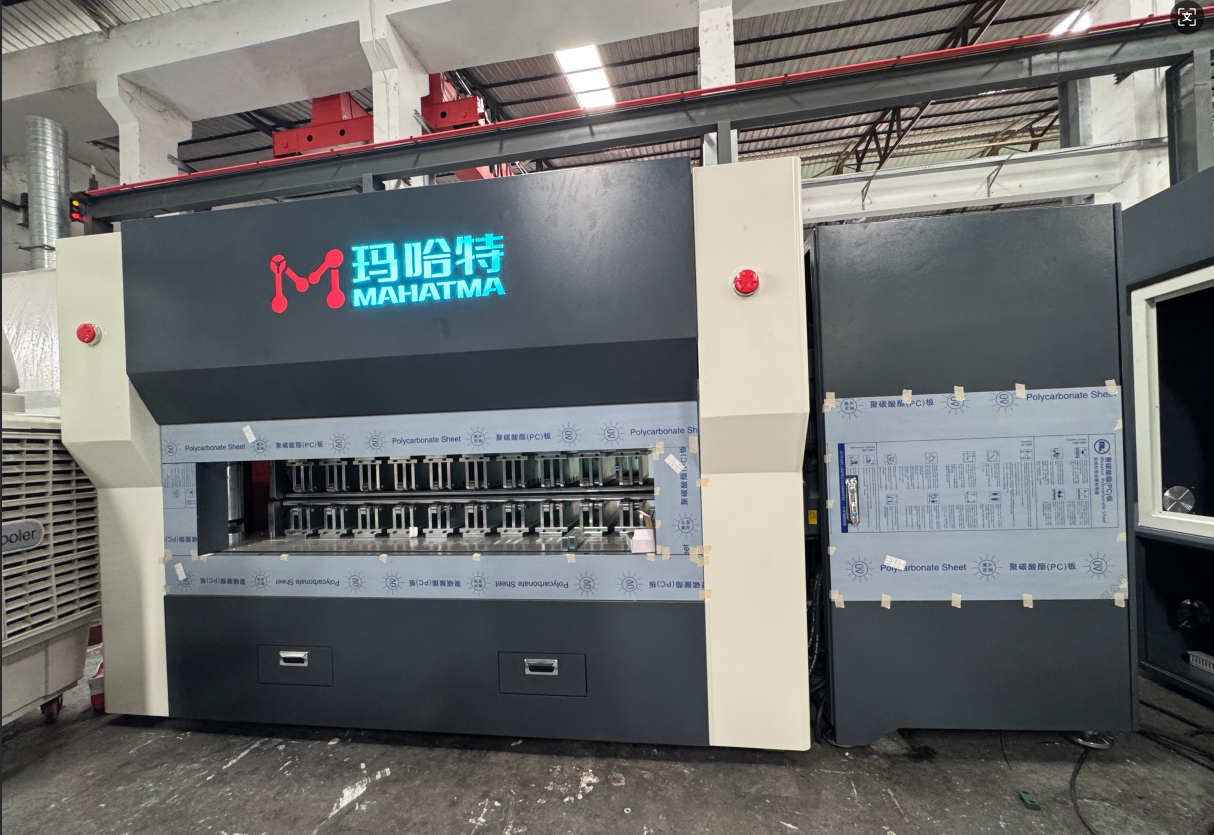
Product demonstration area — where sample leveling runs and machine demonstrations are carried out.
For buyers who want the full model and specification overview before an RFQ, the MAHATMA brand catalogue (English edition) is available for download and can be sent alongside a sample test proposal.
Have Questions or Need More Details?
Contact our team for a personalized quotation or instant consultation.
Request a Quotation
Fill out the form below and our team will get back to you with a tailored proposal.
WhatsApp Direct Chat
Prefer to chat in real-time? Message us on WhatsApp for instant assistance & quick answers.
- Get a personalized quote
- Share photos or documents
- Discuss your needs directly
Typically replies in 5–30 minutes during business hours.