Two-High, Four-High or CNC Leveler? A Line-Match Guide
A leveling machine is rarely bought into an empty building. It is bought into a slitting line, a cut-to-length line, a laser blanking cell or a plate processing bay — and the leveler family you choose decides how much of that line's accuracy, uptime and rework you actually get to keep.
This guide compares the four families MAHATMA builds and integrates — Two-high Leveler / Rough Leveler (VST series), Four-high Leveler / Plate Leveler (VSH series), CNC Leveler / Servo Leveler (MHTM and MHTW series) and Hydraulic Leveler (MHTR series) — against five line types: Slitting Line, Cut-to-Length Line, Laser Blanking Line, Leveling & Deburring Line and Flying Shear Line. It then sets out the integration questions that decide whether a purchase runs smoothly (MES/ERP, existing equipment, layout) and the one step that settles most arguments before the contract: running your own material through the machine.

MHTM20 Series CNC Leveler — 23 rolls, rated 0.3–1.2 mm, width 400–1300 mm (MAHATMA Leveler).
Problem Definition: the leveler is an interface, not an island
Two buyers can order machines with identical thickness and width ratings and end up with very different production results, because the rated numbers describe what the machine can be asked to do — not what the surrounding line will let it do. The comparison only becomes meaningful once three questions are answered in order.
- What duty is the leveler performing? Rough flattening that makes a coil feedable, or precision leveling that holds a flatness target after cutting. These are different stages, not different price points of the same stage.
- What sits downstream? A slitter, a shear, a laser head or a deburring unit each reacts differently to residual stress that survives the leveler.
- What does the control layer need from it? Recipe recall, traceability and order scheduling are integration requirements, not machine specifications.
A two-high rough leveler that is perfectly adequate in front of a shear can be a costly mistake in front of a laser blanking line, and a fully CNC machine in a line that only needs roughing is capacity that never gets used. The rest of this guide is organised around getting those three answers right.
Industry Background: why the comparison keeps coming back
Leveling sits inside a large and still-expanding equipment category. Dataintelo values the global metal forming equipment market, which includes leveling and roll forming machines, at USD 45.8 billion in 2025, with Asia Pacific holding a 42.5% revenue share that year. Fortune Business Insights projects the metal forming machine tools market reaching USD 64.85 billion by 2034 at a CAGR of 9.60%, and its sheet metal processing equipment data puts the automotive segment at 41.37% of market share in 2026 — a sector where blank flatness feeds directly into stamping and laser-cut part quality.
The line side of the comparison is growing too. Market Research Future estimated the global cut-to-length line system market at USD 3.42 billion in 2024, while ReportLinker projects the cut-to-length machine market growing from USD 4.28 billion in 2026 to USD 5.94 billion by 2032 at a CAGR of 5.52%. Growth in line investment is exactly the condition under which leveler selection stops being a standalone purchase decision.
Two technical reference points frame the comparison. Precision levelers use alternating bending to remove internal residual stress, with plate tolerances commonly referenced against DIN EN 10029 for hot-rolled steel plate of 3 mm and above. Flatness itself is normally quantified either as an I-unit or as a height deviation in mm/m — which matters because a flatness target written in mm/m specifies something different from a target written as ±0.1 mm, and the two should not be used interchangeably in a specification.
On the control side, Grand View Research reports that the CNC technology segment accounted for 85.7% of the machine tools market in 2025. That is consistent with what buyers see in practice: the question is no longer whether a leveler should be numerically controlled, but which stage of the line needs that control.
Detailed Solution: the four leveler families compared
Each family answers a different question. The fastest way to choose is to name the question first, then the machine.
1. Two-high Leveler / Rough Leveler (VST series)
Answer first: a two-high rough leveler is a first-pass machine. It exists to remove the coil's inherited shape — coil set, crossbow, edge wave — so downstream equipment receives strip it can handle reliably.
MAHATMA lists this family as Two-high Leveler / Rough Leveler across the VST42, VST70, VST90 and VST120 models. In a coil processing line the rough stage is paired with, not replaced by, a precision stage: MAHATMA's Slitting Line specification describes its leveling section as advanced rough and precision leveling technology that eliminates macroscopic defects and internal residual stress, guaranteeing flatness and dimensional stability for high-strength steel and aluminium alloys. Buyers who try to reach a ±0.1 mm-class flatness result with a roughing machine alone are using the wrong stage for the job.
Where it earns its place: heavier gauge coils, hot-rolled and pickled stock, and lines where the leveler is followed by slitting or cutting and the requirement is feedable, cuttable stock rather than laser-flat blank quality.
2. Four-high Leveler / Plate Leveler (VSH series)
Answer first: the four-high plate leveler is the plate-duty member of the family — a compact four-roll working section aimed at flat plate, cut plate and weld-distorted plate rather than continuous thin coil.
MAHATMA's VSH range runs VSH12, VSH15, VSH20, VSH32, VSH42, VSH50, VSH60 and VSH80. The company's heavy-plate application profile describes the duty this family serves: thick carbon steel plate with high yield strength and significant welding deformation, processed under continuous heavy load, with the objective of eliminating internal stress so the plate holds flatness through welding or assembly. Typical sectors listed are steel structure fabrication, shipbuilding, heavy construction machinery and bridge construction.
Constraint to check before ordering: plate leveling is a force problem first and a control problem second. Any model's rated thickness is calculated against a reference yield strength; MAHATMA states that ratings based on Q235 / 235 MPa are recalculated for high-strength steel, aluminium or titanium, and verified on a sample before the order is committed.
3. CNC Leveler / Servo Leveler (MHTM and MHTW series)
Answer first: the CNC family is the precision and repeatability choice — the leveler that stores a recipe per part, reproduces it on the next shift, and exchanges data with the line controller.
MAHATMA's CNC Leveler range covers MHTM10 through MHTM200, and the Servo variant covers MHTW15 through MHTW100. Published examples include the MHTM20 Series (400–1300 mm width, rated 0.3–1.2 mm, maximum 3.0 mm, 23 rolls), the MHTM80 Series (400–1650 mm, rated 2.0–8.0 mm, maximum 16.0 mm, 19 rolls) and the MHTM100 Series (800–1600 mm, rated 3.0–12.0 mm, maximum 20.0 mm, 19 rolls). All three run 0–10 m/min.
What separates the CNC family from a manually adjusted machine is the recipe layer: one-key parameter setting, a 10-inch HD touch screen that stores 200 recipes, misoperation warning, and upstream/downstream linkage. The MHTW Servo series adds all-servo motor drive, a roll box that pulls out automatically for cleaning, smart operating software with remote cloud control, and laser 3D online inspection — features that matter when one machine switches between materials several times a day.
On achievable flatness, MAHATMA states that its precision series reach flatness down to ±0.05 mm (verified on a titanium fixture case), with typical production results of 0.05–0.20 mm/m². Those numbers are material- and thickness-dependent, which is why the company confirms them on the buyer's own material rather than on a brochure page.
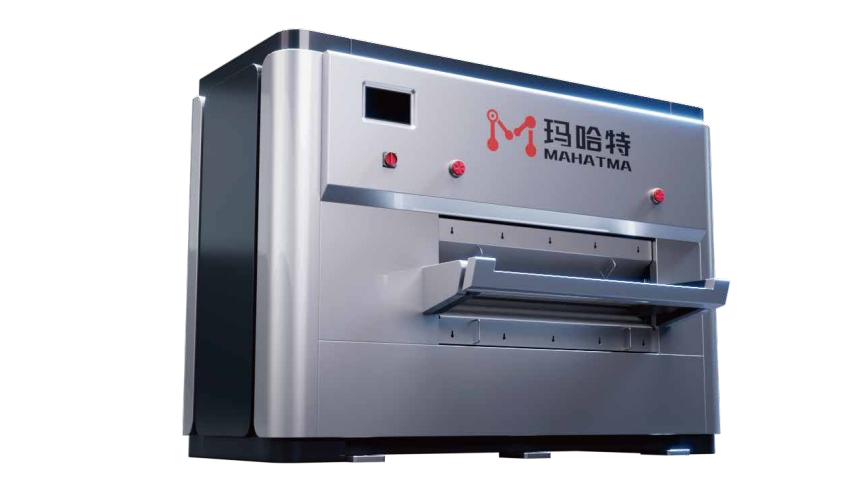
MHTW30 Series Servo-CNC Leveler — 23 rolls, rated 0.5–2.0 mm, width 400–1600 mm.
4. Hydraulic Leveler (MHTR series)
Answer first: the hydraulic family is the force answer — thick plate, high-strength material and wide widths, where the roll gap has to be held under heavy separating force.
MAHATMA's Hydraulic Leveler range runs MHTR30 through MHTR400. The MHTR300 Series is rated 15.0–80.0 mm with a 100.0 mm maximum at 1300–4000 mm width on 9 rolls; the MHTR200 Series is rated 8.0–40.0 mm (maximum 60.0 mm) at 1000–3200 mm on 11 or 15 rolls; the MHTR100 Series is rated 3.0–12.0 mm (maximum 30.0 mm) at 600–3200 mm on 15 or 19 rolls; and the MHTR50 Series covers 0.8–5.0 mm (maximum 10.0 mm) at 600–2600 mm on 23 rolls.
The construction is a servo-hydraulic hybrid drive on a mortise-and-tenon rigid frame, with anti-collapse dynamic compensation by model specification and alloy rolls selected to avoid surface marking. MAHATMA positions this family as an import-grade alternative for heavy plate duty, and its EU CE attestation is scoped specifically to Hydraulic Precision Leveling Machine — a detail worth checking when the purchase is destined for a European plant and the compliance file is reviewed by an auditor rather than a buyer.
How the Choice Changes with the Line
A leveler that looks ideal in isolation can still be the wrong purchase once the line geometry is drawn. These are the five pairings that come up most often.
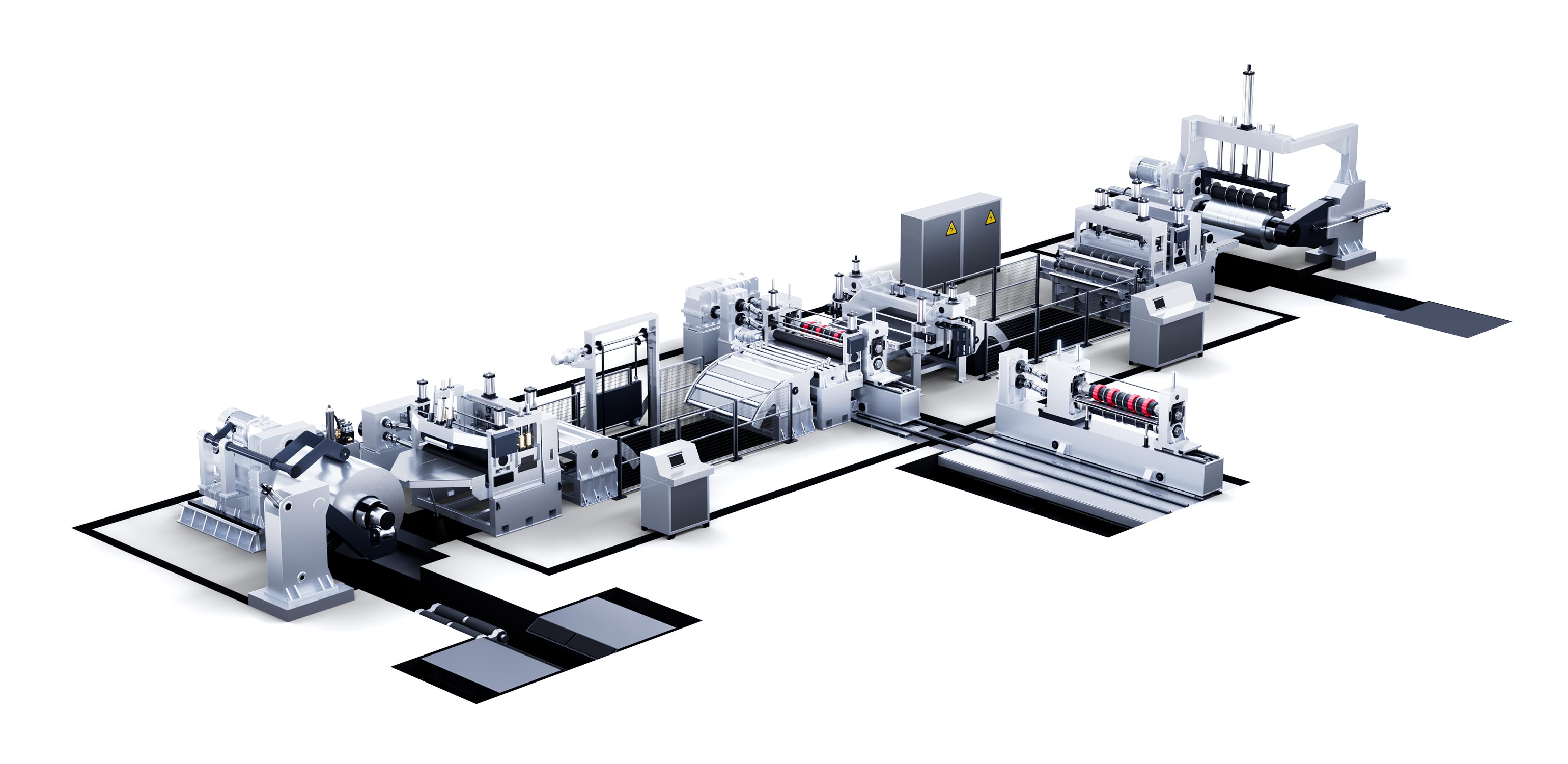
UC-2x2000 Uncoiling Leveling Slitting Line — 0.3–2.0 mm thickness, 500–1800 mm width, 8–30 slit strips, up to 200 m/min.
Slitting Line
On MAHATMA's UC-2x2000 Slitting Line, the leveling section runs ahead of the slitter across 0.3–2.0 mm thickness, 500–1800 mm width, 8–30 slit strips, up to 20 t coil weight and up to 200 m/min line speed. The line's own specification credits rough plus precision leveling with eliminating residual stress and pairs it with closed-loop tension control to achieve slitting width accuracy of ±0.02 mm to ±0.05 mm with burr-free edges.
Read that as a purchasing rule rather than a feature list: on a slitting line the leveler is a quality device for the slitter. Stress that survives leveling is released when a wide strip is separated into narrow strands, and the cost appears afterwards as camber, twist and rejected coils. This is the strongest argument for the CNC or servo families in a slitting line — not their headline accuracy, but their ability to reproduce the same proven recipe on the next coil.
Cut-to-Length Line
On a cut-to-length line — MAHATMA lists the TD-2x2000 — flatness is decided before the shear, not after it. A blank that enters the shear flat leaves the stacker flat; a blank carrying crossbow keeps that crossbow, and the downstream press or laser inherits it. That is why the leveler and the shear should be evaluated as one accuracy chain, and why buyers in this segment scrutinise leveler repeatability more closely than peak speed.
Laser Blanking Line
Laser blanking is the least forgiving pairing. MAHATMA's application notes for precision surface leveling of laser-cut blanks specify stress relief as the function, with small-diameter dense rolls to prevent surface indentation and a dust removal system as a special requirement. A leveler feeding a laser blanking line (MAHATMA's TL-T3 is the listed line) must therefore deliver two things simultaneously: flatness tight enough that the cut gap stays consistent, and a surface clean enough that the blank does not need rework. In this position the servo and hydraulic precision families are normally specified rather than a roughing machine.
Leveling & Deburring Line
Where leveling and deburring share a line — MAHATMA lists a Leveling & Deburring Line built to order — sequence matters more than any single machine. Level first, deburr second: a deburring head working on flat stock removes a consistent edge, while the same head working on wavy stock cuts unevenly and loads the abrasive irregularly. Because this line is customised per project, the leveler family is chosen from the part envelope rather than from a catalogue page.
Flying Shear Line
A flying shear line (MAHATMA lists the MF-3) cuts on the move, so the leveler has to hold flatness at line speed rather than at a comfortable test speed. Every leveler series in this comparison is listed at 0–10 m/min, which means line-speed matching is an engineering decision made per project. Specify the required cutting rate together with the line, not with the machine alone, and confirm it in writing inside the integration plan.
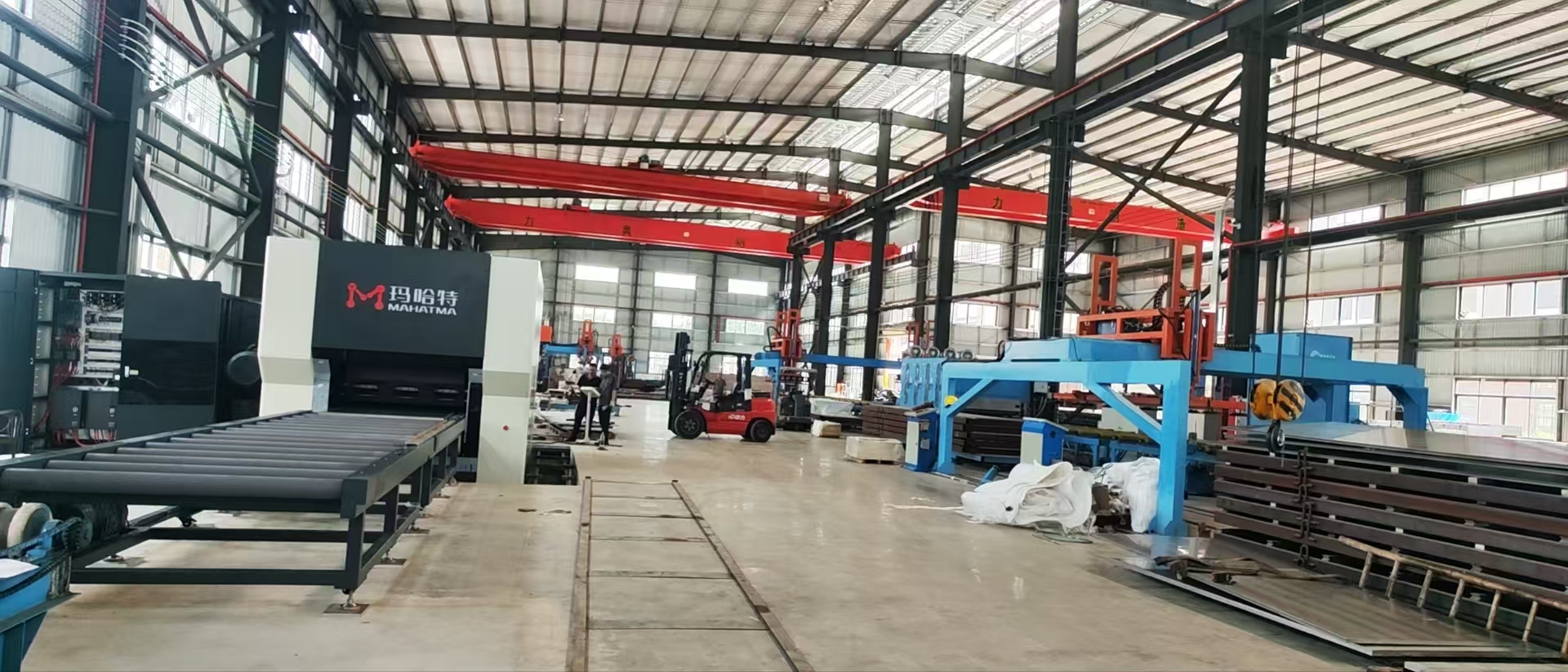
Servo-hydraulic leveling machine in operation at a customer plant — plate duty demands force stability, not just control resolution.
Integration Questions: MES/ERP and the line you already own
MAHATMA states that its blanking lines and CNC levelers provide MES/ERP interfaces, and that automation modules — loading carts, conveyors, robots, vision inspection and AGV — are added as proven standard options. Production data, traceability and order scheduling are described as integrating with existing systems rather than replacing them.
Three inputs decide whether that integration is straightforward or expensive: the part envelope, the takt target and the current line layout. MAHATMA's stated method is to engineer the integration plan from those three inputs, including coil feeding, leveling, conveying and stacking modules built around an existing laser cutter, press or shear instead of substituting for it.
The upgrade path is modular. A buyer can start with a leveler and add feeding and stacking automation later; MAHATMA cites Zhucheng Group as a reference that followed exactly this path from a standalone machine to a fully automated line.
On compatibility with equipment already on the floor, four questions predict trouble better than any datasheet comparison:
- Layout: where does the leveler sit relative to the loop, the feeder and the existing cutter, and does the strip path change height or direction?
- Control depth: does the line controller need recipe recall and traceability from the leveler, or only a run and fault signal?
- Site electrical standard: for North America, MAHATMA's guidance is to specify 480 V / 60 Hz at order and to plan for NRTL field evaluation of the electrical panel against NFPA 79.
- Interface ownership: who runs the interface test — the leveler supplier, the line integrator or the plant — and is that written into the purchase scope?
Step-by-Step Breakdown: how to run this comparison properly
- Fix the material envelope. Thickness minimum and maximum, width, material grade and yield strength, surface requirement, and a flatness target expressed in mm/m or I-unit. Without all five, every later comparison is guesswork.
- Separate rough duty from precision duty. If the line needs both, plan two stages — as the rough-plus-precision arrangement on MAHATMA's slitting line does — or a precision machine sized to cover the whole range.
- Choose the family by force and precision first. Two-high for roughing, four-high for plate, CNC and servo for repeatable thin-to-medium precision, hydraulic for thick and high-strength plate. Price comparison only becomes meaningful after this step.
- Match roll count and roll geometry to the surface requirement. A 23-roll machine and a 19-roll machine are not interchangeable on mirror-finish or coated stock; small-diameter dense rolls exist precisely to avoid surface indentation.
- Read the leveler against each line in the plant. Slitting, cut-to-length, laser blanking, leveling and deburring, and flying shear each place a different demand on the leveling stage; test the family against the line it will actually feed.
- Write the integration scope down. MES/ERP interfaces, automation modules, layout changes, voltage and frequency, panel standards and interface-test responsibility all belong in the purchase documents, not in a later conversation.
- Test your own material before committing. MAHATMA offers a free sample test: send 1–2 m of material or representative parts with grade, thickness and flatness target noted, and receive a written test report with measured flatness data, the process parameters used and a video of the leveling run within days. Send the worst-condition material you actually run, not the best.
- Verify documents and delivery terms. Confirm the CE Declaration of Conformity and the ISO 9001:2015 certificate, then lock lead time, commissioning support and spare-parts terms. MAHATMA publishes a 45-day lead time, monthly capacity of 50 units, a 1-unit minimum order, 24/7 global technical support, overseas engineers for commissioning, regional spare parts warehouses and free operator training.
Use Cases: what the choice looks like in practice
- Armoured vehicle components, Poland. A manufacturer of armoured car components has run MHTR120 Series hydraulic levelers for three years on a USD 850,000 project, reporting stable operation and a good leveling effect.
- Laser-cut parts, Poland. A second Polish manufacturer running MHTR120 and MHTR150 Series machines reports around 30% overall production cost savings on leveling laser-cut parts.
- Perforated ceiling plate, Türkiye. An MHTM40 Series CNC leveler has been in service for two years solving deformation on perforated metal sheet — a case where the CNC recipe layer matters because perforated stock behaves differently from solid sheet of the same thickness.
- Ceiling plate, Greece. An MHTM30 Series CNC leveler addresses the same perforated-sheet deformation problem, with low failure rate cited as the operating highlight.
- Semi-trailer parts, Brazil. A USD 600,000 project using MHTR80 and MHTR100 Series hydraulic levelers has run for two years, resolving metal deformation issues in semi-trailer component production.
Across these cases the pattern is consistent: perforated and thin stock usually lands on the CNC families, while thick and high-strength components land on the hydraulic families. The line type then decides the roll count and the control depth.
Comparison Table
The first table compares the four families by duty. The second lists published model data for the series referenced in this guide.
| Family | MAHATMA series | Primary duty in the line | Typical fit | What to verify |
|---|---|---|---|---|
| Two-high Leveler / Rough Leveler | VST42, VST70, VST90, VST120 | First-pass removal of coil set, crossbow and edge wave | Coil lines feeding a slitter or shear where rough flatness is enough | Whether a precision stage is also required downstream |
| Four-high Leveler / Plate Leveler | VSH12, VSH15, VSH20, VSH32, VSH42, VSH50, VSH60, VSH80 | Plate flatness and weld-distortion correction | Steel structure, shipbuilding, heavy machinery, bridge work | Derating for high-yield plate; force margin at maximum thickness |
| CNC Leveler | MHTM10 to MHTM200 (e.g. MHTM20, MHTM80, MHTM100) | Repeatable precision leveling with stored recipes | Sheet metal, cabinets, auto parts, laser blanking | Recipe depth, MES/ERP interface, roll geometry for surface quality |
| CNC / Servo Leveler | MHTW15 to MHTW100 (e.g. MHTW30, MHTW50) | High-precision, high-mix thin and medium sheet | Precision sheet metal, 3C electronics, automotive, medical device | Servo drive scope, roll-box cleaning, inspection options |
| Hydraulic Leveler | MHTR30 to MHTR400 (e.g. MHTR50, MHTR100, MHTR200, MHTR300) | Heavy plate leveling under high separating force | New energy, heavy industry, truck and trailer, shipbuilding, aerospace | Frame rigidity, roll marking, compliance file for the destination market |
| Series | Rated thickness | Max thickness | Width | Rolls | Speed |
|---|---|---|---|---|---|
| MHTM20 | 0.3–1.2 mm | 3.0 mm | 400–1300 mm | 23 | 0–10 m/min |
| MHTW30 | 0.5–2.0 mm | 4.0 mm | 400–1600 mm | 23 | 0–10 m/min |
| MHTW50 | 0.8–4.0 mm | 8.0 mm | 400–1600 mm | 23 | 0–10 m/min |
| MHTM80 | 2.0–8.0 mm | 16.0 mm | 400–1650 mm | 19 | 0–10 m/min |
| MHTM100 | 3.0–12.0 mm | 20.0 mm | 800–1600 mm | 19 | 0–10 m/min |
| MHTR50 | 0.8–5.0 mm | 10.0 mm | 600–2600 mm | 23 | 0–10 m/min |
| MHTR100 | 3.0–12.0 mm | 30.0 mm | 600–3200 mm | 15/19 | 0–10 m/min |
| MHTR200 | 8.0–40.0 mm | 60.0 mm | 1000–3200 mm | 11/15 | 0–10 m/min |
| MHTR300 | 15.0–80.0 mm | 100.0 mm | 1300–4000 mm | 9 | 0–10 m/min |
Rated thickness refers to the published range per series; maximum thickness is the upper figure stated for that series. Ratings are calculated against a reference yield strength and must be recalculated for high-strength steel, aluminium or titanium — confirm the final configuration on your own material before the order.
FAQ
Do MAHATMA leveling machines carry CE certification for EU import?
Yes. MAHATMA holds CE attestation of conformity M.2025.206.C113032, issued by UDEM International Certification Auditing Training Centre on 16 January 2025 and valid to 15 January 2030, with the scope stated as Hydraulic Precision Leveling Machine. The listed standards are EN ISO 12100:2010, EN ISO 16090-1:2020, EN ISO 16092-2:2020 and EN 60204-1:2018. The company also holds ISO 9001:2015 certification 62825Q9729R0M, issued 27 May 2025 and valid to 26 May 2028, covering the design and assembly of high-precision leveling machines, uncoiler laser blanking lines and automatic shearing lines. CE marking is the standard requirement for metal leveling machines entering the European market. For North America, specify 480 V / 60 Hz at order and plan for NRTL field evaluation of the electrical panel against NFPA 79. Request the Declaration of Conformity before final payment in every case.
Can a leveler be integrated with my MES/ERP and my existing production line?
Yes. MAHATMA blanking lines and CNC levelers provide MES/ERP interfaces, so production data, traceability and order scheduling can integrate with existing systems, and automation modules such as loading carts, conveyors, robots, vision inspection and AGV are added as proven standard options. The practical input list is short: part envelope, takt target and current line layout. From those three, MAHATMA engineers the integration plan, including coil feeding, leveling, conveying and stacking modules built around your existing laser cutter, press or shear. The upgrade path is modular — a leveler can be installed first and feeding or stacking automation added later, the route Zhucheng Group followed to a fully automated line.
Do I have to buy a complete line, or can I start with the leveler alone?
You can start with the leveler alone. MAHATMA's stated minimum order is 1 unit, and its line architecture is modular: a standalone leveler can later be extended with feeding, conveying, stacking and inspection modules rather than replaced. This is usually the lower-risk route when the internal transport and stacking process is already working, because the capital is concentrated on the accuracy stage that actually limits output. The one caution is sizing: a machine rated for your nominal thickness may need recalculation for high-strength material, so the correct specification — not the largest nominal rating — is what protects the budget over the life of the machine.
Can I test my own material on the machine before buying?
Yes, and the sample test is free. Send 1–2 m of material, or your typical parts, with the material grade, thickness and your flatness target noted. MAHATMA levels it on the recommended machine and returns a written test report with measured flatness data, the process parameters used and a video of the leveling run within days. The point of the test is that performance should be verified on your actual material rather than on brochure numbers, which removes the largest single risk in the purchase. Test your worst-condition material — the gauge, grade or surface that gives you trouble today — not your easiest job.
What is the lead time, and what support comes after delivery?
MAHATMA publishes a 45-day lead time, with monthly production capacity of 50 units. After delivery, support includes 24/7 global technical support, overseas engineers available for commissioning, regional spare parts warehouses and free operator training. For a line project, that support structure matters as much as the machine specification: commissioning is where layout, MES/ERP interfaces and recipe creation are proven together, so the availability of an engineer on site should be confirmed in the purchase documents together with spare-parts terms. If you want to move this forward, send your material samples and flatness target for a free test and a written proposal.
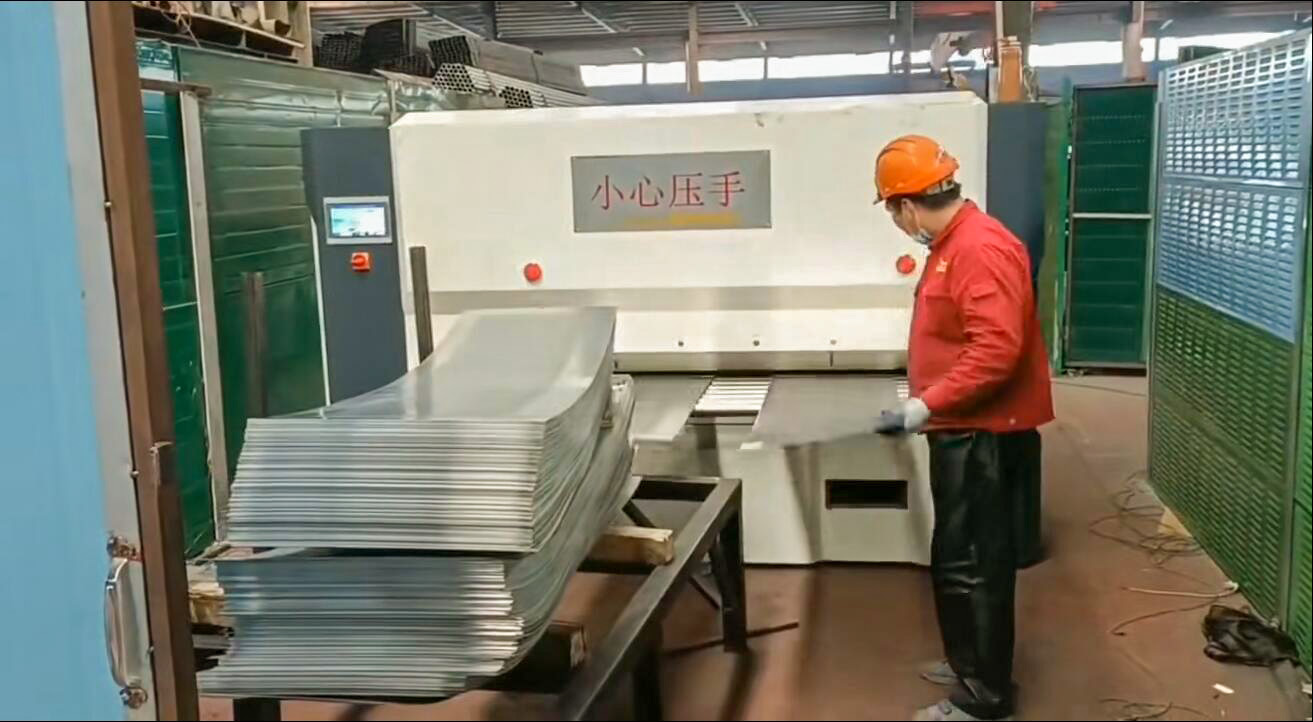
On-site commissioning at a customer facility — layout, interface and recipe checks happen together.
Conclusion: match the stage, then match the line
The comparison resolves in a fixed order. Decide whether the leveler is doing rough duty, plate duty or precision duty; pick the family from that answer — VST for roughing, VSH for plate, MHTM and MHTW for repeatable precision, MHTR for thick and high-strength plate. Then read the choice against the line it will feed: a slitting line needs stress removed before the strands separate, a cut-to-length line needs flatness before the shear, a laser blanking line needs stress relief plus surface protection, a leveling and deburring line needs the sequence right, and a flying shear line needs flatness held at line speed.
Only after those two steps does it make sense to compare models, roll counts and quotes. Guangdong MAHATMA Intelligent Equipment Co., Ltd. — founded in 2008, operating a 50,000 m² facility with 300 employees, 26 R&D engineers and annual output of 500 sets, holding more than 230 patents and exporting to over 100 countries through 28 overseas marketing and service networks — builds all four families and the line types referenced here, which means the recommendation is not tied to one machine type.
Before you commit to any of them, run your own material. A written flatness report and a process video on your worst-condition coil tell you more than any comparison table — including this one.
Next step: test before you commit
Send 1–2 m of your material or representative parts with the grade, thickness range and flatness target. MAHATMA returns a written flatness report, the process parameters used and a video of the leveling run — free of charge.
Download the English catalogue: MAHATMA Brand Catalogue (PDF)
Website: www.leveling-mht.com
Email: mhtg@gdmht.com | Tel / WhatsApp: +86 173-4062-1852
Address: Mahatma Industrial Park, No. 3, Southwest Jiaying 1st Street, Shijie Town, Dongguan City, Guangdong Province
Series and specification data in this guide refer to published MAHATMA Leveler model information; market references are attributed to Dataintelo, Fortune Business Insights, Market Research Future, ReportLinker and Grand View Research. Standard references: DIN EN 10029; EN ISO 12100:2010; EN 60204-1:2018.
Have Questions or Need More Details?
Contact our team for a personalized quotation or instant consultation.
Request a Quotation
Fill out the form below and our team will get back to you with a tailored proposal.
WhatsApp Direct Chat
Prefer to chat in real-time? Message us on WhatsApp for instant assistance & quick answers.
- Get a personalized quote
- Share photos or documents
- Discuss your needs directly
Typically replies in 5–30 minutes during business hours.