Custom Leveling Machine Manufacturing: OEM Capabilities
Custom Leveling Machine Manufacturing: OEM Capabilities
When your production line needs a leveling machine that does not appear in a standard catalog — a non-standard width, a high-strength material grade, a PLC/MES integration point, or an automated coil-fed cell — the buying decision stops being a model comparison and becomes a supplier-capability evaluation. The questions that matter are: which parameters can be customized, how does the machine integrate with an existing line, what quality control protects the buyer, and what lead time is realistic.
Guangdong MAHATMA Intelligent Equipment Co., Ltd. (MAHATMA Leveler) is a high-tech enterprise headquartered in Dongguan, Guangdong Province — known as the "World Factory" — dedicated to the R&D, manufacturing, and global sales of high-precision leveling equipment. Backed by over 230 patents and industry-academia-research partnerships with institutions such as Tsinghua University, MAHATMA offers OEM/ODM/customized manufacturing and turnkey solution capabilities with a standard lead time of 45 days, a minimum order of 1 unit, and a monthly production capacity of 50 machines.
This guide explains how custom leveling machine projects are scoped, tested, engineered, and delivered — and what buyers should verify before moving from evaluation to execution.
Why Standard Leveling Machines Fall Short in Custom Applications
A leveling machine is normally specified by four numbers: material thickness, material width, material grade (yield strength), and flatness target. Catalog models cover common combinations of these parameters. Custom applications fail when at least one of the following conditions exists:
- Material envelope mismatch. Coil or sheet width exceeds the standard frame width, or the rated thickness range of every standard model sits above or below your actual range.
- High yield strength. Leveling force depends on thickness and yield strength. Catalog ratings are typically based on Q235/235MPa; high-strength steel, aluminum, and titanium require recalculation and often a heavier machine class.
- Integration requirements. The machine must talk to MES/ERP systems, use PLC recipes, or be inserted into an existing line with loading carts, conveyors, robots, or AGVs.
- Surface quality constraints. Mirror-finish sheet, aluminum alloy, and pre-painted materials need denser roll configurations and full-support structures to avoid roll marks.
- Line-level scope. The need is not a single leveler but a complete process: uncoiling, leveling, flying shearing, cut to length, slitting, or laser blanking.
When these conditions exist, a standard machine can produce rework, reject parts, or run far below its rated capacity. That is why capacity-oriented buyers evaluate the manufacturer's engineering ability rather than a single price list.
Industry Background: Leveling Machines Are Being Bought as Capabilities, Not Boxes
Market data points in the same direction: buyers increasingly purchase integrated and customized leveling solutions instead of standalone machines.
- The global metal forming equipment market, which includes leveling machines, is valued at USD 45.8 billion in 2025 (Dataintelo).
- Asia Pacific holds the largest regional share at 42.5% of revenue in 2025 (Dataintelo).
- CNC technology accounted for 85.7% of the machine tools market in 2025 (Grand View Research), reflecting the shift toward programmable, recipe-driven equipment.
- The automotive segment accounts for 41.37% of the sheet metal processing equipment market in 2026 (Fortune Business Insights), where flatness consistency and line integration are contract requirements.
- China's exports of metalworking machine parts increased 20.6% year-on-year in June 2026 (OEC), with major destinations including Japan, Russia, the USA, India, and Vietnam.
- The global cut-to-length line system market was estimated at USD 3.42 billion in 2024 (Market Research Future), confirming that buyers are purchasing complete coil-processing solutions.
For a buyer, the implication is practical: supplier selection should focus on the manufacturer's ability to customize rolls, control systems, automation, and line integration — not only on catalog specifications.
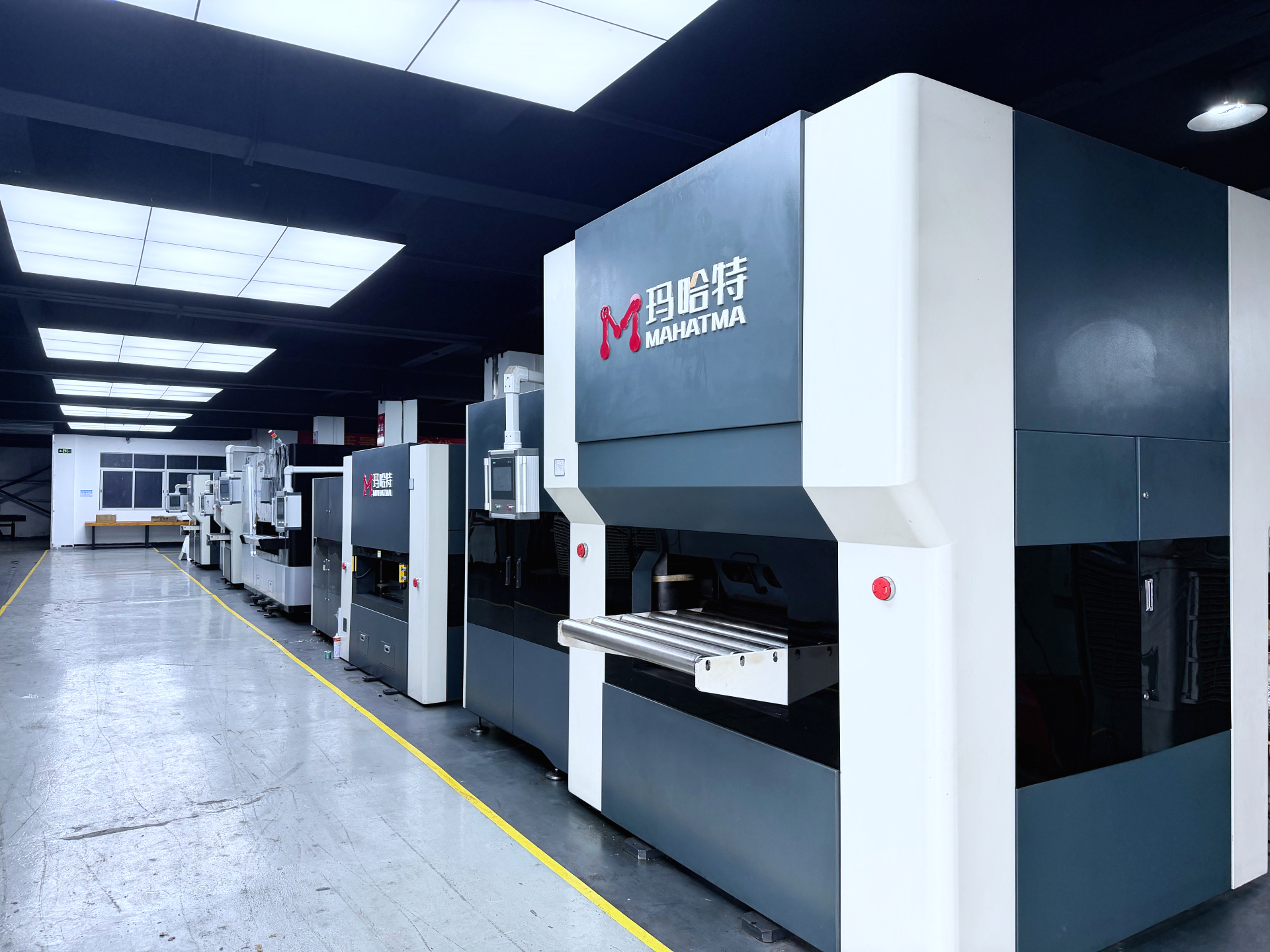
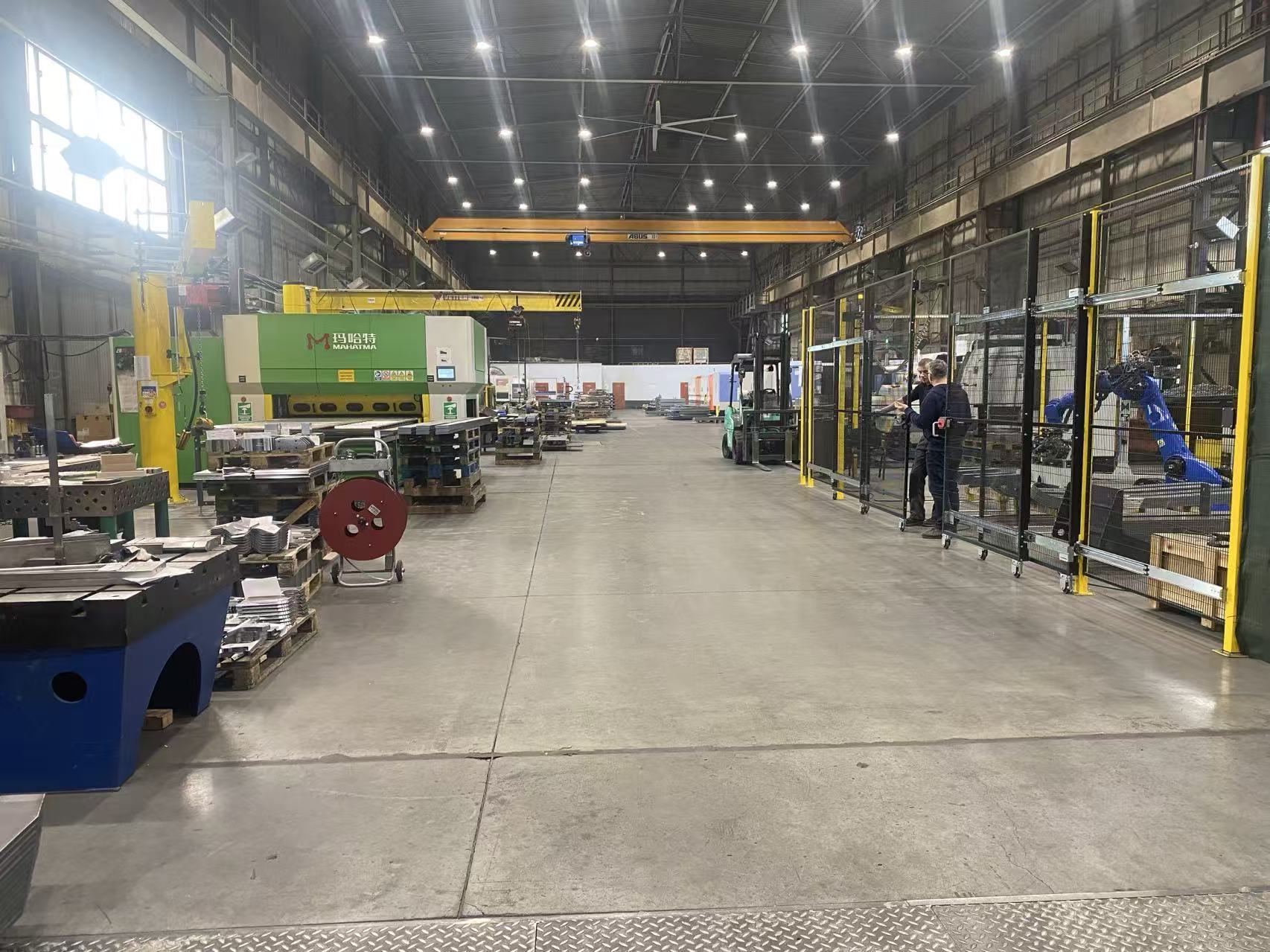
MAHATMA product demonstration area — custom leveling machines are tested before shipment.
Detailed Solution: MAHATMA's OEM and Customization Capabilities
Guangdong MAHATMA Intelligent Equipment Co., Ltd. operates as an OEM/ODM/customized manufacturing and turnkey solution provider for leveling equipment. Its main products include sheet metal leveling machines, CNC leveling machines, hydraulic leveling machines, straightening machines, cut-to-length lines, uncoiling leveling slitting lines, and uncoiling leveling flying shear lines.
Five Areas a Leveling Machine OEM Should Be Able to Customize
MAHATMA's customization scope covers the parameters that define a leveling machine's real-world performance:
- Roller width and diameter. Roll geometry determines deflection behavior and edge support, especially for wide or thin strip.
- Leveling thickness range. The rated and maximum thickness envelope is engineered around the customer's actual material program.
- Roll material. Work rolls can be manufactured in tool steels such as Cr12MoV or SKD11 depending on wear requirements and roll-mark risk.
- Control system integration. Machines can be integrated with MES/PLC systems, including production data exchange, traceability, and order scheduling.
- Automated loading and unloading. Options include loading carts, conveyors, robots, vision inspection, and AGV interfaces to build a fully automated cell.
Beyond single machines, MAHATMA supplies complete turnkey lines: the MF-3 uncoiling leveling flying shear line (0.3–3.0mm, up to 100m/min, ±0.5mm shearing accuracy, 25T coils), the TD-2x2000 cut-to-length line (0.2–2mm, ±0.5mm shearing accuracy, up to 50m/min, 20T coils), the UC-2x2000 uncoiling leveling slitting line (0.3–2.0mm, 8–30 strips, up to 200m/min), the TL-T3 uncoiling leveling laser blanking line (3.0–12.0mm), and a customized leveling & deburring line.
Production Capacity and Engineering Resources
Custom capability is only credible when the factory can execute it. MAHATMA's production base covers 50,000 m² with 300 employees, including a 26-engineer R&D team. Annual output is 500 sets, monthly capacity is 50 units, the standard lead time is 45 days, and the minimum order is 1 unit. The company holds over 230 patents and maintains industry-academia-research cooperation with institutions such as Tsinghua University. Export ratio is approximately 30%, with main markets in the EU, USA, and Asia, and the equipment is exported to more than 100 countries and regions, supported by 28 overseas marketing and service networks.
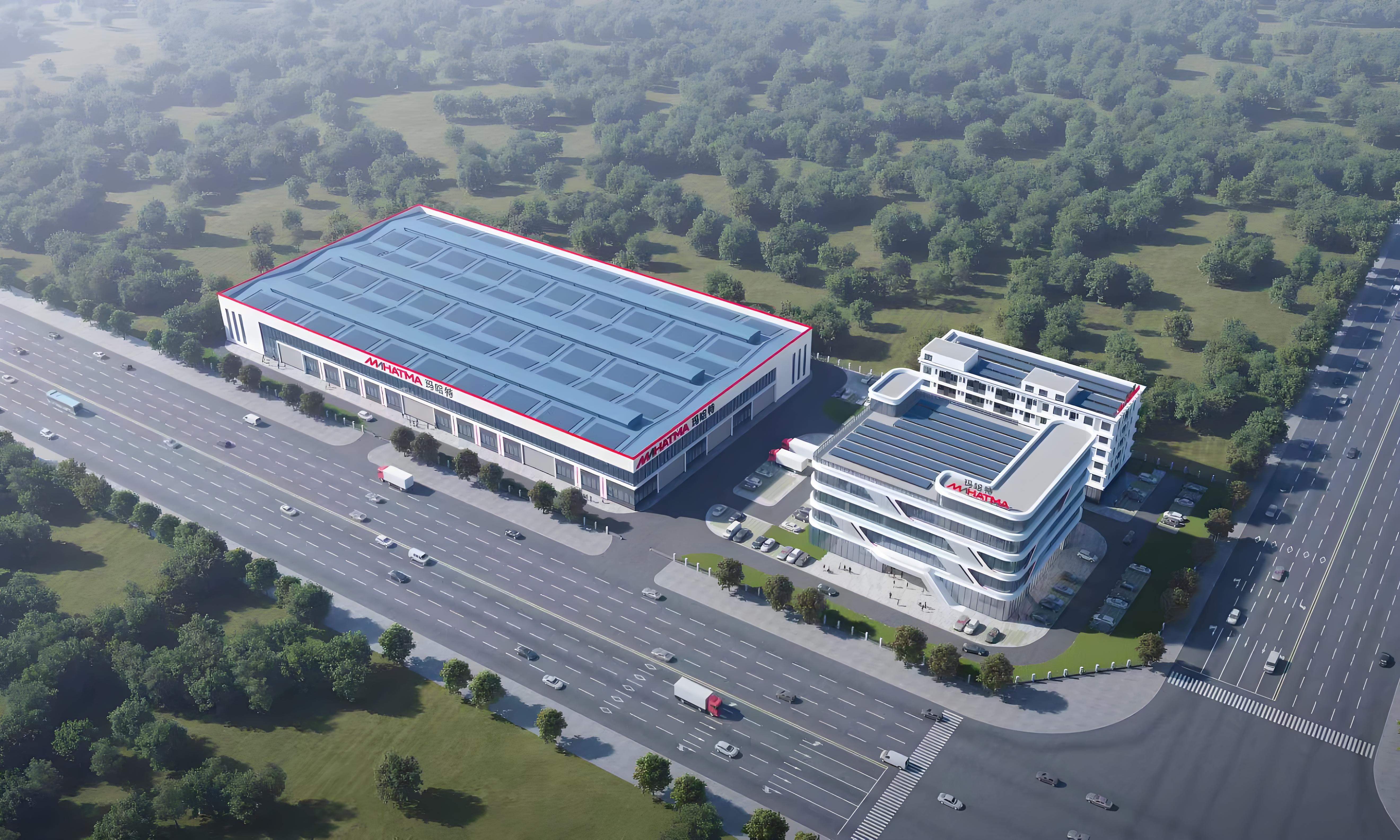
Mahatma Huizhou global manufacturing center supports the 50-unit monthly production capacity.
Quality Control Gates Before Dispatch
For a custom machine, quality control is the buyer's main protection. MAHATMA's standard quality process includes laser 3D online flatness detection, ultrasonic flaw detection on rollers, hardness uniformity testing, and full-load trial runs before shipment. The quality management system is certified to GB/T19001-2016 / ISO 9001:2015 (certificate 62825Q9729R0M), covering design and assembly of high-precision leveling machines, uncoiler laser blanking lines, and automatic shearing lines. Hydraulic precision leveling machines carry CE certification (certificate M.2025.206.C113032) in accordance with EN ISO 12100:2010, EN ISO 16090-1:2020/2022, EN ISO 16092-2:2020, and EN 60204-1:2018.
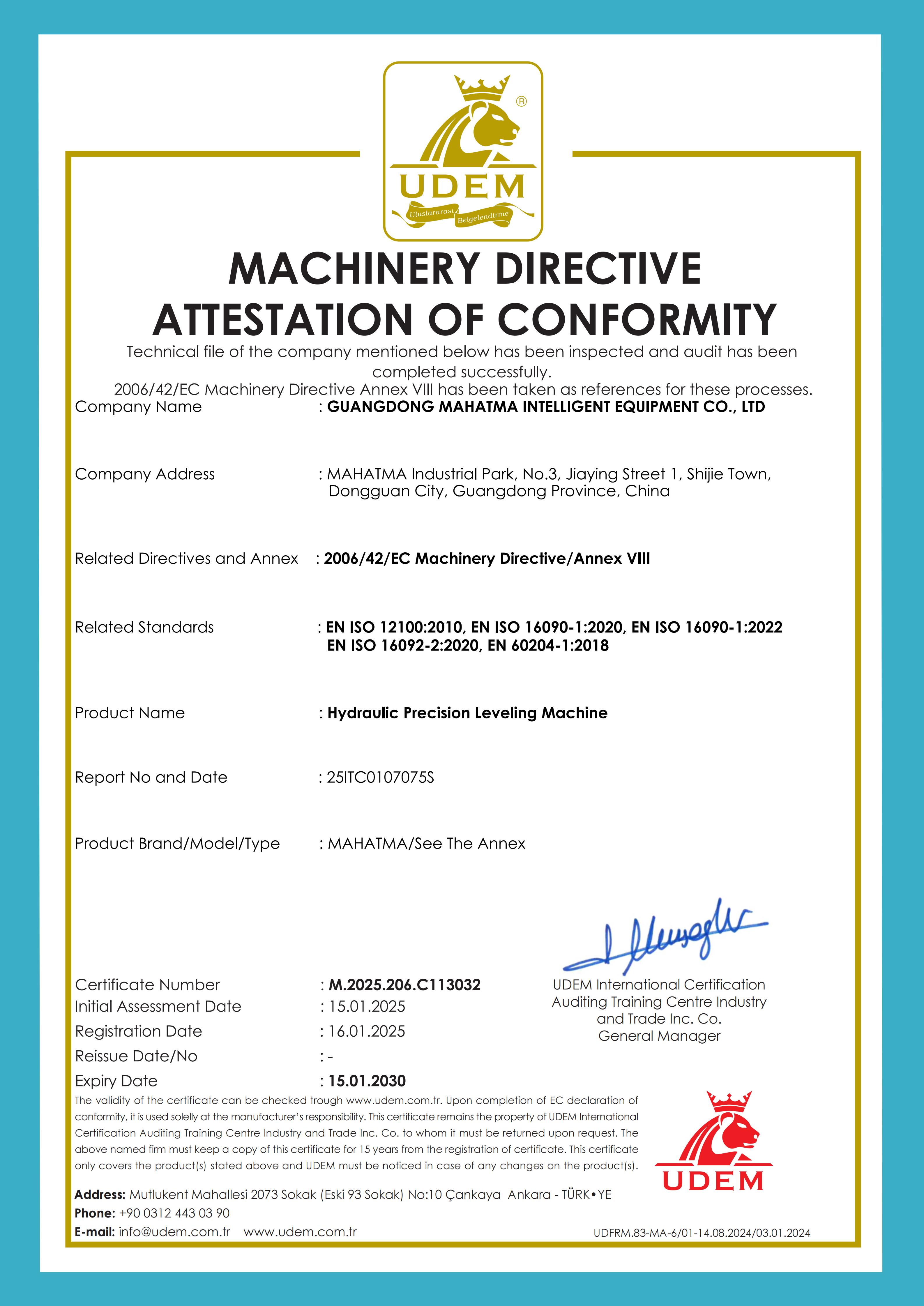
CE certification supports export of MAHATMA leveling machines to the European market.
Machine Series Used as the Customization Base
Customization is built on proven platforms. MAHATMA's portfolio spans five series: VST two-high levelers for rough leveling, VSH four-high plate levelers for small and medium workshops, MHTM intelligent CNC levelers as the standard workhorse for fabrication shops, MHTW servo-CNC levelers for aluminum alloy and precision parts, and MHTR servo-hydraulic levelers for high-strength steel and heavy plate up to 100mm rated thickness. Section 7 compares these series in detail.
Step-by-Step: How to Execute a Custom Leveling Machine Project
The path from requirement to a running custom machine follows a standard procurement workflow. Expect these eight steps:
- Define the material envelope. Provide material types and grades, thickness min–max, width, flatness target, and production volume. Leveling force depends on thickness and yield strength, so high-strength steel, aluminum, or titanium must be declared at the start.
- Run a free sample test. Send 1–2 meters of material or representative parts. MAHATMA levels the material on the recommended machine and returns a written flatness report with measured data and a process video. Test your worst-condition material, not your best.
- Receive the matched model and proposal. Based on the test results, MAHATMA issues a tailored machine proposal with the recommended series, configuration, and integration points.
- Confirm integration and site conditions. Specify MES/ERP interfaces, PLC requirements, loading/unloading automation, available air supply, and grid specification. Standard machines are built for 380V/50Hz; export versions must be configured for the destination grid (e.g., 480V/60Hz for the US, 400V/50Hz for the EU, 200V for Japan).
- Engineering review. Roller width and diameter, leveling thickness range, roll material (e.g., Cr12MoV, SKD11), control system integration, and automation modules are finalized in the engineering plan.
- Production with quality gates. Manufacturing runs within the 45-day standard lead time. Rollers undergo ultrasonic flaw detection and hardness uniformity testing; the assembled machine runs a full-load trial before shipment.
- Pre-shipment inspection and acceptance. Payment terms are 30% deposit and 70% final payment, with goods dispatched after the final payment. Delivery terms include FOB, CIF, and DAP. Acceptance includes a pre-shipment test.
- Delivery, commissioning, and after-sales. MAHATMA provides 24/7 global technical support, overseas engineers for commissioning, regional spare parts warehouses, and free operator training.
Use Cases: Where OEM Configuration Changes the Outcome
Laser Cutting Shops: Pre-Cut Flattening
Laser cutting shops running 0.5–6mm carbon steel, stainless steel, and aluminum typically need to remove coil set, waves, and internal stress so cutting focus height and nesting remain accurate. CNC levelers with gap adjustment and recipe storage reduce changeover time between materials to seconds. Reference cases include a manufacturer in Thailand using MHTM40 and MHTM30 series CNC levelers for laser-cut parts, and a manufacturer in Brazil that expanded capacity by 160% with an MHTM60 series leveler.
Heavy Plate and Armored Vehicles
Thick plate leveling is a force problem. For shipbuilding, steel structures, and armored vehicles, hydraulic levelers with large-diameter rolls and servo-hydraulic gap control absorb load shocks and deliver the bending force required. A manufacturer in Poland processing armored car material has run an MHTR120 series hydraulic leveler for 3 years with stable operation, reporting good leveling effect and improved production efficiency. The MHTR series covers rated thickness from 0.5mm to 100mm, with widths up to 4000mm.
MHTR120 hydraulic leveler in a heavy-plate application.
Aluminum and Precision Parts
Aluminum alloy, mirror-finish sheet, and 3C/electronics parts require denser roll configurations and full-support structures to avoid surface indentation. The MHTW servo-CNC series is specifically suited to aluminum alloy, with up to 33 work rolls on the MHTW15 model and rated coverage from 0.08mm to 12mm. Downstream industries include precision sheet metal, 3C electronics, automotive, home appliances, new energy, and medical devices.
Turnkey Coil Processing Lines
When the requirement is a complete process rather than a single machine, MAHATMA supplies integrated lines. The MF-3 uncoiling leveling flying shear line handles 0.3–3.0mm stainless steel, aluminum, and GI coils up to 25T at 100m/min feeding speed with ±0.5mm shearing accuracy. The UC-2x2000 uncoiling leveling slitting line processes 0.3–2.0mm material into 8–30 strips at up to 200m/min for transformers, motors, home appliances, and new energy applications.
Comparison Table: MAHATMA Leveling Machine Series
| Series | Structure / Type | Rated thickness | Max thickness | Width range | Work rolls | Core application |
|---|---|---|---|---|---|---|
| VST | Two-high / rough leveler | 0.4–10.0mm | 20.0mm | 200–1400mm | 13–19 | Thick-plate rough leveling, budget-limited workshops |
| VSH | Four-high / plate leveler | 0.03–8.0mm | 14.0mm | 200–1000mm | 15–19 | Small/medium sheet metal shops, hardware, small-batch work |
| MHTM | Intelligent CNC leveler | 0.03–30.0mm | 40.0mm | 200–3200mm | 15–25 | Sheet metal fabrication, cabinets, auto parts, laser blanking |
| MHTW | Servo-CNC leveler | 0.08–12.0mm | 20.0mm | 300–2100mm | 19–33 | Precision sheet metal, aluminum alloy, 3C, medical devices |
| MHTR | Servo hydraulic leveler | 0.5–100.0mm | 120.0mm | 400–4000mm | 9–23 | High-strength steel, heavy industry, shipbuilding, aerospace |
All five series offer leveling speeds of 0–10m/min in their standard configurations. Roll counts are listed as the range across each series. If your material sits at the edge of two series, provide the material grade and target flatness — the correct choice is the one that keeps the machine inside its rated envelope including yield-strength derating.
FAQ
1. Do MAHATMA leveling machines have CE certification? Can they be exported to the EU and US?
Yes. MAHATMA leveling machines are CE-certified (certificate M.2025.206.C113032) and the company holds ISO 9001:2015 certification (certificate 62825Q9729R0M). CE marking under the Machinery Directive 2006/42/EC is mandatory for industrial machinery in the EU; machines without it risk customs seizure. For the US and Canada, specify 480V/60Hz at order, and note that local inspectors (AHJ) may require an NRTL field evaluation of the electrical panel per NFPA 79. Always request the Declaration of Conformity copy before final payment.
2. Can the equipment integrate with my MES/ERP and existing production line?
Yes. MAHATMA blanking lines and CNC levelers provide MES/ERP interfaces, and automation modules such as loading carts, conveyors, robots, vision inspection, and AGVs are available as standard options. For a correct integration plan, provide your part envelope, takt target, and current line layout early in the project. MAHATMA engineers the integration around your existing equipment, including coil feeding, leveling, conveying, and stacking modules.
3. Which MAHATMA model should I choose for my material?
Send four numbers — thickness range, width, material grade (yield strength), and flatness target — and MAHATMA returns a matched model plus a free sample test. Leveling force depends on thickness and yield strength, so catalog ratings based on Q235/235MPa must be recalculated for high-strength steel, aluminum, or titanium. As a quick map: VST (0.4–10mm) for rough leveling, VSH (0.03–8mm) for small workshops, MHTM (0.03–30mm) for standard CNC work, MHTW (0.08–12mm) for aluminum and precision parts, and MHTR (0.5–100mm) for high-strength and heavy plate.
4. Can I test my own material on your machine before buying?
Yes — the sample test is free. Send 1–2 meters of your material or representative parts, and MAHATMA levels it on the recommended machine, then returns a written flatness report and process video within days. Include your material grade and flatness target with the samples, and test your worst-condition material rather than your best. This verifies performance claims on your actual material before any commitment.
5. What is the lead time and MOQ for a customized leveling machine?
The standard lead time is 45 days, the MOQ is 1 unit, and monthly production capacity is 50 machines. Procurement terms are 30% deposit and 70% final payment, with goods dispatched after the final payment; delivery is available under FOB, CIF, or DAP, and a pre-shipment test is part of acceptance. Machines are configured for the destination grid at the factory. To start, send your material specifications or samples and request a tailored proposal — the sample test and proposal are free. Contact MAHATMA at mhtg@gdmht.com or WhatsApp +86 173-4062-1852.
Conclusion
A custom leveling machine is only as reliable as the manufacturer's engineering, quality control, and delivery discipline. The evaluation framework is straightforward: confirm that the supplier can customize the parameters that matter (roll design, thickness envelope, roll material, control integration, automation), verify the factory has the capacity to build and test the machine (capacity, lead time, MOQ), and use the free sample test to prove flatness on your own material before payment.
Guangdong MAHATMA Intelligent Equipment Co., Ltd. matches this framework with a 45-day lead time, 1-unit MOQ, 50-unit monthly capacity, OEM/ODM/turnkey capabilities, and documented quality gates from laser 3D flatness detection to full-load trial runs. If your material envelope does not fit a catalog machine, a sample test is the fastest way to validate the solution.
Get a Tailored Leveling Machine Proposal
Send your material specifications (thickness, width, grade, flatness target) or request the free sample test. MAHATMA will return a matched model recommendation with a written flatness report.
Email MAHATMA WhatsAppDownload the MAHATMA company brochure (PDF)
Have Questions or Need More Details?
Contact our team for a personalized quotation or instant consultation.
Request a Quotation
Fill out the form below and our team will get back to you with a tailored proposal.
WhatsApp Direct Chat
Prefer to chat in real-time? Message us on WhatsApp for instant assistance & quick answers.
- Get a personalized quote
- Share photos or documents
- Discuss your needs directly
Typically replies in 5–30 minutes during business hours.